Get and manage Civil Law Procedure Forms online

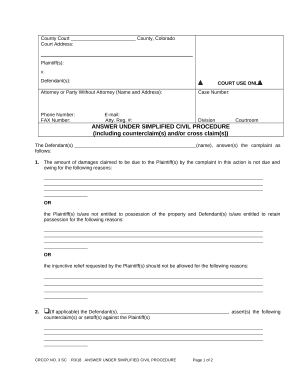
Boost your file management with our Civil Law Procedure Forms library with ready-made templates that meet your requirements. Get the document template, edit it, fill it, and share it with your contributors without breaking a sweat. Start working more efficiently with the forms.

How to use our Civil Law Procedure Forms:

  1. Open our Civil Law Procedure Forms and find the form you need.
  2. Preview your document to ensure it’s what you want, and click on Get Form to begin working on it.
  3. Alter, add new text, or point out important information with DocHub tools.
  4. Fill out your form and save the modifications.
  5. Download or share your document template with other recipients.

Examine all the possibilities for your online file management using our Civil Law Procedure Forms. Get a free free DocHub account right now!


Video Guide on Civil Law Procedure Forms management

video background

Commonly Asked Questions about Civil Law Procedure Forms

Order 1 to 21 of the Code of Civil Procedure, 1908 Order 1: Parties to Suit. Order 2: Frame of Suit. Order 3: Recognized agents and pleaders. Order 4: Institution of suits. Order 5: Issue and service of summons. Order 6: Pleadings generally. Order 7: Plaint. Order 8: Written statement, set-off, and counter-claim. Order 1 to 21 of the Code of Civil Procedure, 1908 - iPleaders ipleaders.in order-1-21-code-civil-procedu ipleaders.in order-1-21-code-civil-procedu
Broadly speaking, civil procedure consists of the rules by which courts conduct civil trials. Civil trials concern the judicial resolution of claims by one individual or class against another and are to be distinguished from criminal trials, in which the state prosecutes an individual for violation of criminal law.
In their technical, narrow sense, the words civil law describe the law that pertains to persons, things, and relationships that develop among them, excluding not only criminal law but also commercial law, labor law, etc.
Rule 1 of the Federal Rules of Civil Procedure requires that disputes be resolved in a manner that is just, speedy and inexpensive. As such, the Court has an obligation to vigorously explore efforts to reduce litigation costs through settlement.
After a summons with notice is served, the defendant will demand that the plaintiff serve a complaint. The plaintiff must then have the complaint served within 20 days after being served with the demand, or the case may be dismissed.
Rule 1 is amended to emphasize that just as the court should construe and administer these rules to secure the just, speedy, and inexpensive determination of every action, so the parties share the responsibility to employ the rules in the same way. Most lawyers and parties cooperate to achieve these ends.
A motion for (civil) contempt is designed to vindicate private parties to litigation when another party disobeys a lawful mandate of the court. (McCain v. Dinkins, 84 N.Y.