Improve your production with Arkansas Property Transfer

Document management takes up to half of your business hours. With DocHub, it is possible to reclaim your time and effort and boost your team's efficiency. Access Arkansas Property Transfer collection and explore all templates relevant to your daily workflows.

Easily use Arkansas Property Transfer:

  1. Open Arkansas Property Transfer and utilize Preview to find the appropriate form.
  2. Click Get Form to begin working on it.
  3. Wait for your form to upload in the online editor and begin modifying it.
  4. Add new fillable fields, icons, and images, change pages, etc.
  5. Complete your form or prepare it for other contributors.
  6. Download or deliver the form by link, email attachment, or invite.

Improve your daily file management with our Arkansas Property Transfer. Get your free DocHub profile today to explore all templates.

Video Guide on Arkansas Property Transfer management

video background

Commonly Asked Questions about Arkansas Property Transfer

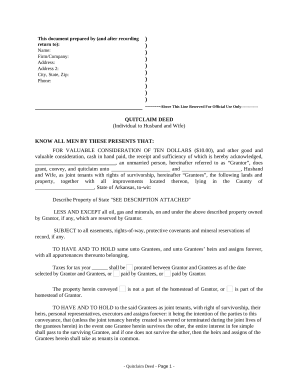
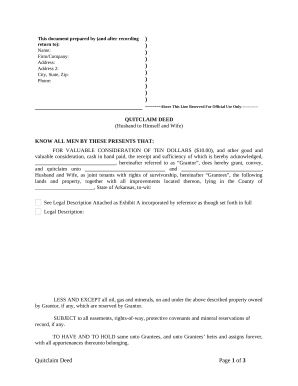
Its usually a very straightforward transaction, but its possible for a quitclaim deed to be challenged. If a quitclaim deed is challenged in court, the issue becomes whether the property was legally transferred and if the grantor had the legal right to transfer the property.
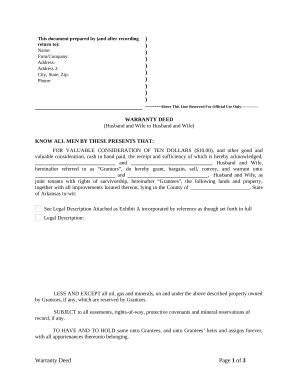
This deed must be signed, docHubd, and recorded in the county where the property is located.
The Legal Process of Transferring Real Estate The legal transfer of real estate in Arkansas involves several steps: The owner must sign the Arkansas beneficiary deed and have it docHubd to affirm their intent. The deed must be recorded at the county recorders office before the owners death to ensure its validity.
As with any conveyance of realty, a gift deed requires a complete legal description of the parcel. Recite the source of title to establish a clear chain of title, and detail any restrictions associated with the property. Each grantor must sign the deed in the presence of a notary public for a valid transfer.
Signing A quitclaim deed has the requirement of the grantor(s) signing in front of a notary public and two disinterested witnesses. Taxes ing to the Department of Finance and Administration, the tax rate on any real estate transfer is $3.30 per $1,000.
The Real Property Transfer Tax is levied on each deed, instrument, or writing by which any lands, tenements, or other realty sold shall be granted, assigned, transferred, or otherwise conveyed. The tax rate is $3.30 per $1,000 of actual consideration on transactions that exceed $100.