Inverter confirmation 2026

Get Form
inverter confirmation Preview on Page 1

Here's how it works

01. Edit your form online
Type text, add images, blackout confidential details, add comments, highlights and more.

02. Sign it in a few clicks
Draw your signature, type it, upload its image, or use your mobile device as a signature pad.

03. Share your form with others
Send it via email, link, or fax. You can also download it, export it or print it out.

How to use or fill out inverter confirmation with our platform

Form edit decoration
9.5
Ease of Setup
DocHub User Ratings on G2
9.0
Ease of Use
DocHub User Ratings on G2
  1. Click ‘Get Form’ to open the inverter confirmation form in the editor.
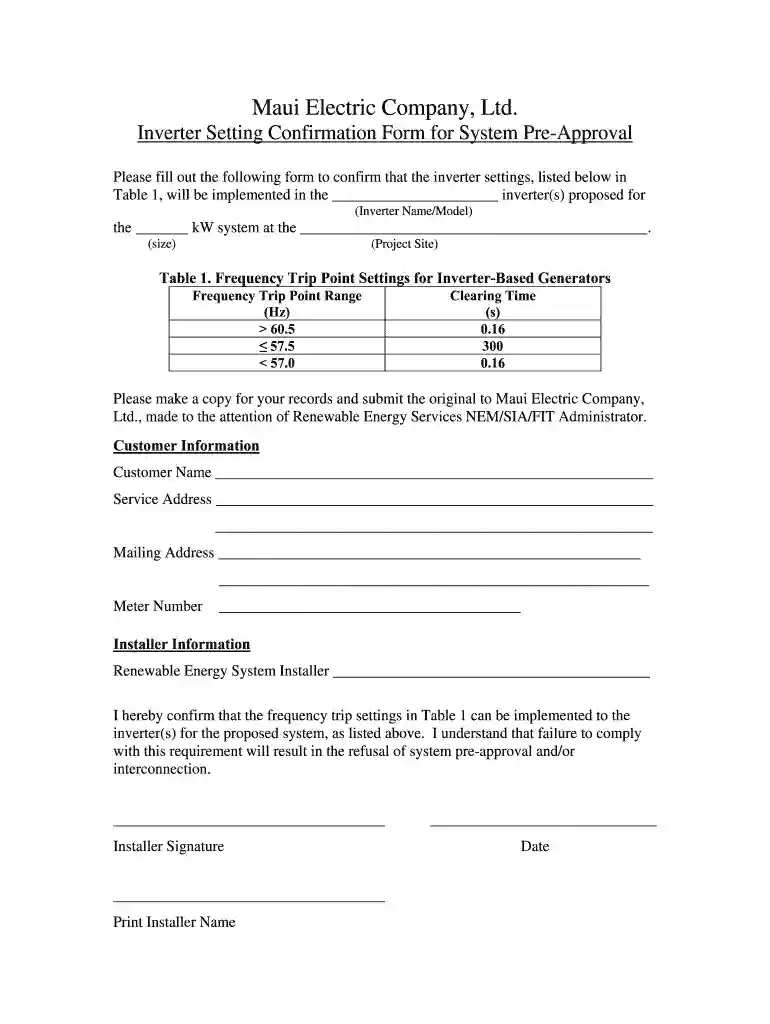
  2. Begin by filling in the Inverter Name/Model and the size of the system in kW at the designated fields. This information is crucial for identifying your specific setup.
  3. Next, locate Table 1 within the form. Here, you will confirm that the frequency trip point settings are correctly implemented. Ensure that you check each setting against your inverter specifications.
  4. Proceed to fill out your customer information, including your name, service address, mailing address, and meter number. Accurate details here are essential for processing your application.
  5. In the installer information section, provide the name of your Renewable Energy System Installer. This ensures accountability and proper communication regarding installation.
  6. Finally, sign and date the form where indicated to confirm compliance with frequency trip settings. Make sure to print your name clearly beneath your signature.

Start using our platform today to easily complete and submit your inverter confirmation form for free!

be ready to get more

Complete this form in 5 minutes or less

Get form

Got questions?

We have answers to the most popular questions from our customers. If you can't find an answer to your question, please contact us.
Contact us
General Inverter Troubleshooting Tips: Reset the inverter: Turn off the inverter, wait for a few minutes, and then turn it back on to see if the fault clears. Check grid conditions: Verify that the grid voltage and frequency are within the acceptable range. If there are grid issues, contact your utility provider.
An inverter is an electronic device that converts direct current (DC) into alternating current (AC). It is commonly used to power household appliances and electronic devices that require AC power when only DC power sources are available, such as in solar power systems or car batteries.
The quickest and easiest way to test an inverter is to run the device you want to power. Simply plug in all the devices you want to run and turn them on. This will tell you immediately if everything is working properly.
To check if your inverter is working, first verify the main fuse and circuit breaker for continuity. Inspect inverter connections for corrosion or loose wiring. Use a multimeter to measure input voltage from the battery and output voltage to connected devices.
Put a meter on your battery when connected to external power. Remove the external power. If the voltage dropped, its working. If it doesnt, your converter is not working. And to see if the comment readers are awake, yes, an inverter doesnt charge batteries, the converter does.

Security and compliance

At DocHub, your data security is our priority. We follow HIPAA, SOC2, GDPR, and other standards, so you can work on your documents with confidence.

Learn more
ccpa2
pci-dss
gdpr-compliance
hipaa
soc-compliance
be ready to get more

Complete this form in 5 minutes or less

Get form

People also ask

Locate the AC isolator switch, which is usually near the main electrical panel or on the inverter itself. Switch it to the On position. This will allow the inverter to feed electricity into your home or export it to the grid.

Related links