




Performance review template 2026

Get Form
free employee performance review template word pdf Preview on Page 1

Here's how it works

01. Edit your free employee performance review template word pdf online
Type text, add images, blackout confidential details, add comments, highlights and more.
02. Sign it in a few clicks
Draw your signature, type it, upload its image, or use your mobile device as a signature pad.
03. Share your form with others
Send free employee performance review template word via email, link, or fax. You can also download it, export it or print it out.

Definition & Meaning of Performance Review Template

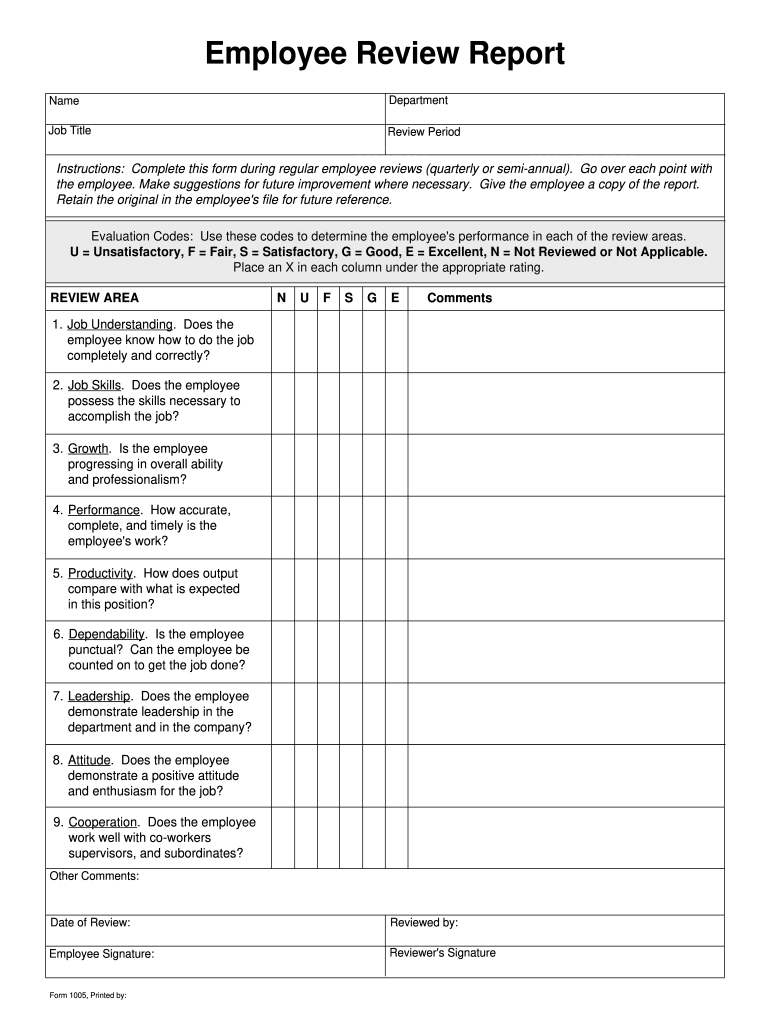
A performance review template is a structured document designed to facilitate the evaluation of an employee’s performance over a specified period, often annually or bi-annually. This template provides clear sections to assess various aspects of an employee’s job performance, including job knowledge, work quality, productivity, and interpersonal skills. By standardizing the evaluation process, it ensures consistency and fairness across evaluations, allowing for more effective feedback and development opportunities.

Performance review templates typically include:

  • Employee Information: Basic details such as name, job title, department, and review period.
  • Performance Metrics: Specific areas for evaluation, often using numerical rating systems, descriptive scales, or competencies.
  • Goals and Objectives: Sections for detailing goals set during the last review period and assessing outcomes.
  • Strengths and Areas for Improvement: Providing constructive feedback helps highlight performance strengths while identifying opportunities for growth.
  • Employee Comments: Encouraging self-evaluation allows employees to express their views on their performance and development.

Using a well-defined performance review template enhances the efficiency of the evaluation process, leading to more actionable results and fostering a culture of growth within the organization.

Key Elements of the Performance Review Template

Essential components within a performance review template ensure that the evaluation is thorough and beneficial. Understanding these elements can improve the quality of reviews and the development of employees.

  • Review Criteria: Each template should outline specific criteria for evaluation, including core competencies relevant to the employee’s role. Examples might include communication skills, ability to meet deadlines, and teamwork.
  • Rating System: A clear rating system, such as a numerical scale from one to five, allows for standardized assessments across different reviewers or departments.
  • Goals Setting: The template should include a section for establishing objectives for the next review period, encouraging forward-thinking and personal development.
  • Feedback Sections: Dedicated areas for comments from both supervisors and employees facilitate balanced feedback, making the process more collaborative.
  • Sign-off Area: A section for both the evaluator and the employee to sign provides accountability and ensures that the evaluation process is transparent.

By featuring these elements, the performance review template ensures that evaluations are not only comprehensive but also constructive and beneficial for the employee's growth.

How to Use the Performance Review Template

Utilizing a performance review template effectively involves several steps that guide users through the evaluation process. Here is a structured approach to employing the template:

  1. Gather Supporting Information: Collect relevant data on the employee's performance, including metrics, previous reviews, and feedback from colleagues.
  2. Complete the Template Sections: Fill in employee details, review period, and specific evaluation criteria based on gathered information. Use rating scales to assess performance quantitatively.
  3. Provide Constructive Feedback: Elaborate on the ratings, providing specific examples that illustrate performance strengths and areas for improvement. This section is crucial for encouraging employee development.
  4. Set Goals: Collaborate with the employee to establish practical, measurable goals for the next review period, ensuring alignment with business objectives.
  5. Review and Finalize: Before presenting the review to the employee, ensure that all sections of the template are complete and clearly articulated. This attention to detail adds professionalism to the process.

By following these steps, organizations can ensure that performance evaluations are not only standardized but also meaningful, facilitating discussions that lead to employee advancement.

Steps to Complete the Performance Review Template

Completing a performance review template effectively requires attention to detail and a systematic approach. The following steps guide evaluators through the process:

  1. Initiate the Process Early: Begin the review process well in advance of the scheduled evaluation date to avoid rushing and ensure thoroughness.
  2. Review Historical Performance Data: Assess the employee's past performance reports, feedback received, and personal notes throughout the review period.
  3. Conduct Self-Evaluation: Allow the employee to complete their self-assessment portion of the template, encouraging them to reflect on their successes and challenges.
  4. Assess Collaborative Input: Gather feedback from peers and supervisors to provide a well-rounded perspective on the employee's performance, which can be integrated into the final evaluation.
  5. Discuss with the Employee: Schedule a meeting to review the completed template with the employee, allowing for an open dialogue about the rating and feedback provided.
  6. Finalize and Document: After discussion, make any necessary adjustments to the template based on the conversation, and store the completed review in the employee's file for future reference.

Completing these steps helps ensure that the performance review template is used as a constructive tool for talent management and development.

Important Terms Related to Performance Review Template

Understanding key terminology related to performance reviews can improve both the preparation and execution of the evaluation process. Here are essential terms to be familiar with:

  • Key Performance Indicators (KPIs): Specific metrics used to evaluate the success of an employee's performance in relation to their job responsibilities.
  • Competencies: Skills or behaviors expected from an employee in the workplace, usually aligning with organizational goals and values.
  • Feedback Cycle: The process through which performance is assessed, feedback is given, and goals are set, ideally occurring regularly throughout the year.
  • Self-Assessment: A self-reflective evaluation where employees assess their own performance against predetermined criteria, fostering engagement and ownership of their development.
  • 360-Degree Feedback: A comprehensive evaluation involving input from various stakeholders, including supervisors, peers, and subordinates, offering a holistic view of performance.

Familiarity with these terms aids evaluators and employees in understanding the review process better, fostering a collaborative environment that promotes growth.

Why Should You Use a Performance Review Template?

Adopting a performance review template frequently offers several advantages for both organizations and employees. The reasons to utilize such templates include:

  • Standardization of Evaluations: Templates help create a uniform process for assessing employee performance, which ensures consistency in evaluation across departments.
  • Objectivity in Feedback: By providing predefined criteria and rating systems, templates minimize personal biases and ensure that evaluations are based on measurable performance indicators.
  • Efficient Documentation: Templates streamline the documentation process, allowing for easy filing and retrieval of performance evaluations, which can be necessary for audits or legal purposes.
  • Developmental Framework: They facilitate constructive feedback, aiding employees in recognizing their strengths and identifying areas for improvement that can be addressed in future performance cycles.
  • Enhancing Communication: A structured format encourages open dialogue between supervisors and employees, fostering a culture of continuous improvement and engagement.

Utilizing a performance review template not only enhances the quality of evaluations but also contributes to the overall growth and development of the workforce.

Examples of Using the Performance Review Template

Considering practical scenarios can help illustrate how to use a performance review template effectively. Here are a few examples:

  1. Annual Performance Review: In a corporate setting, a manager uses the performance review template at the end of the fiscal year to assess an employee’s contributions, highlighting achievements and setting goals for the upcoming year.
  2. Quarterly Check-Ins: A retail supervisor employs a simplified performance review template every quarter to evaluate employee performance in a fast-paced environment, focusing on customer service metrics and teamwork.
  3. Self-Review Pre-Meeting: An employee completes a self-assessment using the template prior to their annual review meeting, providing insights into their perceived performance and aligning their goals with those of the organization.
  4. Improvement Plans: When addressing performance issues, managers can use the template to create a performance improvement plan, detailing specific areas that need development, target deadlines, and review intervals to assess progress.
  5. Peer Reviews: In a collaborative project, the performance review template is adapted for peer evaluations, allowing team members to comment on each other's contributions, fostering a culture of feedback and shared responsibility.

These examples showcase how performance review templates can be versatile tools catered to various organizational needs, ultimately supporting employee development and organizational growth.

be ready to get more

Complete this form in 5 minutes or less

Get form

Got questions?

We have answers to the most popular questions from our customers. If you can't find an answer to your question, please contact us.
Contact us
There isnt one universal set of 5 words, but common themes in performance reviews often revolve around Reliability, Collaboration, Initiative, Communication, and Results (or related concepts like Accountability, Quality, Adaptability, Efficiency). These words describe key traits like dependable work, teamwork, taking action, clear messaging, and achieving goals, forming the basis for feedback. Here are some words that frequently appear, representing core performance areas: Reliable/Dependable: Consistently meets expectations, punctual, trustworthy. Collaborative/Teamwork: Works well with others, fosters positive relationships, supports team goals. Proactive/Initiative: Takes action, anticipates needs, seeks improvements. Efficient/Productive: Manages time well, delivers quality work, achieves goals. Adaptable/Flexible: Responds well to change, learns new skills, adjusts to challenges. Other common words to consider: Accountability: Takes ownership of tasks and outcomes. Communication: Articulates ideas, listens effectively. Creative: Brings innovative solutions. Leadership: Guides others, makes decisions. Quality: Accuracy, thoroughness of work. AI can make mistakes, so double-check responses5 Employee Performance Review Samples 72 Example CommentsApr 13, 2024 Strong points: * Good manager With you on the job, the task gets done on time and always more than adequately. * StHRMorning100+ Performance Review Examples for 2026 - TalentGuardWhat is the 5-word performance review sample? Five words commonly used in performance reviews are: Reliable, Adaptable, CollaboratTalentGuard
21) Has a cheerful attitude that benefits her teammates. 22) Looks for the positive in every situation. 81) Accepts constructive criticism and works to improve. 82) Shows ability to come up with new solutions to common problems. 141) Exceeded expectations on goals set during last performance review.
In a performance review, avoid absolutes (always, never), personality judgments, vague feedback, comparing yourself to others (Why cant I be like Sam?), ultimatums, and blaming mistakes on colleagues; instead, focus on specific examples, solutions, growth, and constructive dialogue to make the conversation productive and avoid defensiveness. This video explains some of the phrases you should avoid during a performance review: 55sTeamflectYouTube Aug 5, 2024What to avoid saying (for employees) Thats not my job.: It shows a lack of team spirit; offer to help, even if its outside your scope. I should be making more money.: Link this to demonstrated value and achievements, not just a demand. Ill leave if I dont get a raise.: Never give ultimatums. Well, so-and-so does it this way.: Comparisons create resentment; focus on your own performance against company goals. I know.: Can sound dismissive; follow up with a plan for improvement. Blame or excuses. Own your mistakes and focus on solutions. This video provides tips for managers on what not to say during an annual review: 57sMakeda AndrewsYouTube Nov 17, 2024What managers should avoid saying Absolutes: You never meet deadlines or You always interrupt. Vague feedback: Youre doing okay or Needs improvement without specifics. Personality attacks: Youre too emotional, Youre too sensitive, or You come off as bossy. Unsolicited directives: You should do it this way instead of guiding them to a solution. Surprises: Bringing up major issues for the first time during the review. But: Use and to join ideas instead of creating an argument (e.g., I heard you say X, and Ive been thinking Y). General pitfalls to avoid Bringing up old grudges: Keep the review focused on current performance and future goals. Ignoring data: Dont rely on gut feelings; use specific examples and metrics. Focusing only on weaknesses: Acknowledge strengths and contributions too. Bias: Be aware of gender, racial, or other biases in your feedback. AI can make mistakes, so double-check responses6 Things to Discuss ( 4 Not to Say) in a Performance Review - IQ PartnersJan 21, 2025 By preparing thoughtfully and focusing on professionalism and positivity, employees can maximize the benefits of the pIQ Partners11 Things to Never Say During Your Performance Review - GlassdoorNov 4, 2020 4. But Going one step further, adding a but can be even more antagonizing. When you couple a you statement withGlassdoor
Simple performance review template It typically includes a short list of performance qualities and skills, a rating scale (for example, from unsatisfactory to excellent), and sections for reviewing progress on past goals and setting new ones.
The 3 Ps of performance appraisal (or management) commonly refer to Purpose, People, and Process, providing a framework for effective employee evaluation and development, focusing on organizational goals (Purpose), individual strengths/growth (People), and consistent methods (Process) for tracking and feedback. Another common set, especially for individual success, is Planning, Progress, and Performance, emphasizing goal setting, ongoing monitoring, and outcome evaluation. Purpose, People, Process (Organizational Focus) Purpose: Defines the why aligning employee goals with company objectives, desired outcomes, and strategic direction. People: Focuses on the individuals identifying strengths, fostering development, providing coaching, and recognizing contributions. Process: Establishes the how the consistent, structured methods like regular check-ins, reviews, and feedback loops to ensure fairness and clarity. Planning, Progress, Performance (Individual/Cycle Focus) Planning: Setting clear, measurable goals and expectations at the start of a cycle. Progress: Ongoing monitoring, coaching, and feedback throughout the period to keep employees on track. Performance: Evaluating the final outcomes, rewarding achievements, and identifying areas for improvement. Other Interpretations Prioritization, Preparation, Performance: A framework for individual effectiveness, focusing on critical tasks, gathering resources, and executing. Performance, Perception, Potential: Looking at current results, how they are viewed, and future capabilities. AI can make mistakes, so double-check responsesWhat are the 3 Ps of employee performance management?What are the 3 Ps of an effective performance management? In todays dynamic workplacewhere remote work, hybrid teams, and shiftiemPerformAddressing the 3 Ps of Effective Employee Performance ManagementMay 30, 2025 Effective employee performance management requires the application of the 3 Ps principle, with a focus on purpose, peoStaffCircle

Security and compliance

At DocHub, your data security is our priority. We follow HIPAA, SOC2, GDPR, and other standards, so you can work on your documents with confidence.

Learn more
ccpa2
pci-dss
gdpr-compliance
hipaa
soc-compliance
be ready to get more

Complete this form in 5 minutes or less

Get form

People also ask

Your top 3 areas for improvement likely fall into Communication, Time Management/Organization, and Technical/Industry Skills, focusing on active listening, prioritizing tasks, and learning new tools or trends, but the specifics depend on your career stage and goals. To find your areas, reflect on recent challenges, feedback, and areas where you feel less confident, then choose skills to develop that align with your professional growth. Common Areas for Improvement Communication: (Verbal, Written, Digital, Presentation, Active Listening). Example: Improving public speaking or writing clearer emails. Time Management Organization: (Prioritizing, Planning, Project Management). Example: Meeting deadlines, avoiding multitasking, balancing priorities. Technical Industry Skills: (Software proficiency, Data Literacy, New Trends, Certifications). Example: Learning a new software or understanding analytics. Leadership Interpersonal Skills: (Delegation, Conflict Resolution, Teamwork, Emotional Intelligence). Example: Mentoring others, handling difficult conversations. Proactiveness Adaptability: (Taking Initiative, Resisting Change, Embracing New Tools). Example: Identifying problems before they arise. How to Identify Your Top 3 Review Past Performance: Think about feedback from performance reviews or recent projects where things didnt go perfectly. Consider Your Goals: What skills would help you get a promotion, transition roles, or become more effective?. Identify Gaps: Where do you feel less confident compared to colleagues or the demands of your role?. Choose areas that are relevant to your current role and future aspirations, and be ready to share how you plan to improve them. AI can make mistakes, so double-check responses20 Areas of Improvement for Employees | Indeed.comDec 16, 2025 While this can vary by job, industry and employer, here are some potential areas you might focus on to impress: * ComIndeed7 Examples of Areas of Improvement in Performance Reviews | Article | LatticeJun 24, 2024Lattice
Positive phrases: Consistently exceeds performance expectations. Achieves goals and targets consistently. Takes initiative to improve performance. Delivers high-quality work consistently. Demonstrates a strong work ethic. Shows dedication and commitment to the job.

free employee performance review template word free download