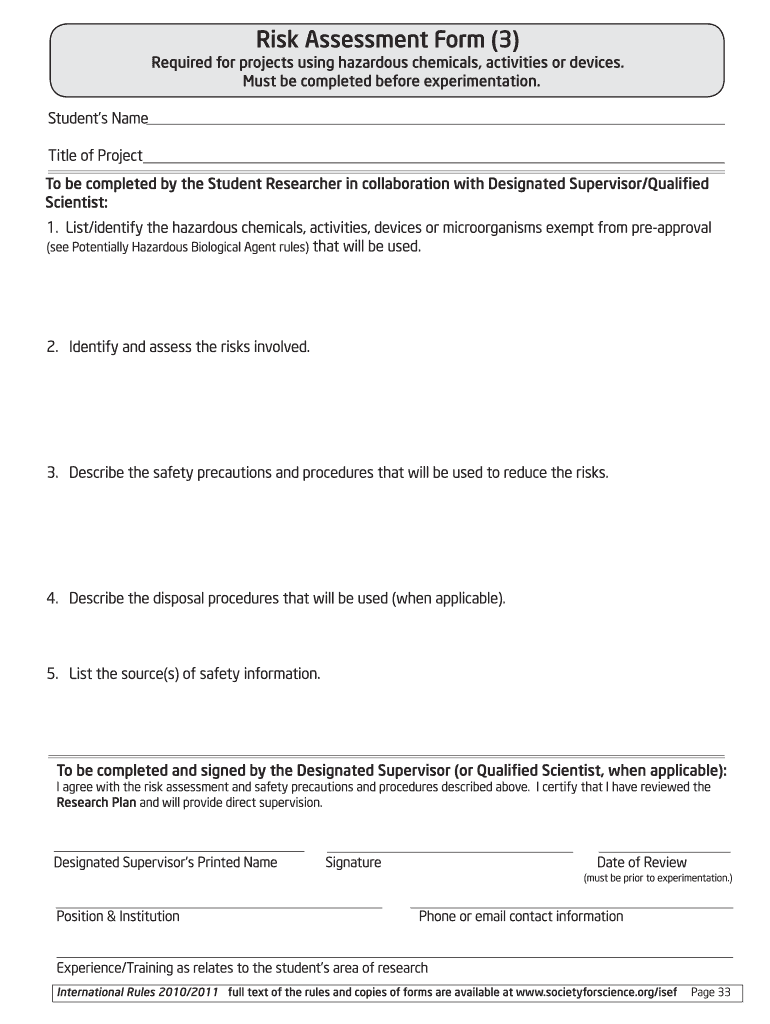
Risk Assessment Form (3) - The Ohio State University - emtsef utsa 2026

Get Form
form risk assessment Preview on Page 1

Here's how it works

01. Edit your form risk assessment online
Type text, add images, blackout confidential details, add comments, highlights and more.
02. Sign it in a few clicks
Draw your signature, type it, upload its image, or use your mobile device as a signature pad.
03. Share your form with others
Send form assessment via email, link, or fax. You can also download it, export it or print it out.

How to use or fill out Risk Assessment Form (3) - The Ohio State University - emtsef utsa with DocHub

Form edit decoration
9.5
Ease of Setup
DocHub User Ratings on G2
9.0
Ease of Use
DocHub User Ratings on G2
  1. Click ‘Get Form’ to open it in the editor.
  2. Begin by entering your name in the 'Student’s Name' field, followed by the 'Title of Project'. This sets the context for your assessment.
  3. In the first section, list all hazardous chemicals, activities, devices, or microorganisms that will be used. Be thorough to ensure compliance with safety regulations.
  4. Next, assess and describe the risks involved with each identified item. This is crucial for understanding potential hazards.
  5. Outline the safety precautions and procedures you will implement to mitigate these risks. Detail specific actions to enhance safety during experimentation.
  6. If applicable, describe your disposal procedures for hazardous materials. Ensure these comply with relevant guidelines.
  7. Finally, provide sources of safety information that support your risk assessment. This adds credibility to your document.
  8. Have your Designated Supervisor or Qualified Scientist review and sign the form, confirming their agreement with your assessment and procedures.

Start using our platform today to complete your Risk Assessment Form efficiently and for free!

be ready to get more

Complete this form in 5 minutes or less

Get form

Got questions?

We have answers to the most popular questions from our customers. If you can't find an answer to your question, please contact us.
Contact us
The Health and Safety Executive (HSE) recommends following five actionable steps to conduct an effective risk assessment. Step 1: Identify Hazards. Step 2: Assess the Risks. Step 3: Control the Risks. Step 4: Record your Findings. Step 5: Review the Controls.
The essentials for a successful risk assessment. Namely, Collaboration, Context, and Communication. These 3 components combine to form a more comprehensive risk assessment process that creates more favourable outcomes.
It involves: Identifying potential hazards. Identifying who might be harmed by those hazards. Evaluating risk (severity and likelihood) and establishing suitable precautions. Implementing controls and recording your findings. Reviewing your assessment and re-assessing if necessary.
Step 3: Evaluate the risks explore problems and develop solutions. The main aim of this step in HSEs Management Standards approach is to take the data collection and analysis from the previous step, and talk the conclusions through with a representative sample of employees and work with them to develop solutions.
The 4 Ps of risk assessmentPredict, Prevent, Prepare, and Protecttakes on a heightened significance in environments where the potential for severe and costly risks is ever-present. Effective risk assessment is paramount to ensure safety, operational continuity, and environmental responsibility.

People also ask

Risk assessments are basically made up of five steps: Identify the hazards. Consider who could be harmed and how. Evaluate the risks and decide on actions to mitigate them. Record the docHub findings and implement them. Review the assessment and update where necessary.
Principle 3. Risk taking involves judgement and balance. Decision makers are required to consider the value and likelihood of the possible benefits of a particular decision against the seriousness and likelihood of the possible harms.
There are four main types of risk assessments that organisations commonly utilize: qualitative, quantitative, subjective, and objective. In this article, we will explore each type of risk assessment in-depth, discussing their importance, processes, benefits, and limitations.