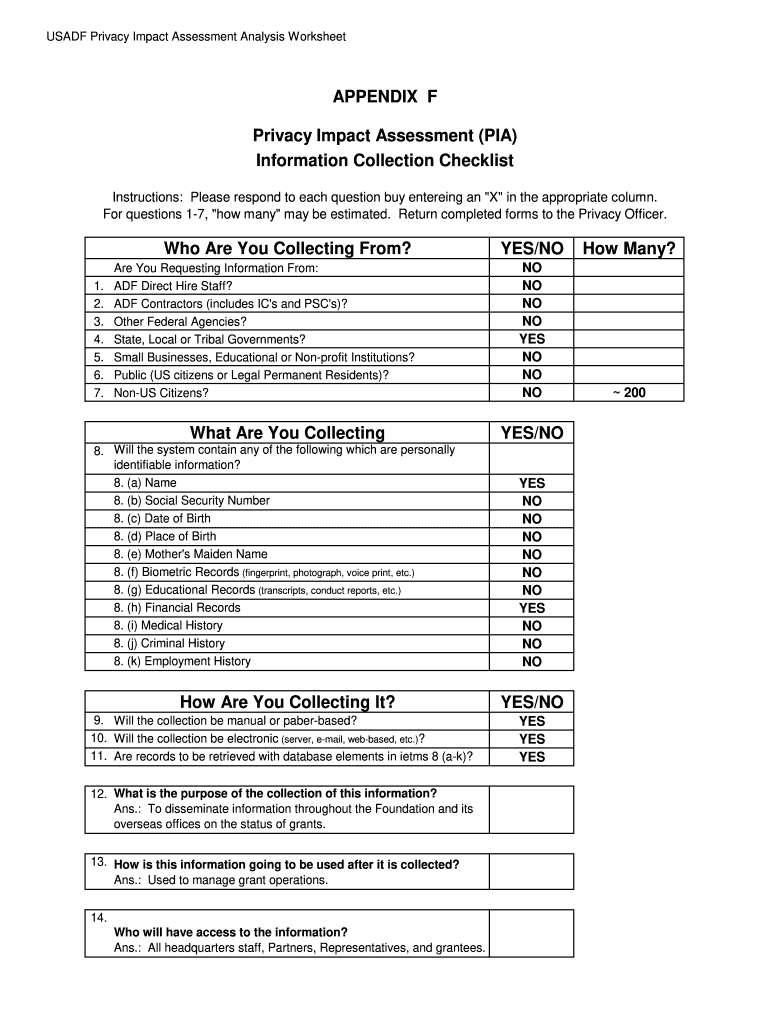
Privacy Impact Assessment Form - adf 2026

Get Form
pia assessment example Preview on Page 1

Here's how it works

01. Edit your pia assessment example online
Type text, add images, blackout confidential details, add comments, highlights and more.
02. Sign it in a few clicks
Draw your signature, type it, upload its image, or use your mobile device as a signature pad.
03. Share your form with others
Send dd form 2930 download via email, link, or fax. You can also download it, export it or print it out.

How to use or fill out Privacy Impact Assessment Form - adf with our platform

Form edit decoration
9.5
Ease of Setup
DocHub User Ratings on G2
9.0
Ease of Use
DocHub User Ratings on G2
  1. Click ‘Get Form’ to open the Privacy Impact Assessment Form - adf in the editor.
  2. Begin by filling out the 'Contact Information' section. Enter your name, role/title, organization, telephone number, and email address in the designated fields.
  3. Proceed to the 'System Information' section. Provide a detailed description of the system, including its purpose and legal authority. Ensure you accurately describe how it supports USADF's mission.
  4. In the 'Collecting and Sharing Personally Identifiable Information (PII)' section, respond to each question regarding PII collection methods and categories. Use checkboxes for clarity.
  5. Complete the 'Retention, Notice and Redress' section by detailing data retention periods and individual notification processes.
  6. Finally, review all entries for accuracy before submitting. Utilize our platform’s features to save your progress or share with colleagues for feedback.

Start using our platform today to efficiently complete your Privacy Impact Assessment Form - adf for free!

be ready to get more

Complete this form in 5 minutes or less

Get form

Got questions?

We have answers to the most popular questions from our customers. If you can't find an answer to your question, please contact us.
Contact us
Pursuant to Section 208 of the E-Government Act and Section 222 of the Homeland Security Act, a PIA should be conducted when a program or system is doing any of the following: Developing or procuring any new technologies or systems that handle or collect personally identifiable information.
A Privacy Impact Assessment (PIA) is an instrument for assessing the potential impacts on privacy of a process, information system, program, software module, device or other initiative which processes personal information and in consultation with stakeholders, for taking actions as necessary to treat privacy risk.
A DPIA is a mandatory compliance requirement under the General Data Protection Regulation (GDPR). On the other hand, a PIA or Privacy Impact Assessment is a process to ensure and enable privacy by design in an organization.
A privacy impact assessment (PIA) is a systematic assessment of a project that identifies the impact that the project might have on the privacy of individuals, and sets out recommendations for managing, minimising or eliminating that impact.
The concept of a DPIA and a PIA is the same. Both are an assessment of the privacy or data protection risks associated with a new product or service, as well as identifying and applying the appropriate measures or controls to address these risks.

Security and compliance

At DocHub, your data security is our priority. We follow HIPAA, SOC2, GDPR, and other standards, so you can work on your documents with confidence.

Learn more
ccpa2
pci-dss
gdpr-compliance
hipaa
soc-compliance
be ready to get more

Complete this form in 5 minutes or less

Get form

People also ask

Conducting a Privacy Impact Assessment: A How-To Guide Catalog Personal Data and Systems. Map How Data Flows Through Your Organization. Classify Data and Define Protection Obligations. Assess Current Risks and Controls. Address Gaps and Explore Alternatives. Document Findings in a Privacy Impact Assessment Report.
The DTIA is conducted to assess the risks associated with the international transfer of personal data. In contrast, the DPIA assesses the risks associated with any processing of personal data within the European Union (when such processing may impair the protection of the rights of individuals).

pia template