



Gladwin co soil erosion form 2026

Get Form
gladwin co soil erosion form Preview on Page 1

Here's how it works

01. Edit your form online
Type text, add images, blackout confidential details, add comments, highlights and more.
02. Sign it in a few clicks
Draw your signature, type it, upload its image, or use your mobile device as a signature pad.
03. Share your form with others
Send it via email, link, or fax. You can also download it, export it or print it out.

How to use or fill out gladwin co soil erosion form with our platform

Form edit decoration
9.5
Ease of Setup
DocHub User Ratings on G2
9.0
Ease of Use
DocHub User Ratings on G2
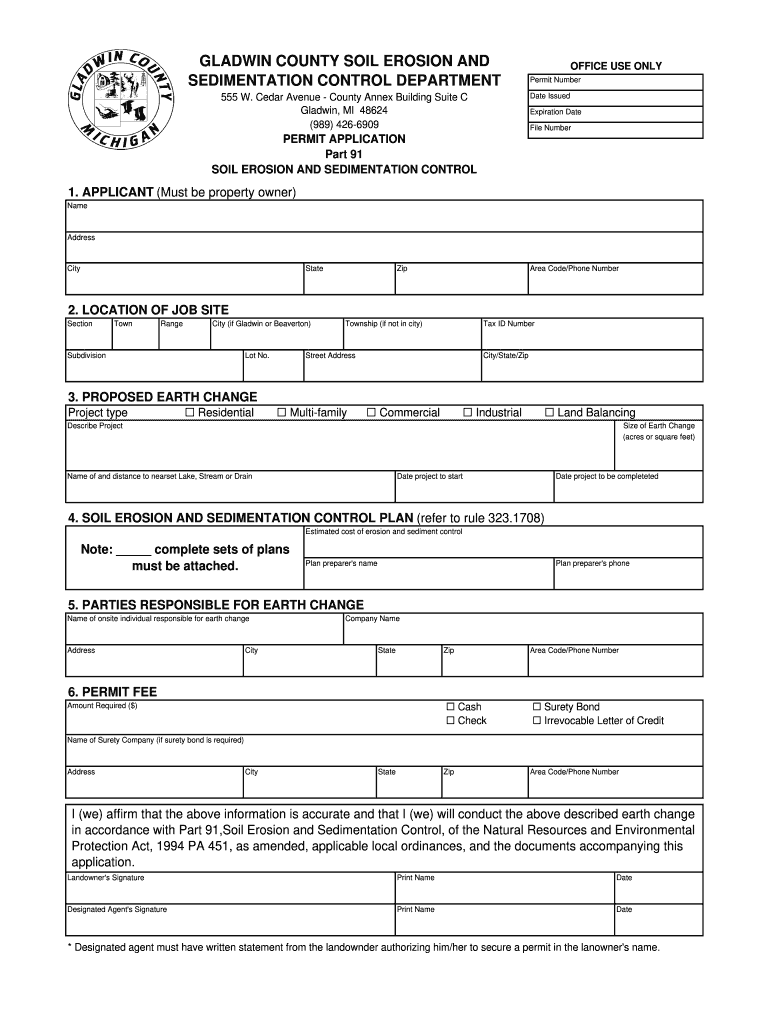
  1. Click ‘Get Form’ to open the gladwin co soil erosion form in the editor.
  2. Begin by filling out the 'APPLICANT' section. Enter your name, address, state, city, zip code, and phone number. Ensure that you are the property owner as this is a requirement.
  3. Next, move to the 'LOCATION OF JOB SITE' section. Provide details such as section, town, range, city (if applicable), subdivision, lot number, township (if not in city), tax ID number, and street address.
  4. In the 'PROPOSED EARTH CHANGE' section, specify the project type (residential, commercial, etc.), describe the project briefly, and indicate the size of earth change in acres or square feet. Also include information about nearby lakes or streams.
  5. Complete the 'SOIL EROSION AND SEDIMENTATION CONTROL PLAN' by estimating costs and providing the plan preparer's name and phone number. Remember to attach complete sets of plans as required.
  6. Fill out the 'PARTIES RESPONSIBLE FOR EARTH CHANGE' section with relevant contact information for those overseeing the project.
  7. Finally, enter permit fee details and affirm that all provided information is accurate by signing where indicated.

Start using our platform today to easily fill out your gladwin co soil erosion form for free!

be ready to get more

Complete this form in 5 minutes or less

Get form

Got questions?

We have answers to the most popular questions from our customers. If you can't find an answer to your question, please contact us.
Contact us
Lets get started! Begin by cutting off one side of all 3 of the plastic bottles. Place the bottles on their sides and fill each one with two cups of soil. In one bottle, add the 1 cup of mulch and leaf litter and pack it down. In the second bottle, add the grass that was collected and pack it down.
Using nuclear technology, such as the fallout radionuclide (FRN) technique and the compound specific stable isotope (CSSI) technique, the IAEA helps to assess soil erosion, so that the right strategies to protect soil can be implemented.
Soil erosion is a gradual process that occurs when the impact of water or wind detaches and removes soil particles, causing the soil to deteriorate.
However, when wind or water carries the detached soil away, youll find yourself losing your topsoil if you dont take action. Sheet Erosion. Rill Erosion. Gully Erosion. Wind Erosion. Floodplain Erosion. Protecting Your Topsoil From Many Types of Soil Erosion.
Soil erosion is a gradual process that occurs when the impact of water or wind detaches and removes soil particles, causing the soil to deteriorate. Soil deterioration and low water quality due to erosion and surface runoff have become severe problems worldwide.

Security and compliance

At DocHub, your data security is our priority. We follow HIPAA, SOC2, GDPR, and other standards, so you can work on your documents with confidence.

Learn more
ccpa2
pci-dss
gdpr-compliance
hipaa
soc-compliance

People also ask

The four main types of river erosion are abrasion, attrition, hydraulic action and solution. Abrasion is the process of sediments wearing down the bedrock and the banks. Attrition is the collision between sediment particles that break into smaller and more rounded pebbles.
Physical processes Rainfall, and the surface runoff which may result from rainfall, produces four main types of soil erosion: splash erosion, sheet erosion, rill erosion, and gully erosion. In splash erosion, the impact of a falling raindrop creates a small crater in the soil, ejecting soil particles.
1) Sheet erosion by water; 2) Wind erosion; 3) Rill erosion happens with heavy rains and usually creates smalls rills over hillsides; 4) Gully erosion when water runoff removes soil along drainage lines.

Related links