
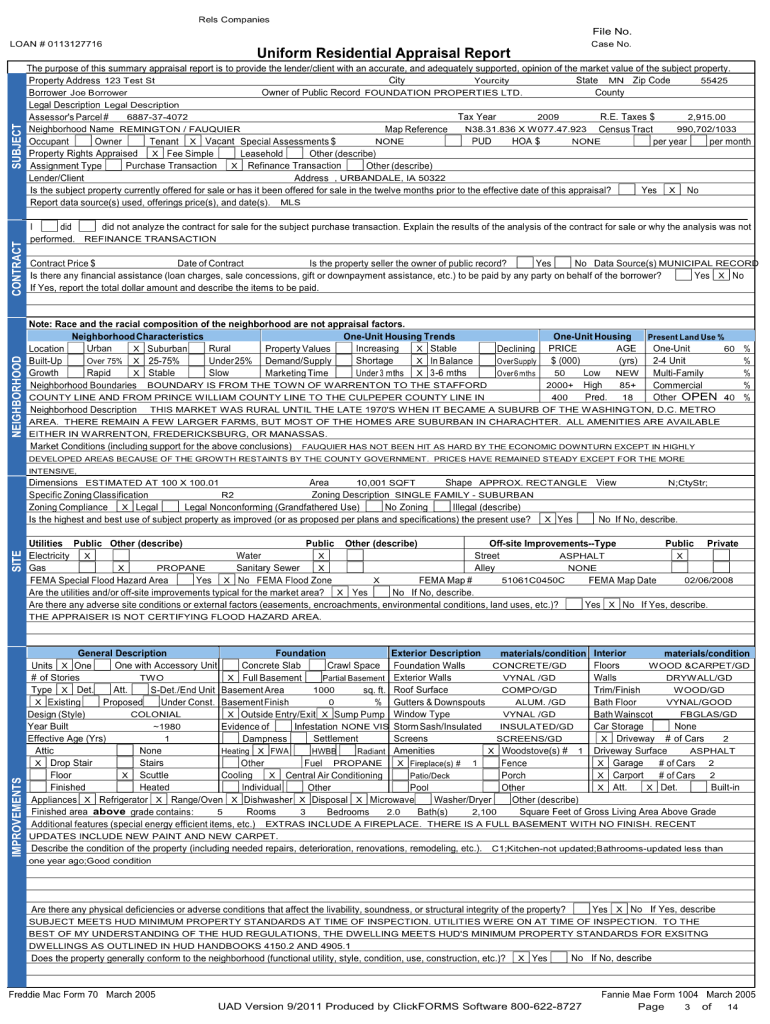







Understanding the Uniform Residential Appraisal Report
Definition and Function of the Uniform Residential Appraisal Report
The Uniform Residential Appraisal Report (URAR) is a standardized document used by appraisers to provide an assessment of a residential property’s value. This report is crucial in the lending process as it helps lenders determine the market value of a property before issuing a mortgage. The URAR is designed to be straightforward, presenting essential information in a uniform format for clarity and ease of use.
Key Components of a URAR
Each URAR consists of several key sections that provide vital information about the property being appraised. These components include:
- Property Identification: Essential details such as the property address, legal descriptions, and the purpose of the appraisal.
- Owner Information: Name and contact information of the property owner.
- Market Conditions: A summary of the real estate market trends affecting the property's value, including sales data and neighborhood analysis.
- Site Description: Characteristics of the property’s location, size, and zoning.
- Improvements: Detailed descriptions of the property's structure, including year built, square footage, number of rooms, and condition assessment.
Completing the Uniform Residential Appraisal Report
When filling out a URAR, attention to detail is paramount. The appraisal process generally follows these steps:
- Data Collection: Gather information through inspections, public records, and interviews with homeowners or real estate professionals.
- Property Inspection: Conduct a thorough physical inspection of the property to assess its condition and gather data for analysis.
- Market Analysis: Analyze comparable sales (comps) within the same area to derive an estimate of the property’s value based on similar sales.
- Final Valuation: Synthesize the information collected to formulate a final opinion of value, which gets documented in the URAR.
Importance of Accurate Appraisal Reports
Accurate residential appraisal reports are essential in various situations, including:
- Mortgage Approval: Lenders require a URAR to ensure that the property value supports the mortgage amount.
- Refinancing: Homeowners looking to refinance will typically need a URAR for the lender to assess current value versus the loan amount.
- Tax Assessments: Appraisal reports provide data that can impact property tax assessments and disputes.
Examples of URAR Use Cases
Several scenarios showcase the application and necessity of a URAR:
- Home Purchase: A prospective buyer may obtain a URAR to determine if the asking price of a home reflects its true market value.
- Estate Planning: Executors handling an estate may rely on a URAR to ascertain the value of a property for distribution among beneficiaries.
- Investment Decisions: Real estate investors utilize URARs to make informed decisions about property acquisitions based on market value assessments.
Variants of the Uniform Residential Appraisal Report
While the URAR is a commonly used format, variations may appear depending on specific needs, such as:
- Desktop Appraisal Reports: These require less comprehensive inspections, offering faster evaluations often used for refinancing.
- Drive-By Appraisals: In this approach, the appraiser evaluates the property from the street without entering, suitable for quick assessments in low-risk situations.
Legal and Regulatory Aspects of the URAR
Regarding legal compliance, appraisers must ensure their reports adhere to guidelines set forth by the Federal Housing Finance Agency (FHFA) and comply with the Uniform Standards of Professional Appraisal Practice (USPAP).
Sample Residential Appraisal Report
When reviewing a sample residential appraisal report, the reader will typically find the completed sections reflecting the components mentioned above. For example, a report may indicate a property located in a thriving neighborhood with in-depth consideration of local amenities impacting market value. The findings and value opinion presented must be supported by data and market analysis to ensure credibility and objectivity.




