







Definition and Meaning of Properties of Integer Exponents
The properties of integer exponents govern how expressions with exponents can be simplified and manipulated. Understanding these properties is essential for solving mathematical problems involving powers and exponents.
Key Properties Include:
- Product of Powers: When multiplying like bases, add the exponents. For example, (a^m \times a^n = a^{m+n}).
- Quotient of Powers: When dividing like bases, subtract the exponents. For instance, (a^m / a^n = a^{m-n}).
- Power of a Power: When raising a power to another power, multiply the exponents. For example, ((a^m)^n = a^{mn}).
- Zero Exponent: Any non-zero base raised to the power of zero equals one. For instance, (a^0 = 1) (where (a \neq 0)).
- Negative Exponent: A negative exponent indicates that the base is on the opposite side of the fraction line. For instance, (a^{-n} = 1/a^n).
These properties facilitate the simplification of complex algebraic expressions, making them vital in algebra and higher-level mathematics.
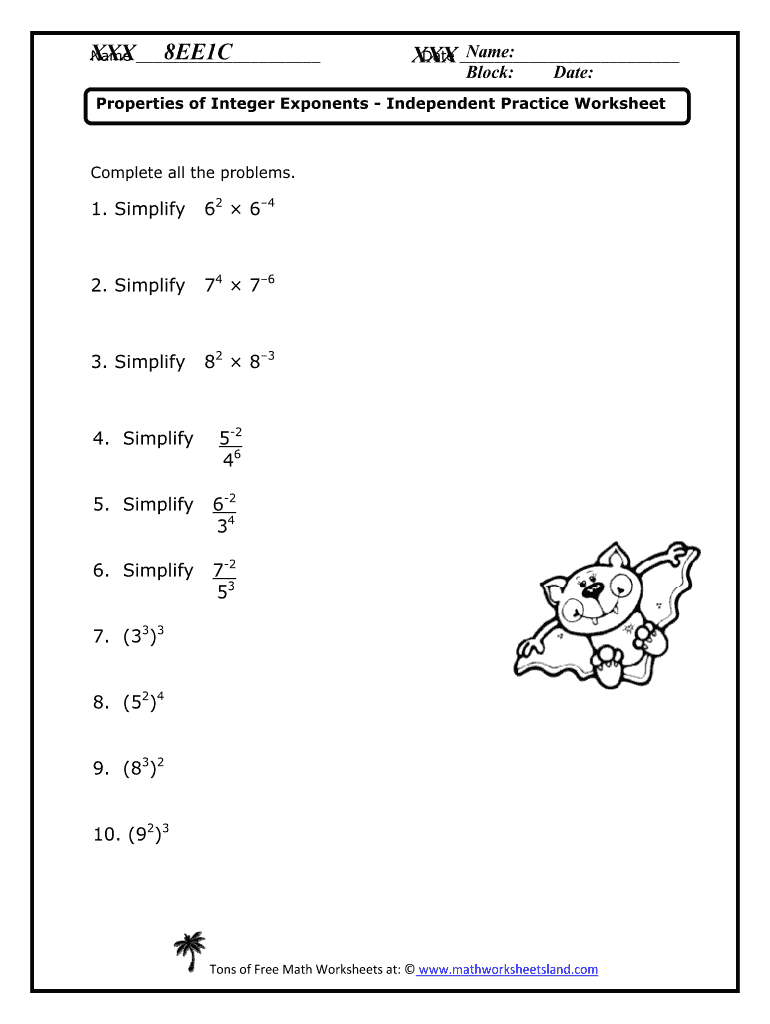
How to Use the Properties of Integer Exponents Independent Practice Worksheet Answers
The independent practice worksheet focused on the properties of integer exponents allows students to reinforce their understanding through various exercises.
Steps to Utilize the Worksheet:
- Identify Each Problem: Read through the worksheet to identify the types of problems, including simplifications and calculations using exponent properties.
- Apply Relevant Properties: For each problem, determine which exponent properties apply. Refer to the definitions to guide your solving process.
- Show Work: As you solve each problem, write out the steps clearly to illustrate how you applied the properties. This practice not only aids in learning but is also useful for review.
- Check Answers: Use the provided answer key to verify your solutions. If discrepancies exist, revisit the problem to understand your mistakes.
For example, if a problem asks to simplify (x^3 \times x^5), students should apply the product of powers property to arrive at (x^{8}).
Steps to Complete the Properties of Integer Exponents Independent Practice Worksheet
Completing the worksheet effectively involves a systematic approach.
- Review the Worksheet: Familiarize yourself with each type of problem presented.
- Start with Examples: If provided, look at any worked examples before diving into the problems.
- Categorize Problems: Group problems by type, such as those that only involve multiplying or dividing exponents. This approach helps in recognizing patterns.
- Solve Step-by-Step: Take each problem individually, applying the relevant exponent properties. Ensure clarity in each step.
- Use the Answer Key: After attempting each problem, compare your answers against the answer key to check accuracy and learn from errors.
By following these steps, students can efficiently work through the worksheet and strengthen their grasp of integer exponents.
Real-World Applications of Exponent Properties
Understanding the properties of integer exponents has practical implications beyond the classroom.
Areas of Application Include:
- Science and Engineering: Exponents are used in scientific notation to express large or small numbers efficiently. This notation allows for clearer explanations of concepts like population growth where values can become exponentially large.
- Finance: In finance, compound interest calculations utilize exponent properties. For example, the formula for compound interest (A = P(1 + r)^t) uses exponents to determine future value after a certain number of compounding periods.
- Information Technology: Algorithms in computer science often employ exponentiation, especially when dealing with algorithms that have exponential time complexity.
These applications demonstrate the relevance of understanding integer exponents in various professional fields.
Important Terms Related to Properties of Integer Exponents
Familiarity with specific terms related to the properties of integer exponents aids in better comprehension and application of these concepts.
Key Terms Include:
- Base: The number that is raised to an exponent.
- Exponent: Indicates how many times to multiply the base by itself.
- Power: The term for the overall expression (a^n), where (a) is the base and (n) is the exponent.
- Non-negative Integers: Integers that are either positive or zero, often used in contexts involving exponentiation.
Understanding these terms not only enhances mathematical vocabulary but also aids in grasping complex problems involving integer exponents.
Examples of Using the Properties of Integer Exponents
Illustrative examples can enhance understanding and application of properties of integer exponents.
Example Problems:
-
Simplifying Expressions:
- Problem: Simplify (2^3 \times 2^4).
- Solution: Using the product of powers property, (2^3 \times 2^4 = 2^{3+4} = 2^7).
-
Handling Negative Exponents:
- Problem: Simplify (x^{-2}).
- Solution: By the negative exponent property, (x^{-2} = 1/x^{2}).
-
Combining Powers:
- Problem: Simplify ((3^2)^3).
- Solution: Using the power of a power property, ((3^2)^3 = 3^{2 \cdot 3} = 3^6).
These examples illustrate the practical application of exponent properties in various mathematical contexts.




