







Definition and Overview of the Modified Barthel Index PDF
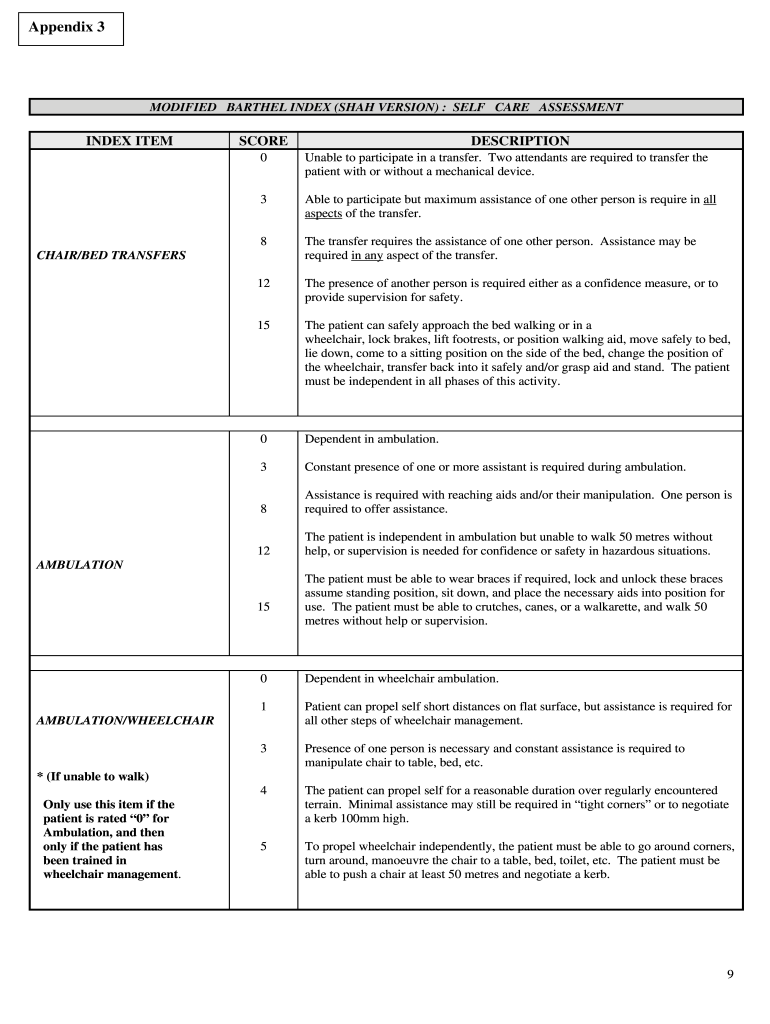
The Modified Barthel Index (MBI) is a standardized tool designed for assessing an individual's functional independence in daily living activities. The modified version offers a more sensitive measure of performance across various tasks, providing a detailed understanding of a person’s self-care capabilities. Key activities evaluated include:
- Transfers: The ability to move from one position to another, such as from a bed to a chair.
- Ambulation: The capacity to walk independently or with assistance.
- Toileting: The ability to use the bathroom independently.
- Bathing and Dressing: Evaluates the individual’s capability in personal hygiene and clothing.
- Feeding: Assesses the ability to eat independently.
Each activity on the MBI is assigned a specific score, helping to distinguish between varying levels of dependence and independence. The scoring ranges from zero (total dependence) to 100 (full independence), enabling healthcare professionals to interpret rehabilitation needs for discharge planning effectively.
How to Use the Modified Barthel Index PDF
Using the Modified Barthel Index PDF involves a systematic approach to accurately assess a patient's ability to perform daily living activities. Follow these steps to effectively utilize the MBI:
- Download the form: Access the modified Barthel index pdf from a reliable source, ensuring you have the most current version.
- Familiarize yourself with the scoring: Understand the scoring system for each activity. Each task has specific scores assigned that correspond to levels of assistance required.
- Conduct a thorough assessment: Observe and record the patient’s performance in each activity outlined in the form. It may be useful to ask direct questions to gauge their self-reported abilities.
- Calculate the total score: Sum the scores from each section to determine the overall functional independence score. This total score aids in evaluating areas that may require intervention or support.
- Document findings and recommendations: Use the results to inform treatment plans, resource allocation, and rehabilitation goals. Share this information with healthcare teams for comprehensive care planning.
How to Obtain the Modified Barthel Index PDF
The modified Barthel index pdf can be readily obtained through various channels:
- Healthcare Institutions: Many hospitals and rehabilitation centers provide the MBI as part of their patient assessment tools. Engaging with your health provider may lead to access.
- Official Publications: Look for formal publications and medical literature that include the MBI. Academic journals often publish studies and tools related to functional assessments.
- Online Resources: Trusted healthcare websites frequently offer downloadable copies of the MBI. Ensure you are on a credible site to avoid inaccurate or outdated materials.
- Professional Associations: Organizations focused on rehabilitation or occupational therapy sometimes provide resources, including the modified Barthel index pdf, as part of their educational materials.
Key Elements of the Modified Barthel Index PDF
The MBI PDF is characterized by several essential elements that enhance its utility in clinical practice:
- Structured Format: The form features clear sections for each activity, allowing for organized data entry.
- Scoring System: Detailed scoring guidelines facilitate accurate assessments. The specific scores for each task help clarify the individual’s level of independence.
- Interpretation Guide: Many versions of the MBI include guidance on interpreting scores, offering insights for clinicians in treatment planning.
- User-Friendly Design: The layout is designed for simplicity, enabling quick assessments while minimizing confusion during use.
- Versions and Adaptations: Different versions may cater to specific populations, such as those with particular disabilities, enhancing its applicability in diverse settings.
Important Terms Related to the Modified Barthel Index PDF
Understanding key terms associated with the MBI is crucial for effective application:
- Functional Independence: The capability to perform daily living activities without assistance.
- Dependence Levels: Ranging from total dependence to complete independence, indicating the amount of help required.
- Rehabilitation Needs: Insights gathered from the MBI can guide therapeutic interventions and resource allocation.
- Self-Care Assessment: The process of evaluating an individual’s ability to care for themselves, integral in home health and rehabilitation settings.
Examples of Using the Modified Barthel Index PDF
Several scenarios illustrate the practical application of the modified Barthel index in various healthcare settings:
- Inpatient Rehabilitation: A patient recovering from a stroke may have their MBI evaluated weekly to track improvements in independence, guiding therapy sessions.
- Home Health Care: Home health aides can utilize the MBI to determine how much support a client requires daily, ensuring appropriate levels of care.
- Geriatric Assessments: In long-term care facilities, the MBI can help identify residents who are experiencing declines in functional skills, prompting further evaluation and intervention.
Digital vs. Paper Versions of the Modified Barthel Index PDF
Both digital and paper versions of the Modified Barthel Index offer unique advantages and considerations:
-
Digital Version:
- Accessibility: Can be accessed from various devices, facilitating usage in multiple settings.
- Easy Sharing: Results can be quickly shared among healthcare providers digitally, promoting collaboration.
- Data Integration: Some digital formats may allow for integration with electronic health record systems, improving data management.
-
Paper Version:
- Physical Interaction: Some users may prefer filling out assessments manually for clarity and tactile engagement.
- No Technological Barriers: Easily usable in environments where digital access is limited or technology is not preferred.
Choosing between the two forms depends on the specific context and preferences of both the healthcare provider and the patient.




