
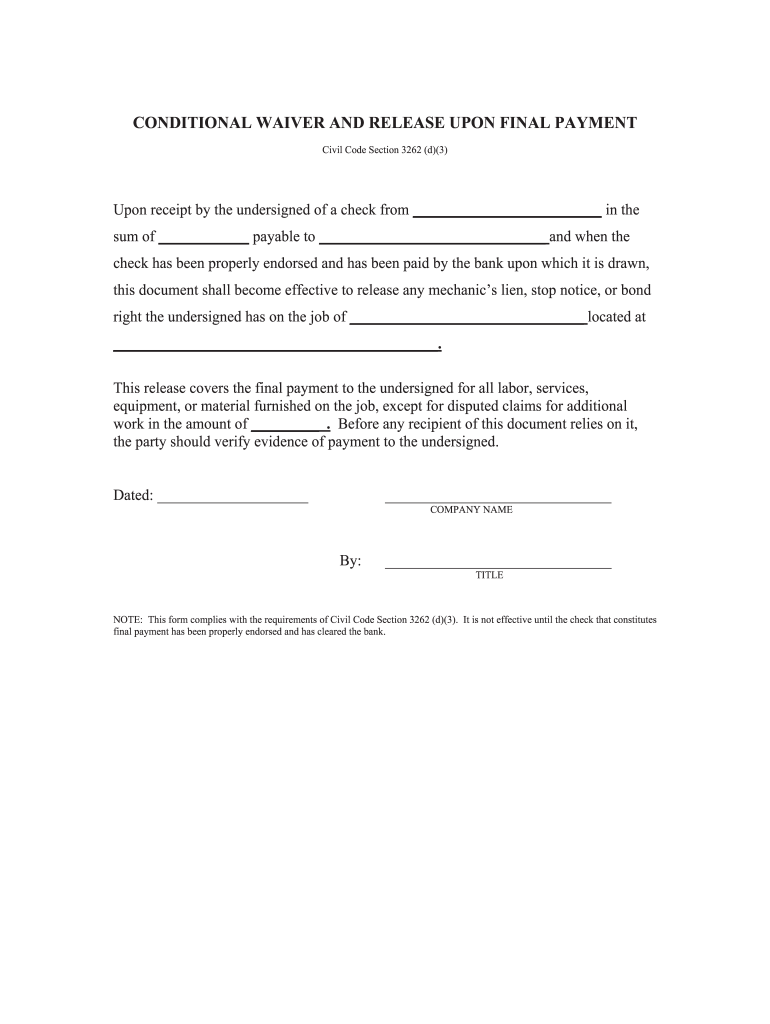







Definition and Meaning of the "Upon Final Form"
The term "upon final form" refers to a specific legal document often used in construction or contractual settings, particularly to signify the conditions under which a party releases mechanics' lien or bond rights upon receiving final payment. This document ensures that upon the completion of terms outlined in a contract and after the payment has been made and cleared, certain rights are relinquished, effectively protecting both payer and payee in the transaction.
- Purpose: The primary purpose of this form is to formalize the agreement that upon the receipt of the final payment, the party waives the right to future claims related to the services rendered or materials supplied.
- Importance in Construction: In the construction industry, this form is pivotal as it prevents future disputes and lien claims on a property after the final payment is processed.
- Legally Binding: Once both parties sign this document and the final payment is made, it becomes enforceable under applicable state laws.
Steps to Complete the "Upon Final Form"
Completing the "upon final form" involves careful attention to detail to ensure compliance with specific legal standards. Here is a structured outline of steps to effectively complete this form:
-
Gather Necessary Information: Ensure you have all relevant details regarding the parties involved, the contract, and the payment in question.
- Legal names and addresses of the involved parties.
- Contract specifics, including project details.
- Payment amounts and conditions.
-
Obtain the Template: Select a reliable template for the conditional lien waiver. This can often be found through various legal document services or created using word processing software.
-
Fill in Required Fields: Input specific information into the form, such as:
- Project description.
- Amount received and method of payment.
- Identification of conditions for the waiver to be effective.
-
Review and Sign: Before finalizing, both parties should review the document carefully to ensure accuracy. Once confirmed, proceed with the signatures.
- Ensure that all required witnesses or notarization is fulfilled if needed by your state’s regulations.
-
Disseminate Copies: After execution, provide copies of the fully signed "upon final form" to all parties involved to ensure transparency and to maintain official records.
Legal Use of the "Upon Final Form"
The legal implications of the "upon final form" are significant, particularly in the way it protects parties in construction and contractual agreements. Understanding its legal use includes:
- Contractual Rights: The document acts as a waiver of rights under the construction lien laws in various states, making it crucial for contractors to secure payment efficiently.
- Compliance with State Laws: Different states have varied laws regarding lien waivers, and using the form correctly ensures compliance with those regulations.
- Proof of Payment and Release: By signing this form, the contractor confirms they have received payment and visibly releases the lien interest, protecting the property owner from future claims of payment.
Key Elements of the "Upon Final Form"
Understanding the components of the "upon final form" is essential for its correct utilization. The key elements include:
- Project Details: Any pertinent information regarding the specific project that is referenced within the form.
- Payment Information: Clear documentation of the amount paid and the date to substantiate the financial transaction.
- Recipient Information: Specifics about who is waiving their lien rights, identifying the service provider or contractor involved.
- Conditions: A detailed outline of the conditions that must be met for the waiver to be effective, such as receiving payment confirmation.
Common Examples of Usage for the "Upon Final Form"
Practical scenarios can illustrate the utility of the "upon final form" in real-world applications. Here are a few examples:
- Construction Contractor Scenario: A contractor completes work on a residential property and submits the final bill. The homeowner makes the payment, and the contractor provides the "upon final form" to confirm that they waive their right to place a lien on the property.
- Service Provider Context: A landscaping service finishes its contracted work, and the homeowner pays the full amount. The service must submit the "upon final form" to confirm complete satisfaction and release any claim should further issues arise.
- Commercial Agreements: In a business arrangement where products were supplied, after the final invoice is settled, the "upon final form" serves to assure the buyer that no further claims for payment will arise from the seller.
Important Terms Related to the "Upon Final Form"
Clarity on terminology is critical when dealing with the "upon final form." Here are essential terms connected with this document:
- Mechanic's Lien: A legal claim against a property for unpaid work or materials provided in improving that property.
- Waiver of Lien: A document representing the relinquishment of a lien, allowing property owners to have clearer titles.
- Conditional Waiver: A waiver that is only effective upon the occurrence of a specific event, such as the clearance of a final payment.
Each of these concepts informs the user about the legal framework and contractual obligations related to using the "upon final form."
State-Specific Rules for the "Upon Final Form"
Regulations governing the "upon final form" can vary significantly across different states. It's crucial for parties to be aware of:
- State Requirements: Every state has unique regulations defining how lien waivers should be constructed and enforced.
- Enforcement Variations: Some states may have more stringent enforcement rules, such as requiring notarization or particular phrasing to be legally binding.
It is recommended to consult state-specific resources or legal experts when drafting or executing the "upon final form" to ensure compliance.
Digital vs. Paper Version of the "Upon Final Form"
The choice between digital and paper formats for the "upon final form" can affect its execution and storage:
- Digital Advantages: Using digital forms offers easy accessibility and can streamline the signing process through electronic signatures and document management systems.
- Paper Considerations: Physical copies may be necessary in certain jurisdictions or scenarios that require wet signatures or original documents for filing and verification.
Familiarity with both formats allows for flexibility in meeting the demands of specific transactions or state laws.
Common Pitfalls in Using the "Upon Final Form"
Being aware of challenges that can arise with the "upon final form" usage assists in preventing potential issues:
- Incomplete Information: Failing to fully complete the form can lead to disputes in claims.
- Improper Execution: Not adhering to state requirements regarding signatures or notarization may render the waiver invalid.
- Misunderstanding Conditions: Not clearly delineating terms within the conditional waiver can result in future claims and compliance difficulties.
Awareness of these common pitfalls ensures that parties can effectively mitigate risks when utilizing the "upon final form."




