
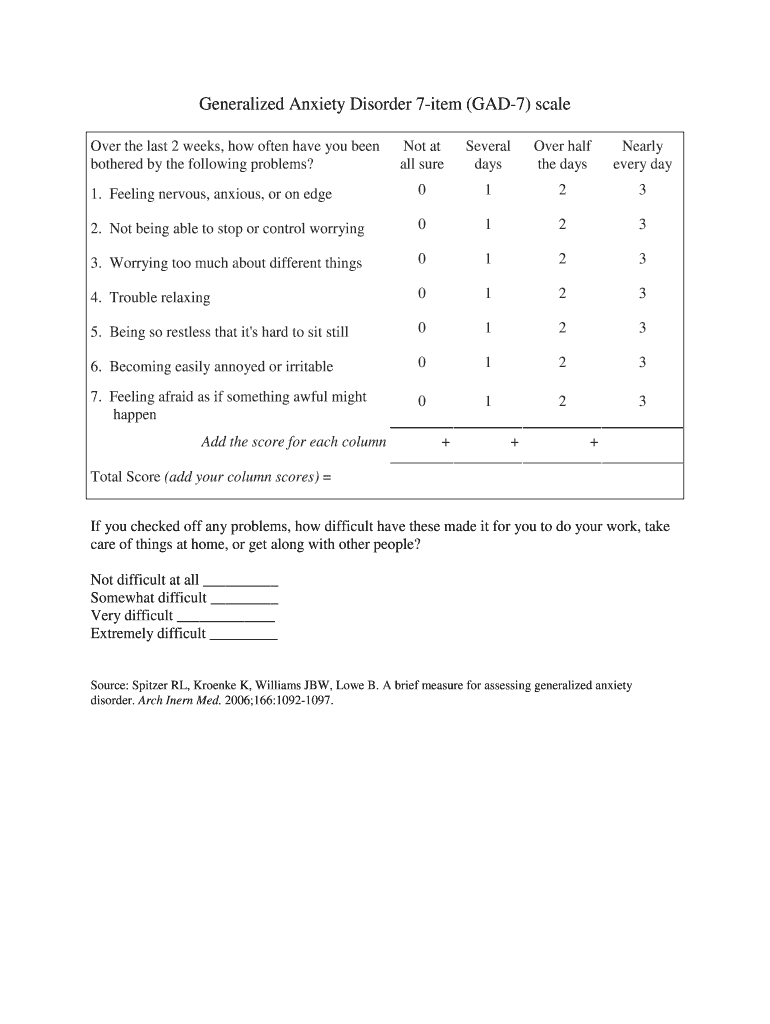







Definition & Meaning of the GAD-7
The Generalized Anxiety Disorder 7-item (GAD-7) scale is a self-assessment questionnaire used to measure anxiety severity. It consists of seven questions that ask respondents to rate the frequency of specific anxiety-related symptoms experienced over the past two weeks. Each item is scored on a scale from zero (not at all) to three (nearly every day), allowing for quantification of anxiety levels. The GAD-7 serves as an important tool for both individuals and healthcare professionals to assess anxiety and monitor treatment progress.
Understanding the Items
Each of the seven items addresses different aspects of anxiety, including:
- Nervousness: Feeling anxious or on edge.
- Worry: Experiencing excessive concerns about various aspects of life.
- Restlessness: Difficulty relaxing or sitting still.
- Fatigue: Feeling unusually tired despite sufficient rest.
- Irritability: Experiencing general irritability.
- Concentration Issues: Trouble focusing on tasks.
- Sleep Disturbances: Problems with sleeping due to anxiety.
The cumulative score from these items assists in determining the severity of anxiety, which can categorize symptoms into minimal, mild, moderate, and severe anxiety levels.
How to Use the GAD-7
Using the GAD-7 involves several steps, allowing individuals to self-assess their anxiety levels effectively.
- Access the Questionnaire: The GAD-7 is available in various formats, including a printable PDF, an editable document, and as part of different mental health screening tools.
- Complete the Questions: Respondents should answer each question based on their experiences over the past two weeks.
- Calculate Your Score: Each response has a point value; add these values to get a total score.
- Interpret the Score: Based on the total score, individuals can gauge the severity of their symptoms, helping them determine if they need to seek further evaluation or treatment.
- Discuss Results with a Professional: It is beneficial to review results with a healthcare provider, who can provide guidance based on the score and its implications for mental health.
Scoring Interpretation
- 0-4: Minimal anxiety
- 5-9: Mild anxiety
- 10-14: Moderate anxiety
- 15-21: Severe anxiety
This scoring is foundational for both patients and practitioners in understanding anxiety levels and determining next steps.
How to Obtain the GAD-7
Obtaining the GAD-7 is straightforward and can be done through several channels.
- Official Websites: Many healthcare organizations and mental health websites host the GAD-7 scale for download.
- Healthcare Providers: Doctors and mental health professionals often have copies to distribute during evaluations.
- Mental Health Apps: Several mobile applications provide access to the GAD-7 as a part of their screening tools.
- Printable Forms Available: Users can find printable versions to ensure ease of use, offering flexibility for different settings.
Accessibility
The GAD-7 scale is commonly available in PDF format, making it easy for users to print and complete the questionnaire at their convenience.
Steps to Complete the GAD-7
Completing the GAD-7 involves a straightforward series of steps facilitating an accurate self-assessment.
- Find a Quiet Space: Choose a comfortable and distraction-free environment to ensure you can focus on your responses.
- Review Each Question Carefully: Take your time to understand each item and reflect on your experiences over the last two weeks.
- Rate Your Symptoms: Circle the number that best reflects how often you experienced the symptoms described in each question.
- Total Your Score: After responding to all questions, calculate the total by adding the points.
- Refer to the Scoring Guide: Use the established scoring ranges to understand the severity of your anxiety.
Reflection
Self-completing the GAD-7 can serve as a valuable reflective exercise, offering insights into personal anxiety triggers and symptoms.
Important Terms Related to the GAD-7
Understanding the terminology associated with the GAD-7 can enhance comprehension and usage of this assessment tool.
- Generalized Anxiety Disorder: A common anxiety disorder characterized by chronic, excessive worry about various aspects of life.
- Self-Assessment: A method where individuals evaluate their own mental health status.
- Symptoms: Observable or felt signs that indicate the presence of anxiety.
- Score Interpretation: The process of understanding the total score achieved on the GAD-7 and its implications for mental health.
Related Tools
Other assessment tools include:
- PHQ-9: A scale for depression screening, often used in conjunction with the GAD-7.
- Beck Anxiety Inventory: Another popular self-assessment for anxiety levels.
These terms and tools can help refine the understanding and discussion around anxiety and its impact.
Legal Use of the GAD-7
The GAD-7 is used within a medical context for assessment and diagnosis, with significant emphasis on confidentiality and informed consent.
- Confidentiality: Information collected through the GAD-7 should be treated with strict confidentiality as part of patient privacy regulations.
- Medical Release: If results are to be shared with parties outside of the treatment team, consent must be obtained to comply with legal standards.
Clinical Applications
Healthcare providers utilize the GAD-7 in consultations to determine treatment paths, monitor progress, and modify interventions based on severity scores. This legal framing is critical in ensuring ethical standards in mental health care.
Examples of Using the GAD-7
Practical examples can highlight the adaptability of the GAD-7 in various scenarios.
- Primary Care Settings: Physicians may administer the GAD-7 during routine check-ups as part of holistic patient assessments.
- Mental Health Clinics: Therapists might integrate the GAD-7 into initial assessments to gauge patient needs.
- Community Health Programs: Organizations focused on mental health outreach may distribute the GAD-7 for individuals seeking help.
- Workplace Wellness Initiatives: Employers may offer the GAD-7 as part of mental health resources to support employee wellbeing.
Flexibility of Use
Due to its accessible format and comprehensive nature, the GAD-7 can be adapted for various environments, facilitating widespread implementation in mental health assessments.




