
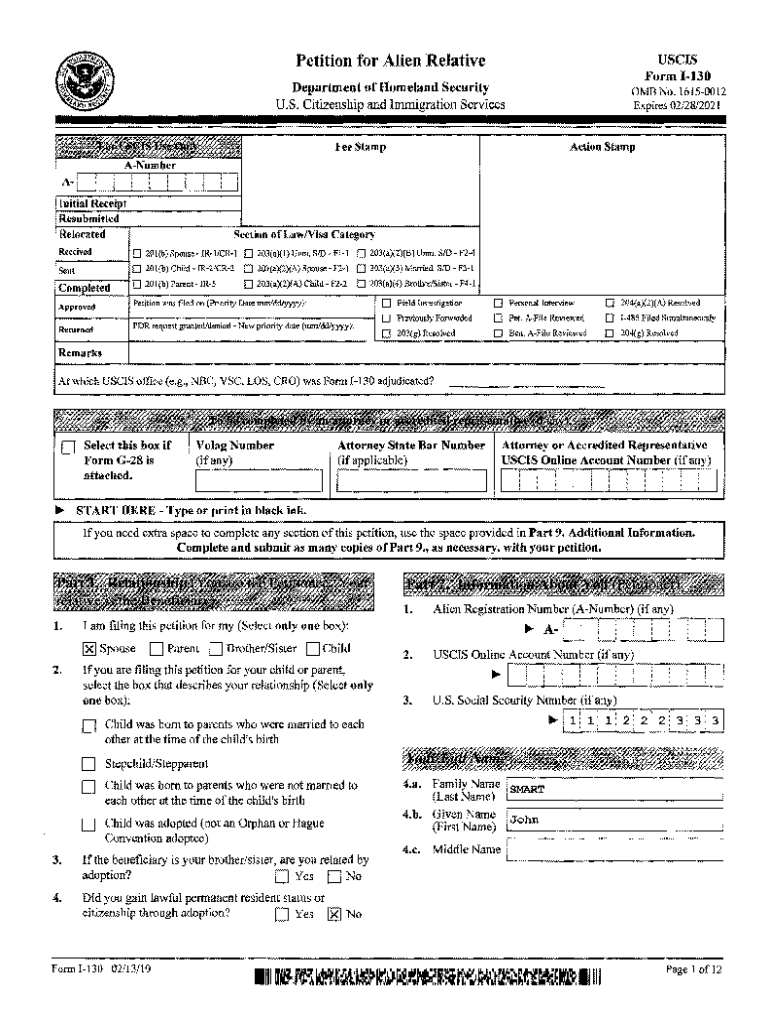







Definition and Meaning of the I-130 Form in Spanish
The I-130 form, officially known as the Petition for Alien Relative, is an essential document used by U.S. citizens and lawful permanent residents to sponsor relatives for immigration to the United States. This form enables the petitioner to establish a familial relationship with the beneficiary, who may then apply for a visa or adjustment of status to become a lawful permanent resident.
-
Primary Purpose: The primary purpose of the I-130 form in Spanish, or "formulario I-130 en español,” is to help U.S. citizens or permanent residents bring their family members to the United States. It serves as the foundational step in the family-based immigration process.
-
Legal Relevance: Understanding the I-130 form is crucial for applicants as it carries legal weight in immigration proceedings and can affect the potential immigrant's ability to enter the country. Mistakes or omissions in the form can delay processing or lead to denials.
Steps to Complete the I-130 Form in Spanish
Completing the I-130 form in Spanish involves careful attention to detail and adherence to specific requirements. The following steps guide individuals through the process:
-
Download the Form: Obtain a copy of the I-130 form in Spanish from authorized resources, such as the official USCIS website or trusted legal sources. The form is available in PDF format (formulario I-130 pdf español).
-
Gather Required Information: Collect necessary information about both the petitioner and the beneficiary. This includes personal data, such as names, addresses, birth dates, and any relevant immigration history.
-
Complete the Form:
- Fill out all sections accurately. Each question must be answered truthfully to avoid complications.
- Use clear and legible handwriting or type the information if filling out the form electronically.
-
Attach Supporting Documentation: Include necessary supporting documents, such as proof of relationships (e.g., birth certificates, marriage certificates), and any previously issued immigration paperwork.
-
Review and Sign: Double-check all entries for accuracy and completeness. The petitioner must sign and date the form. Ensure that the signature is an original and not a photocopy, as USCIS requires original signatures.
-
Submit the Form: Send the completed I-130 form directly to the appropriate USCIS address based on the instructions provided.
Important Terms Related to the I-130 Form in Spanish
Several critical terms are associated with the I-130 form that can help in understanding its purpose and implications:
-
Beneficiary: The individual for whom the petition is filed. This person is seeking to immigrate to the United States based on their familial relationship with the petitioner.
-
Petitioner: The U.S. citizen or lawful permanent resident who is filing the I-130 form to sponsor a relative for immigration.
-
Affidavit of Support: A necessary document that may follow the approval of the I-130 form, ensuring that the beneficiary will not become a public charge in the U.S.
-
Visa Bulletin: A monthly publication by the Department of State that indicates the availability of immigrant visas, which impacts how long beneficiaries may wait following the approval of the I-130 form.
Required Documents for the I-130 Form in Spanish
When filing the I-130 form, certain documents must accompany the application to ensure that it is processed without delay. Key required documents include:
-
Proof of U.S. Citizenship or Permanent Residency: This may include a copy of a U.S. passport, naturalization certificate, or permanent resident card.
-
Evidence of Relationship: To establish a qualifying family relationship, submit documents like marriage certificates, birth certificates, or adoption decrees.
-
Passport-Style Photos: Recent, passport-sized photos of both the petitioner and the beneficiary may be required, adhering to specified guidelines regarding size and background.
-
Form I-864 (Affidavit of Support): After approval, to ensure that the beneficiary has adequate financial support, this form must be filled out and submitted.
Legal Use of the I-130 Form in Spanish
The legal significance of the I-130 form extends beyond mere paperwork. It operates within the framework of U.S. immigration law to establish eligibility for family-based immigration. Key points regarding its legal use include:
-
Inevitability of Adherence: The form must be completed in compliance with regulations set forth by the U.S. Citizenship and Immigration Services (USCIS). Failing to adhere to these regulations can lead to legal ramifications, including denial of the application.
-
Protection Against Fraud: The information provided must be truthful and verifiable, as fraudulent claims can result in severe penalties for the petitioner, including bans on re-entry into the U.S. for both the petitioner and beneficiary.
-
Pathway to Permanent Residency: Its approval serves as an essential step towards obtaining immigrant visas or adjusting status for the beneficiary, facilitating their transition to lawful permanent residency in the U.S.




