Or supplemental project application 2026

Get Form
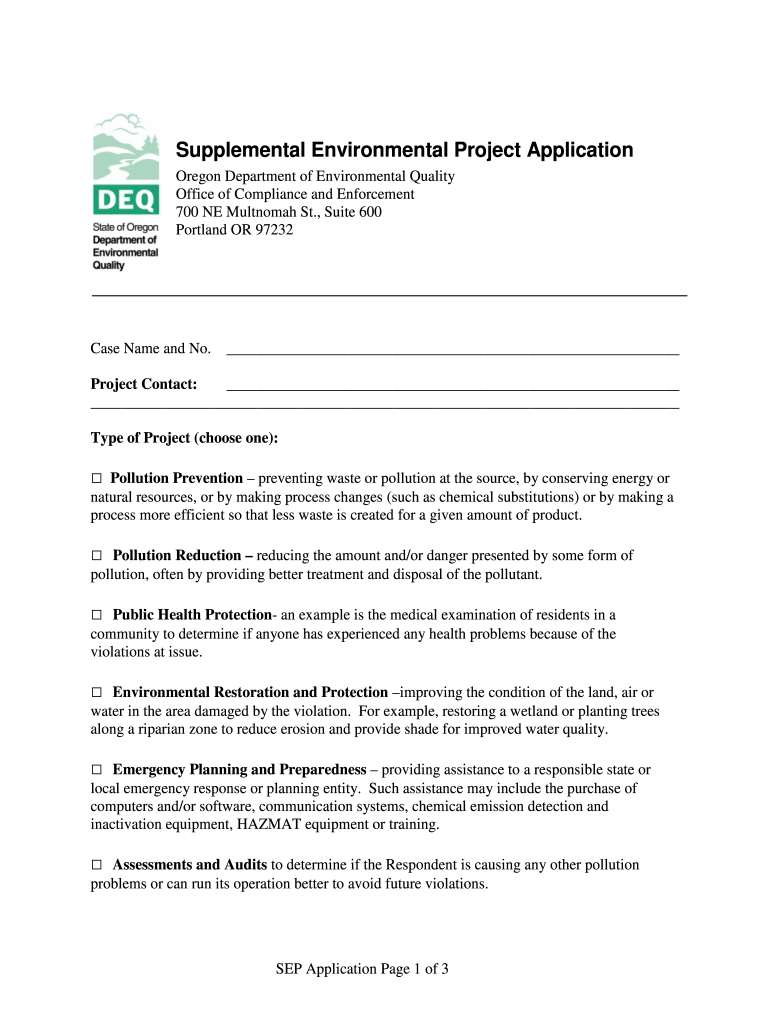
or supplemental project application Preview on Page 1

Here's how it works

01. Edit your form online
Type text, add images, blackout confidential details, add comments, highlights and more.
02. Sign it in a few clicks
Draw your signature, type it, upload its image, or use your mobile device as a signature pad.
03. Share your form with others
Send it via email, link, or fax. You can also download it, export it or print it out.

How to use or fill out the Supplemental Environmental Project Application

Form edit decoration
9.5
Ease of Setup
DocHub User Ratings on G2
9.0
Ease of Use
DocHub User Ratings on G2
  1. Click ‘Get Form’ to open it in the editor.
  2. Begin by entering the Case Name and Number at the top of the form. This helps identify your application.
  3. Fill in the Project Contact information, including name and contact details, ensuring that all fields are complete for effective communication.
  4. Select the Type of Project by checking one of the boxes provided. Choose from options like Pollution Prevention or Environmental Restoration based on your project focus.
  5. Indicate who is conducting the project, whether it's you or a third-party entity, and provide their details.
  6. Specify the location where the project will take place, ensuring accuracy for regulatory purposes.
  7. In the Project Description section, provide a detailed overview of your project. If necessary, attach additional sheets for clarity.
  8. Outline expected environmental benefits and how you plan to measure these benefits in their respective sections.
  9. Detail the total projected cost of the project, explaining qualifying costs as outlined in the instructions.
  10. Finally, specify the timeframe for completion, including key milestones and a final completion date before signing and dating your application.

Start using our platform today to streamline your Supplemental Environmental Project Application process for free!

be ready to get more

Complete this form in 5 minutes or less

Get form

Got questions?

We have answers to the most popular questions from our customers. If you can't find an answer to your question, please contact us.
Contact us
The DEQ Office of Compliance and Enforcement issues fines and requires violators to correct violations. DEQs Supplemental Environmental Project policy allows up to 80% of fines to go to projects that benefit human health and the environment. DEQ reviews proposed projects on a case-by-case basis.
A Supplemental Environmental Project (SEP) is an environmentally beneficial project that is included as part of a settlement for environmental violations. Violators can voluntarily agree to undertake such projects in lieu of part of the penalty that they are required to pay for the violations.
DEQs Laboratory and Environmental Assessment Division (aka LEAD or the Lab) is located in a more than 40,000-square-foot facility in Hillsboro, Oregon. Its activities include air and water quality field monitoring, inorganic and organic analytical chemistry, data management and analysis, quality assurance and more.
DEQs Environmental Cleanup Program protects human health and the environment by identifying, investigating, and remediating sites contaminated with hazardous substances.
Supplemental Projects are research, development or demonstration projects offered outside of the annual research portfolio. These projects are often spearheaded in response to an immediate need by an individual or group of members.

Security and compliance

At DocHub, your data security is our priority. We follow HIPAA, SOC2, GDPR, and other standards, so you can work on your documents with confidence.

Learn more
ccpa2
pci-dss
gdpr-compliance
hipaa
soc-compliance

People also ask

0:02 3:27 And water are protected. And can be enjoyed by all these Natural resources provide a richMoreAnd water are protected. And can be enjoyed by all these Natural resources provide a rich environment for people plants and wildlife as well as benefiting agriculture.
Under DEQs ECO Program, employers with more than 100 employees must provide commute options to employees designed to reduce the number of cars driven to work in Portland and surrounding areas. If you have more than 100 employees at a single work site, you are subject to ECO rules.

Related links