De Prescribing of Antipsychotics in Home Patients: Current ... 2025

Get Form
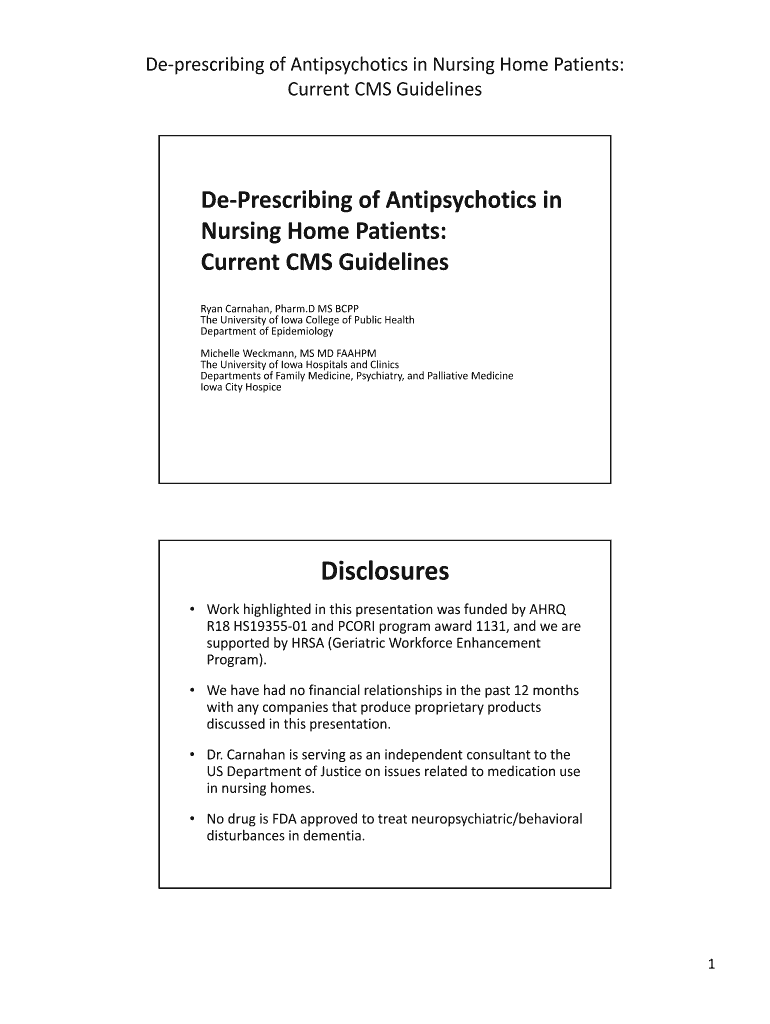
cms antipsychotic guidelines 2022 Preview on Page 1

Here's how it works

01. Edit your cms antipsychotic guidelines 2022 online
Type text, add images, blackout confidential details, add comments, highlights and more.
02. Sign it in a few clicks
Draw your signature, type it, upload its image, or use your mobile device as a signature pad.
03. Share your form with others
Send it via email, link, or fax. You can also download it, export it or print it out.

How to use or fill out De Prescribing of Antipsychotics in Home Patients: Current Guidelines with Our Platform

Form edit decoration
9.5
Ease of Setup
DocHub User Ratings on G2
9.0
Ease of Use
DocHub User Ratings on G2
  1. Click ‘Get Form’ to open it in the editor.
  2. Begin by reviewing the objectives section, which outlines the appropriate and inappropriate indications for antipsychotic use. This will guide your understanding as you fill out the form.
  3. In the 'Meet Mrs. A' section, input relevant patient information such as age, medical history, and current medications. Ensure accuracy to reflect her condition.
  4. Proceed to document any challenges faced in managing symptoms. Use our platform's text tools to highlight key issues like side effects or alternative treatments considered.
  5. Fill out the CMS regulations section by detailing compliance measures taken regarding antipsychotic prescriptions. Utilize checkboxes and dropdowns for clarity.
  6. Finally, review all entries for completeness and accuracy before saving or sharing the document directly from our platform.

Start using our platform today to streamline your document editing and ensure efficient completion of important forms!

be ready to get more

Complete this form in 5 minutes or less

Get form

Got questions?

We have answers to the most popular questions from our customers. If you can't find an answer to your question, please contact us.
Contact us
Other adverse outcomes associated with antipsychotic use in dementia include risk of extrapyramidal side effects including gait disturbance (with use of FGAs and risperidone, but less commonly olanzapine, , and quetiapine), sedation, venous thromboembolism, and pneumonia [6, 25, 51, 54].
The most frequent reasons for discontinuation were side effects and patient believed he/she no longer needed the medication because he/she was now better. The most frequent reasons for continuation were benefits for positive symptoms and another person told them to.
The five steps to individualize deprescribing practices to each patient are (1) to identify potentially inappropriate medications; (2) to determine if the medication dosage can be reduced or the medication stopped; (3) to plan tapering; (4) to monitor (for discontinuation symptoms or the need to restart) and support
We estimated the risk of recurrence within the first year following medication discontinuation to be 77%.
The adverse effects of antipsychotic medications range from relatively minor tolerability issues (e.g., mild sedation or dry mouth) to very unpleasant (e.g., constipation, akathisia, sexual dysfunction) to painful (e.g., acute dystonias) to disfiguring (e.g., weight gain, tardive dyskinesia) to life threatening (e.g.,

People also ask

From the patient perspective, the reasons given as the single most important reason for discontinuing the drug used prior to study start were positive symptoms not sufficiently improved or made worse (26.2%), patient wishes to try a new antipsychotic (21.6%), and adverse events (19.0%).

Related links