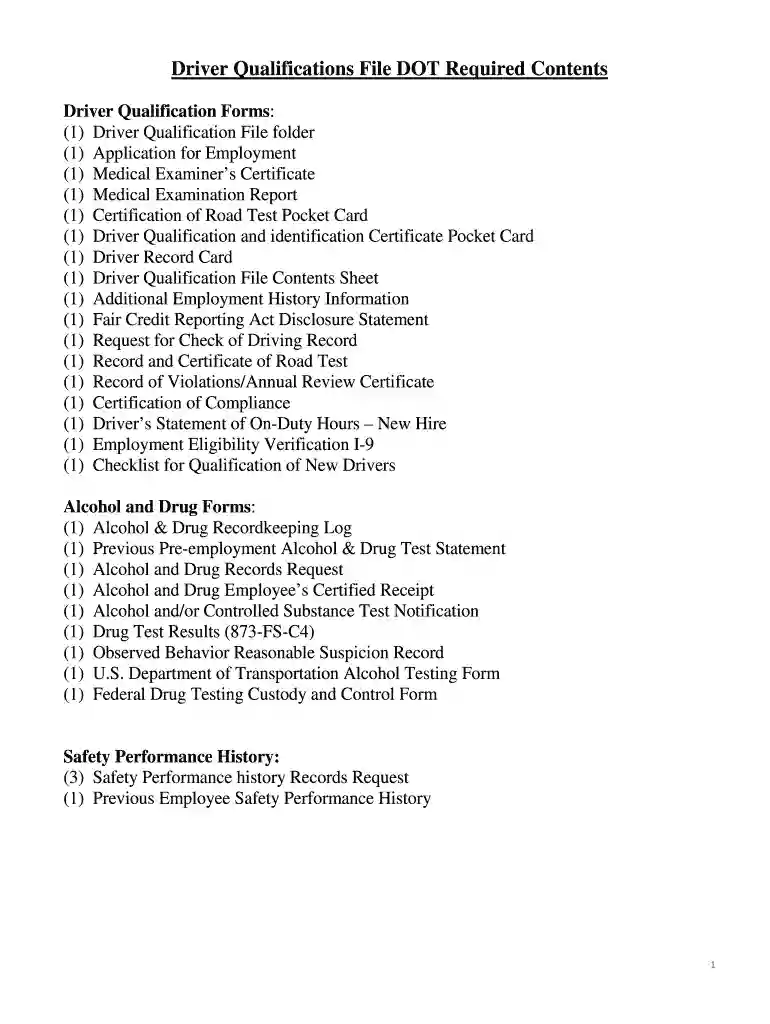
Driver Qualifications File DOT Required Contents - RiskWise 2026

Get Form
driver qualification file checklist Preview on Page 1

Here's how it works

01. Edit your driver qualification file checklist online
Type text, add images, blackout confidential details, add comments, highlights and more.

02. Sign it in a few clicks
Draw your signature, type it, upload its image, or use your mobile device as a signature pad.

03. Share your form with others
Send dq file checklist via email, link, or fax. You can also download it, export it or print it out.

Definition and Purpose of the Driver Qualifications File

The Driver Qualifications File (DQ File) is a critical component of compliance for motor carriers in the United States, as mandated by the Department of Transportation (DOT). The DQ File serves to collect essential information regarding a commercial motor vehicle driver’s qualifications, ensuring they meet federal safety standards as set forth in the Federal Motor Carrier Safety Administration (FMCSA) regulations. The primary purpose is to maintain stringent records that can be reviewed during compliance audits or safety inspections, reflecting the carrier's commitment to hiring qualified drivers.

The file must contain several key elements, including:

  • Driver Application for Employment: A completed application form that captures the driver's background, work history, and qualifications.
  • MVR (Motor Vehicle Record): A recent report detailing the driver's licensing history, violations, and endorsements.
  • Medical Examination Certificate: Verification that the driver has successfully passed a DOT medical examination, confirming their fitness to operate a commercial vehicle.
  • Drug and Alcohol Testing Records: Documentation of compliance with the drug and alcohol testing requirements, including pre-employment testing and any follow-up actions.
  • Driving Experience: Evidence and records relating to the driver’s prior experience behind the wheel.

Each of these elements plays a crucial role in ensuring driver competency and safety on the road, contributing to the overall objective of minimizing risks associated with commercial driving.

Key Elements Required in a Driver Qualifications File

Creating a comprehensive Driver Qualifications File necessitates the inclusion and meticulous organization of several essential components. Adhering to the DOT regulations involves retaining numerous documents and records that reflect the qualifications of the commercial driver. Each component must be accurately maintained and easily accessible for compliance audits and inspections.

  1. Driver Application: This form should include personal information, work history, and references. It is the starting point for assessing a candidate’s suitability for a driving role.
  2. Motor Vehicle Record: An up-to-date MVR must be acquired before hiring, revealing any traffic violations or license suspensions.
  3. Medical Examinations: A valid Medical Examiner's Certificate is required to confirm the driver’s physical ability to perform their duties safely.
  4. Drug and Alcohol Testing Records: Employers must maintain records reflecting the driver's compliance with drug and alcohol testing programs, crucial for ensuring workplace safety.
  5. Safety Performance History: This includes records of any accidents and violations from previous employment, offering insight into the driver’s safety practices.

Maintaining accurate and current records is not just a legal obligation but a best practice that promotes safety and accountability.

Steps to Complete and Maintain a Driver Qualifications File

Establishing and maintaining a Driver Qualifications File is a structured process that all employers must follow meticulously. By adhering to specific steps in compiling and updating the DQ File, carriers can ensure compliance and enhance their operational integrity.

  1. Gather Information: Start with the potential driver’s application form. Ensure the applicant fills in all relevant details accurately.
  2. Obtain the Motor Vehicle Record: Before employment, order an official MVR from the state’s Department of Motor Vehicles (DMV).
  3. Conduct a Medical Examination: Schedule a DOT medical examination to secure the Medical Examiner’s Certificate, validating the driver’s health to operate commercial vehicles.
  4. Implement Drug and Alcohol Testing: Subject the driver to required drug and alcohol testing, ensuring they meet federal standards.
  5. Compile Safety Records: Collect and include records of any safety violations or incidents they may have had in previous employment.

Regularly review and update these documents to maintain an up-to-date Driver Qualifications File that reflects current compliance requirements.

Legal Requirements and Compliance

Compliance with federal regulations regarding the Driver Qualifications File is not optional; it is required by the DOT to uphold safety standards in the transportation industry. Employers must understand the legal implications of maintaining these records, as non-compliance can result in severe penalties.

  • Regulatory Framework: Familiarize yourself with the FMCSRs that govern the contents and maintenance of the DQ File.
  • Retention Policies: Retain records for specific timeframes. For instance, driver qualification files must be kept for a minimum of three years after a driver leaves the company.
  • Audits and Inspections: Be prepared for DOT audits or requests for documentation, ensuring quick access to the DQ File.

Neglecting these legal requirements can lead to compliance violations, fines, or suspension of operating authority.

Practical Examples of Driver Qualifications File Usage

Understanding how to implement and maintain a Driver Qualifications File effectively can be illustrated through practical scenarios that demonstrate its application in real-world situations.

  • Example One: A carrier hiring a new driver conducts all necessary background checks, ensuring the driver’s MVR is free of serious violations. The DQ File is established diligently, which later proves essential during a DOT audit, showcasing the carrier’s commitment to safety.

  • Example Two: A company that failed to keep updated medical certificates for its drivers faces fines during a surprise compliance check. This situation highlights the necessity of continuous diligence in maintaining a robust DQ File.

By analyzing such scenarios, organizations can learn the repercussions of mishandling DQ Files and the benefits gained from structured compliance.

Importance of the Driver Qualification File in Risk Management

The Driver Qualifications File is not only a regulatory requirement but also a vital tool for managing risk associated with commercial driving. It provides a systematic approach to ensuring that drivers are fit for duty and adhere to safety standards, which can significantly reduce potential liabilities for the employer.

  • Enhanced Safety: Insisting on comprehensive records helps ensure that only qualified individuals operate heavy vehicles, mitigating risks of accidents.
  • Defense in Legal Matters: In case of a legal dispute or accident involving a commercial vehicle, having thorough documentation from the Driver Qualifications File could serve as evidence that proper hiring and compliance procedures were followed.
  • Improved Driver Performance: By screening and assessing qualifications diligently, companies are more likely to have a reliable workforce, leading to better overall performance and efficiency.

Incorporating risk management strategies through the maintenance of a Driver Qualifications File is beneficial for both employee safety and the organization's liability protection.

See more Driver Qualifications File DOT Required Contents - RiskWise versions

We've got more versions of the Driver Qualifications File DOT Required Contents - RiskWise form. Select the right Driver Qualifications File DOT Required Contents - RiskWise version from the list and start editing it straight away!
Versions Form popularity Fillable & printable
2009 4 Satisfied (52 Votes)
be ready to get more

Complete this form in 5 minutes or less

Get form

Got questions?

We have answers to the most popular questions from our customers. If you can't find an answer to your question, please contact us.
Contact us
Physical Disqualifying Conditions Vision impairment that cannot be corrected to 20/40 in each eye and a field of vision of at least 70 degrees in the horizontal Median in each eye. Hearing loss. Insulin-Treated Diabetes Mellitus (ITDM). Heart disease. Seizures and epilepsy. Oxygen therapy. Menieres disease.
DOT background checks typically include the following reports: Criminal records check. DOT physical. DOT drug test. Employment verification with a safety performance history from employers in the last three years. Motor vehicle records (MVR) check from each state in which the applicant has held a CDL.
What are requirements to pass a DOT Physical? Blood pressure and pulse check. Check for abdomen abnormalities and hernia. Check for spine deformities. Hearing test, drivers must be able to hear a forced whisper from at least 5 feet away. Heart and lung evaluation for murmurs or impaired respiratory functions.
The Driver Qualification File must contain the drivers: DOT-compliant application. Motor Vehicle Report. Certificate of Road Test. Medical Examination Report. Medical Examiners National Registry Verification. Skill Performance Evaluation Certificate Application (if required)
Minimum DOT Requirements for CDL Truck Drivers Have a valid, non-commercial drivers license. Be at least 18 years old or at least 21 to drive across state lines or carry hazardous materials. Have a minimum of one to two years of driving experience. Have no active suspensions.

Security and compliance

At DocHub, your data security is our priority. We follow HIPAA, SOC2, GDPR, and other standards, so you can work on your documents with confidence.

Learn more
ccpa2
pci-dss
gdpr-compliance
hipaa
soc-compliance

People also ask

Inquiry to Previous Employers for Safety Performance History Motor carriers must investigate, document, and retain all drivers previous employment safety performance history for the three years immediately prior to the driver joining a new employer.
Common DOT safety compliance requirements include: Refraining from drugs and alcohol. Following inspection requirements. Following FMCSA guidelines. Adhering to hazardous material regulations. Meeting general safety requirements.

driver qualification file packet pdf