Colorado Living Trust for individual, Who is Single, Divorced or Widow or Widower with Children 2026

Get Form
contracts agreements Preview on Page 1

Here's how it works

01. Edit your contracts agreements online
Type text, add images, blackout confidential details, add comments, highlights and more.
02. Sign it in a few clicks
Draw your signature, type it, upload its image, or use your mobile device as a signature pad.
03. Share your form with others
Send covenants definitions via email, link, or fax. You can also download it, export it or print it out.

How to use or fill out Colorado Living Trust for individual, Who is Single, Divorced or Widow or Widower with Children

Form edit decoration
9.5
Ease of Setup
DocHub User Ratings on G2
9.0
Ease of Use
DocHub User Ratings on G2
  1. Click ‘Get Form’ to open it in the editor.
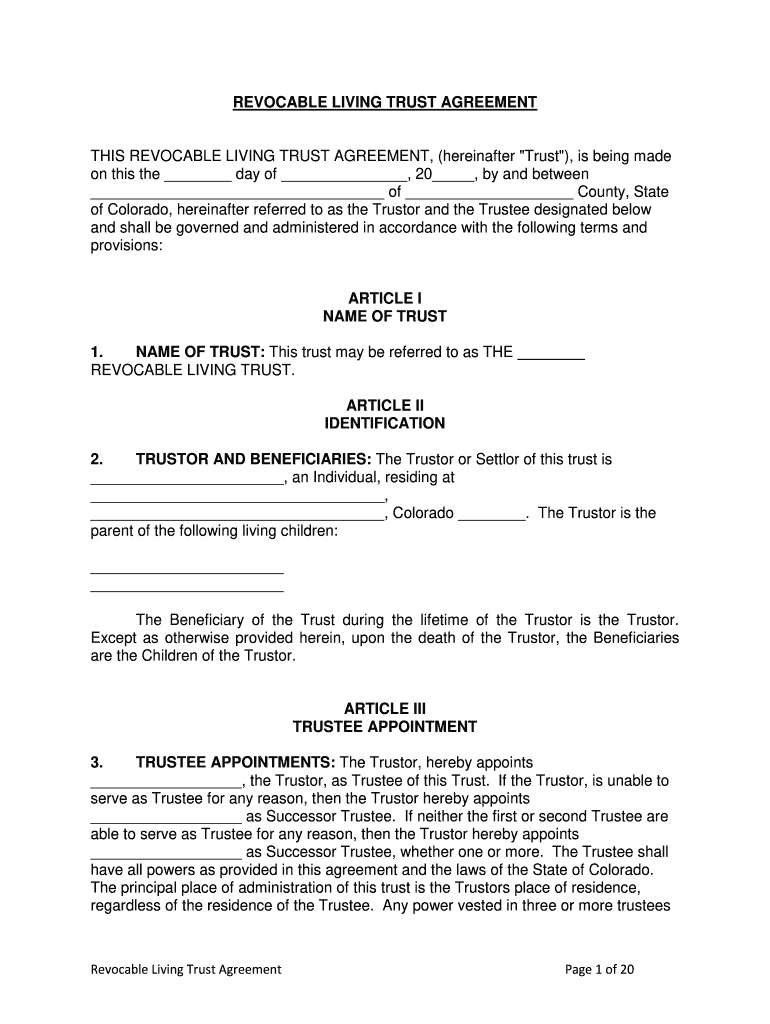
  2. Begin by entering the date at the top of the form. This establishes when the trust is created.
  3. In Article I, specify the name of your trust. This can be a personal choice, such as 'The [Your Name] Revocable Living Trust'.
  4. In Article II, fill in your name and address as the Trustor. List your children’s names as beneficiaries.
  5. For Article III, appoint yourself as Trustee and designate a Successor Trustee in case you are unable to serve.
  6. In Article IV, list all assets you wish to include in the trust. You may need to attach an Exhibit A for detailed descriptions.
  7. Review Articles V through XII carefully to understand trustee powers and administration rules before finalizing your document.

Start using our platform today to create your Colorado Living Trust easily and for free!

be ready to get more

Complete this form in 5 minutes or less

Get form

Got questions?

We have answers to the most popular questions from our customers. If you can't find an answer to your question, please contact us.
Contact us
If a revocable living trust is considered marital property, it can still docHubly impact the divorce settlement. The assets held within the trust may be subject to equitable division during the divorce proceedings, influencing the allocation of assets between the divorcing spouses.
Yes, you can exclude your spouse from a trust. This is common when there are children from previous relationships. The type of property matters, as it depends on when it was acquired. This includes financial accounts and other assets, even those not jointly held.

Security and compliance

At DocHub, your data security is our priority. We follow HIPAA, SOC2, GDPR, and other standards, so you can work on your documents with confidence.

Learn more
ccpa2
pci-dss
gdpr-compliance
hipaa
soc-compliance
be ready to get more

Complete this form in 5 minutes or less

Get form