




01. Edit your equivalence certificate online
Type text, add images, blackout confidential details, add comments, highlights and more.

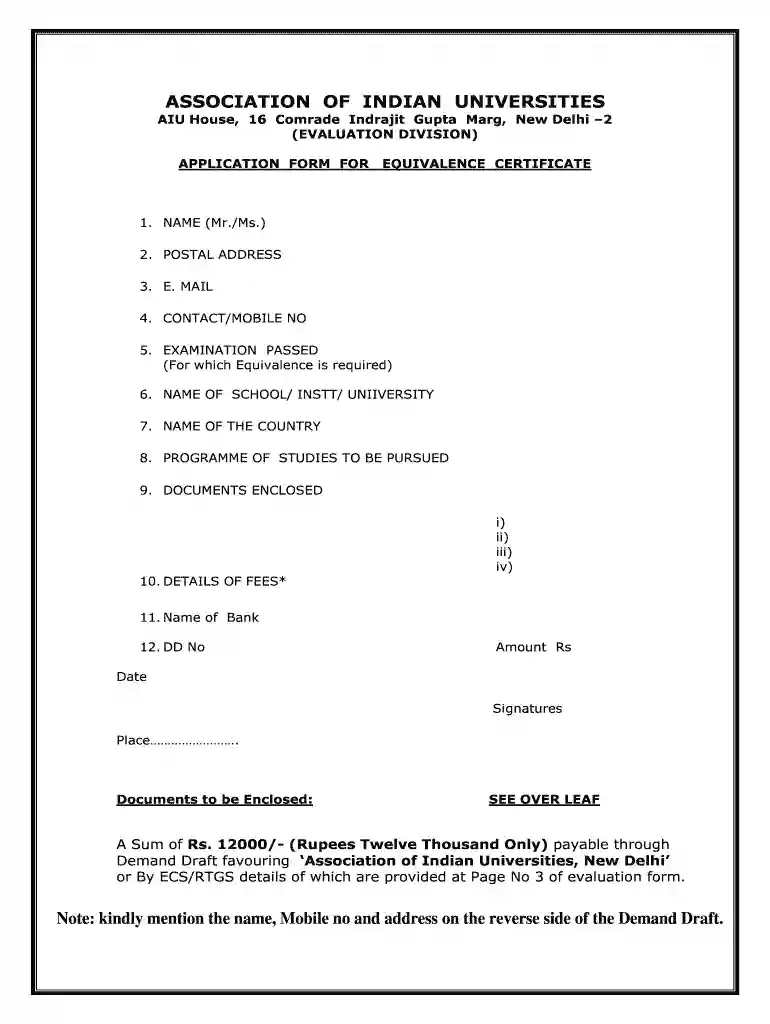
Type text, add images, blackout confidential details, add comments, highlights and more.

Draw your signature, type it, upload its image, or use your mobile device as a signature pad.

Send what is equivalence certificate via email, link, or fax. You can also download it, export it or print it out.
An equivalence certificate serves as an official document confirming that an individual's educational qualifications obtained from a foreign institution align with the standards of the certifying country. In the United States, it is crucial for individuals seeking employment, further education, or professional licensing. The equivalence certificate validates the academic credentials for various educational levels, such as high school diplomas, bachelor’s degrees, and advanced degrees like master’s or PhDs.
The primary purpose of the equivalence certificate is to facilitate the recognition of educational qualifications from one country by another. This is particularly important in multicultural and globalized environments where education systems vary significantly. For example:
The process of obtaining an equivalence certificate involves several key steps, depending on the issuing body, usually an educational authority or an academic institution.
Research the Requirements:
Prepare Required Documents:
Complete the Application Form:
Submit Application:
Wait for Processing:
Understanding key terminology is beneficial when navigating the equivalence certificate process.
The documentation required for applying for an equivalence certificate varies by issuing authority but generally includes:
It is crucial to ensure that all documents are organized and readily available, as this can streamline the application process.
An equivalence certificate can be utilized in various contexts, showcasing its importance across different sectors.
Higher Education: A student from another country applying to a U.S. university submits their equivalence certificate to demonstrate that their previous education meets admission standards.
Employment: An individual applying for a job in a regulated profession (such as healthcare or teaching) uses the equivalence certificate to prove that their foreign qualifications are recognized by U.S. standards.
Immigration: When applying for a visa or residency, immigrants may need to present an equivalence certificate as part of their application to certify their qualifications.
Each state may have its own rules and regulations governing the issuance and usage of equivalence certificates.
Understanding these state-specific rules ensures compliance and a smoother application process for individuals seeking recognition of their educational achievements across state lines.
At DocHub, your data security is our priority. We follow HIPAA, SOC2, GDPR, and other standards, so you can work on your documents with confidence.
When faculty request Online Teaching Certification Equivalency, the following Equivalency Review Process will be followed.Read more
A foreign equivalency certification is a report by an acceptable educational credential evaluator used to establish U.S. educational equivalency of college/Read more


