General power of attorney india nri sample pdf 2026

Get Form
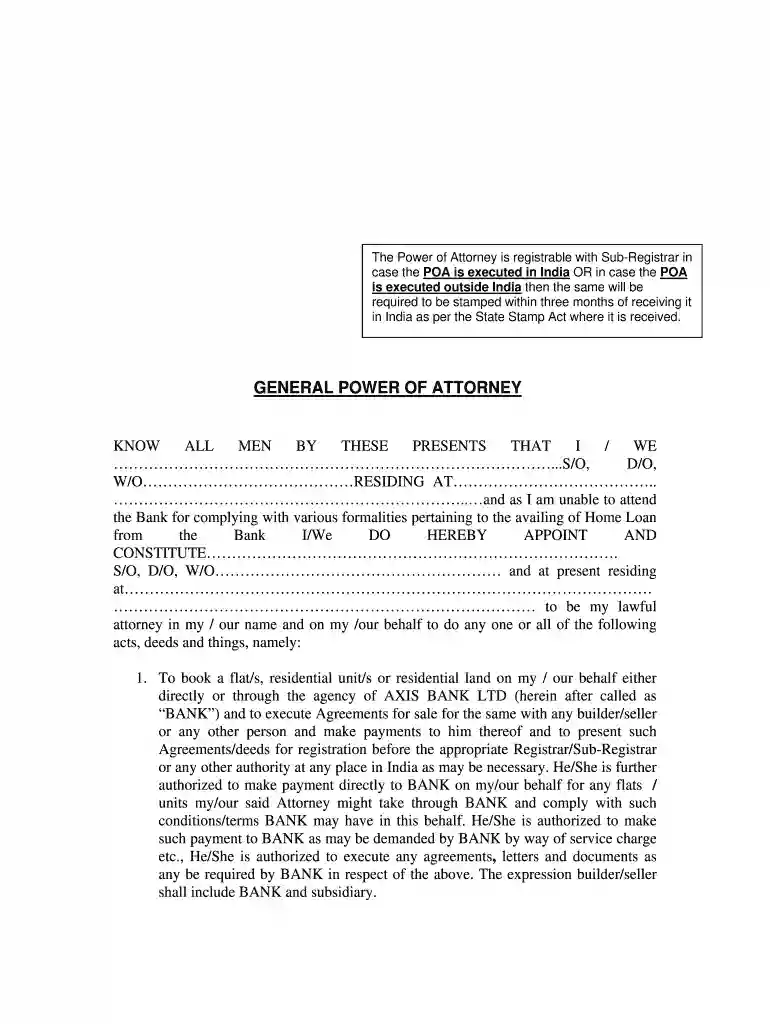
general power of attorney india nri sample pdf Preview on Page 1

Here's how it works

01. Edit your general power of attorney india nri sample pdf online
Type text, add images, blackout confidential details, add comments, highlights and more.

02. Sign it in a few clicks
Draw your signature, type it, upload its image, or use your mobile device as a signature pad.

03. Share your form with others
Send sample power of attorney for india from usa via email, link, or fax. You can also download it, export it or print it out.

Definition and Purpose of General Power of Attorney in India for NRIs

A General Power of Attorney (GPA) is a legal document that grants one person (the attorney-in-fact) the authority to act on behalf of another (the principal) in various matters. For Non-Resident Indians (NRIs), this document is particularly important in managing property, financial assets, and business affairs while living abroad. The GPA enables the attorney to handle tasks such as signing documents, managing bank accounts, and facilitating real estate transactions.

Key Features of General Power of Attorney

  • Wide Range of Authorities: The attorney can undertake any lawful act that the principal could do in person, providing flexibility in managing affairs.
  • Irrevocability: Many GPAs are irrevocable. This means once executed, they can't be easily revoked, which is crucial for ongoing transactions.
  • Registration Requirements: A GPA related to property in India must be registered to be legally enforceable, especially if executed in India. If created abroad, it must be appropriately stamped according to the local laws of the jurisdiction where it is executed.

Components of a General Power of Attorney Document

A comprehensive General Power of Attorney will typically include several key components that detail the extent and limitations of the powers granted.

  1. Principal and Attorney Information: Full names, addresses, and identification details of both the principal and the attorney-in-fact.
  2. Scope of Authority: A clear description of the specific powers granted, such as:
    • Buying, selling, or leasing property.
    • Managing bank accounts and financial transactions.
    • Representing the principal in legal matters.
  3. Conditions and Limitations: Any restrictions on the authority granted to the attorney-in-fact, specifying actions that require the principal's prior consent.
  4. Duration of the Agreement: Indication of the intended duration of the authority, whether it's for a specific period or until revoked.
  5. Signatures and Witness Requirements: Signatures of the principal, the attorney, and witnesses, as required by Indian law for validity.

Steps to Execute a General Power of Attorney in India

Creating a valid General Power of Attorney requires a systematic approach to ensure compliance with legal standards.

  1. Drafting the Document:

    • Use clear and formal language to outline the powers and limitations.
    • Ensure it includes all essential components.
  2. Notarization:

    • Sign the document in the presence of a notary public to validate it.
    • This step is crucial to establish credibility if any disputes arise later.
  3. Registration:

    • Visit the local sub-registrar's office for registration if the GPA pertains to property transactions.
    • Present required identification documents and pay the applicable registration fee.
  4. Stamp Duty:

    • Pay the appropriate stamp duty as mandated by Indian law. This varies by state, so consult local regulations to ensure compliance.
  5. Distribution:

    • Provide copies of the signed and registered GPA to the attorney-in-fact and retain one for personal records.

Common Uses for General Power of Attorney for NRIs

Non-Resident Indians often use General Powers of Attorney for various purposes while managing their affairs remotely. Some common scenarios include:

  • Real Estate Transactions: Granting authority to handle the buying or selling of property in India. This is vital for NRIs who may not be able to travel frequently to manage such transactions themselves.
  • Banking and Financial Management: Allowing someone to operate bank accounts, invest in stocks, or conduct transactions on behalf of the principal.
  • Legal Representation: Appointing an individual to appear in legal matters, including court appearances and negotiations on behalf of the principal.

Legal Considerations for Non-Residents Executing GPA

Executing a General Power of Attorney presents unique legal considerations for NRIs. It is critical to be aware of:

  • Local and International Law Implications: Depending on the country of residence, the powers of attorney may need to comply with local laws concerning POAs to ensure validity.
  • Legal Recourse: If disputes arise over interpretations or executions of the GPA, it may require engagement with legal professionals both in India and the NRI's country of residence.
  • Revocation Procedures: Understanding the process to revoke a GPA is essential, especially if the principal wishes to make changes in their choice of attorney.

Sample General Power of Attorney Formats for NRIs

Providing sample formats can be incredibly beneficial for NRIs looking to draft an effective General Power of Attorney. Typically, the format includes sections for:

  • Introduction: Identifying the parties involved and the purpose.
  • Power Clauses: Detailing the specific authorities granted.
  • Notarization and Execution Details: Stating the need for notarization and registration.

A sample GPA format can serve as a practical template for NRIs, ensuring vital elements are not overlooked and that it aligns with legal requirements for execution in India.

Various online resources, including templates, can facilitate the process, ensuring clarity and adherence to legal standards while minimizing the risk of errors that could invalidate the document.

be ready to get more

Complete this form in 5 minutes or less

Get form

Got questions?

We have answers to the most popular questions from our customers. If you can't find an answer to your question, please contact us.
Contact us
Documents to be attached: Duly filled Miscellaneous Application Form (Click here) signed by the applicant. In case of Indian Passport Holders: Valid passport in original and self-attested copies of first two and last two pages of the passport and the page (s) containing passport officers observation (s) (if any).
Get the deed attested by the Indian embassy or consulate in that country. Any Notary from there can also attest it. The person making the deed, the Grantor, should sign the deed in all pages. This attested deed should be sent to a known person in Indian address by registered post or courier.
Heres a detailed breakdown of how to set up a Power of Attorney in India: Step 1: Identify the Requirement. Step 2: Choose the Right Agent. Step 3: Draft the POA Document. Step 4: Legal Formalities. Step 5: Witnesses and Notarisation. Step 6: Registration. Step 7: Notify Relevant Parties. Step 8: Keep the Document Updated.
Yes, NRIs can grant a Power of Attorney (PoA) to a trusted individual to sell property in India. The PoA must be executed on non-judicial stamp paper (₹100) and registered at the Sub-Registrars Office in India. The presence of two witnesses is required for attestation.
Yes, you can have a single PoA executed in favour of one person in certain situations. For instance, if there are multiple NRI joint owners of an immovable property in India, they may appoint a resident Indian to manage the property on their behalf.

Security and compliance

At DocHub, your data security is our priority. We follow HIPAA, SOC2, GDPR, and other standards, so you can work on your documents with confidence.

Learn more
ccpa2
pci-dss
gdpr-compliance
hipaa
soc-compliance

People also ask

You have a couple of options: Use your states POA form. Many states offer free, basic power of attorney forms. Use an online template. Some companies offer power of attorney forms online. Hire an attorney to draft your documents. Use free online software.
A Power of Attorney is a legal document that lets someone (the agent or attorney-in-fact) act on behalf of another person (the principal) in specific matters. If you want someone to manage your property, handle finances, or represent you in legal matters, a POA from USA to India allows them to do so.

sample power of attorney to sell property in india from usa