




01. Edit your vanderbilt adhd test for adults pdf online
Type text, add images, blackout confidential details, add comments, highlights and more.

Type text, add images, blackout confidential details, add comments, highlights and more.

Draw your signature, type it, upload its image, or use your mobile device as a signature pad.

Send vanderbilt test for adhd via email, link, or fax. You can also download it, export it or print it out.
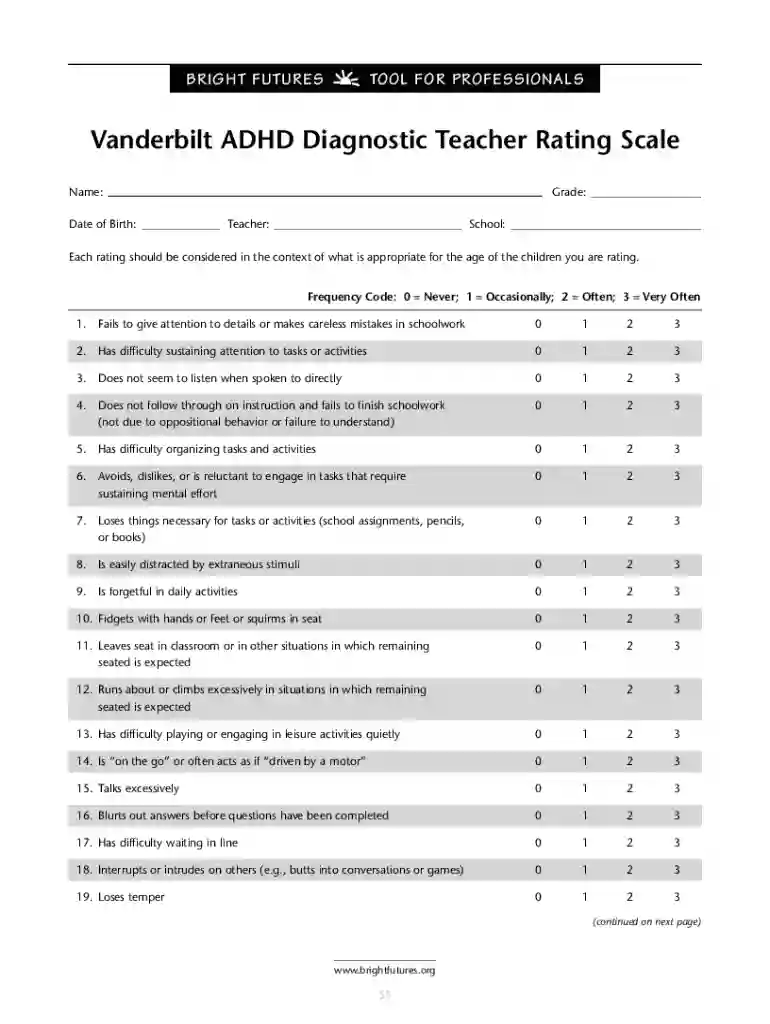
The Vanderbilt ADHD Questionnaire is a comprehensive tool used by healthcare professionals to assess symptoms of Attention-Deficit/Hyperactivity Disorder (ADHD) in children and adolescents. This instrument is designed to capture various behavioral dimensions associated with ADHD, including inattention, hyperactivity, and impulsivity. It typically comprises parent and teacher versions, allowing for a multifaceted view of the child's behavior in different environments.
The questionnaire measures specific behaviors that align with the diagnostic criteria for ADHD, as defined by the DSM-5. It assists clinicians not only in confirming a diagnosis but also in identifying co-occurring conditions such as oppositional defiant disorder, conduct disorders, anxiety, and depression. Through this tool, detailed insights are gained regarding a child's performance in academic settings and their social interactions, facilitating a broader understanding of their challenges.
Using the Vanderbilt ADHD Questionnaire involves several steps to ensure an accurate assessment. Healthcare providers typically guide parents and teachers through the process to guarantee that all relevant behaviors are reported accurately.
Administration: The questionnaire is divided into two sections: a parent rating scale and a teacher rating scale. Both forms should be completed independently to reduce bias.
Behavioral Rating: Respondents rate the frequency of specific behaviors on a Likert scale, ranging from "Never" to "Very Often". This allows for nuanced insight into the child's behavior patterns across different settings.
Compilation of Results: Each completed questionnaire is scored according to predetermined criteria. This scoring helps in comparing the child's behaviors against established benchmarks for ADHD.
Review by Clinician: The compiled results are then analyzed by a healthcare professional, who will discuss the findings with the child’s family and outline any potential next steps, including further assessments or treatments.
Key elements of the Vanderbilt ADHD Questionnaire are essential for understanding the depth of the assessment. These components contribute to a thorough evaluation of a child's ADHD symptoms and associated behaviors.
Behavioral Symptoms: The questionnaire evaluates core symptoms of ADHD, including:
Co-occurring Conditions: In addition to ADHD symptoms, the questionnaire assesses signs of other disorders that may complicate the child’s clinical picture, including:
Academic and Social Functioning: The assessment also examines how these behaviors impact the child’s performance in school and social interactions, offering valuable context for clinical decisions.
The process of completing the Vanderbilt ADHD Questionnaire is straightforward but should be approached with care to ensure accuracy.
Distribute the Questionnaire: Provide both the parent and teacher versions of the questionnaire to the respective respondents. Ensure they have a quiet environment to facilitate reflection.
Explain Scoring System: Clearly outline the response scale (from "Never" to "Very Often") to ensure consistent understanding among all respondents.
Encourage Honest Responses: Stress the importance of answering based on observations rather than personal feelings about the child to maintain objectivity.
Submit Completed Forms: Once both questionnaires are completed, collect them and prepare them for review by a qualified healthcare provider.
Discussion of Findings: Schedule a follow-up appointment to discuss the results with the healthcare provider and consider further steps for diagnosis or intervention.
Real-world applications of the Vanderbilt ADHD Questionnaire illustrate its utility in clinical practice, enhancing the diagnosis and treatment of ADHD.
School Evaluations: A school psychologist may use the questionnaire to gather input from teachers about a student struggling academically and behaviorally to confirm possible ADHD and plan appropriate interventions.
Clinical Assessments: Pediatricians might employ the Vanderbilt ADHD Questionnaire during routine checkups when parents express concerns about their child’s behavior at home and school.
Treatment Planning: Mental health professionals can use results from the questionnaire to tailor interventions by identifying specific behavioral challenges that need to be addressed.
Each of these examples emphasizes the importance of a structured, evidence-based approach to evaluating ADHD through multiple perspectives, supporting comprehensive care.
Understanding terminology associated with the Vanderbilt ADHD Questionnaire enhances effective communication between healthcare providers and families. Key terms include:
ADHD (Attention-Deficit/Hyperactivity Disorder): A neurodevelopmental disorder characterized by symptoms of inattention, hyperactivity, and impulsivity.
DSM-5: The Diagnostic and Statistical Manual of Mental Disorders, Fifth Edition, which provides standardized criteria for diagnosing mental health conditions.
Behavioral Rating Scale: A standardized form used to objectively assess the frequency and impact of specific behaviors related to ADHD and other disorders.
Comorbidity: The presence of one or more additional disorders co-occurring alongside ADHD, highlighting the complexity of diagnosis and treatment.
Familiarity with these terms supports discussions about the questionnaire and the broader context of ADHD assessment and management.
At DocHub, your data security is our priority. We follow HIPAA, SOC2, GDPR, and other standards, so you can work on your documents with confidence.
A tool for assessing ADHD. Source: NICHQ, American Academy of Pediatrics. For Providers. CPAN PeriPAN ADHD Anxiety Depression SAFETY-A.Read more
Vanderbilt Assessment Scale: Designed for usage in kids, assessing ADHD symptoms and related behavioral issues.Adult ADHD Self-Report Scale (ASRS): A self-
Vanderbilt ADHD Diagnostic Parent Rating Scale. Page 1 of 3. VANDERBILT ADHD DIAGNOSTIC PARENT RATING SCALE. Childs Name: Todays Date: Date of Birth: AgeRead more


