
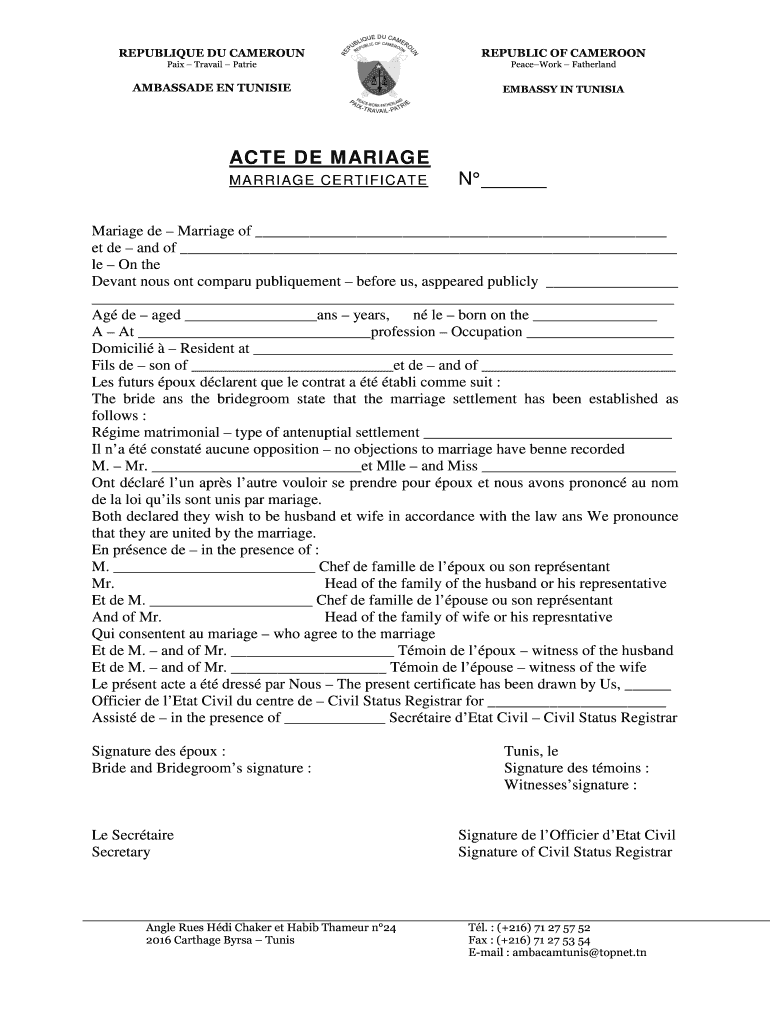







Definition and Importance of the Acte de Mariage Cameroun
The acte de mariage camerounais is an official document that serves as proof of marriage under Cameroonian law. This document is indispensable for individuals looking to establish their marital status legally. It outlines key details, such as the names of the parties involved, their identities, and information regarding the witnesses and authorities who officiated the marriage.
The acte de mariage holds significant legal weight, as it is often required for a variety of processes, including but not limited to, changing one's name, applying for spousal benefits, and legal documentation for immigration purposes. Understanding its importance is crucial for ensuring compliance with legal standards in Cameroon and for securing rights and benefits that accompany marital status.
Steps to Obtain the Acte de Mariage Cameroun
Acquiring the acte de mariage involves a series of steps, which may vary based on specific circumstances and the locality within Cameroon. Below is a detailed outline of the typical process:
-
Marriage Registration: Couples must first register their marriage with the appropriate local authorities. This generally takes place at the town hall or relevant government offices.
-
Documentation Preparation: Required documents for marriage registration often include:
- Valid identification (passport or national ID)
- Proof of residency
- Any required certificates of celibacy or single status
-
Ceremony and Witnesses: The couple must formally conduct a marriage ceremony. Two witnesses are typically required, and they must also provide identification.
-
Application Submission: Following the ceremony, the completed marriage registration application, along with the supporting documents, must be submitted to the relevant registry.
-
Processing Time: After submission, the registry will process the application, which may take several days to weeks, depending on local procedures.
-
Receiving the Acte de Mariage: Once approved, the official acte de mariage will be issued to the couple, confirming their marriage status.
Key Elements of the Acte de Mariage Cameroun
The acte de mariage should contain several essential elements to be considered valid. These key components typically include:
- Personal Information: Names, ages, nationalities, and occupations of both spouses.
- Witness Information: Names and identification details of the witnesses present at the marriage.
- Date and Place of Marriage: The specific date and venue where the marriage ceremony took place.
- Legal Authority Details: Information regarding the official who conducted the marriage ceremony, including their title and registration number.
- Additional Notes: Any customizations or special conditions associated with the marriage, particularly in cases of customary marriages.
Collectively, these elements ensure the document's authenticity and legal strength, providing necessary evidence of the marital union.
Legal Use of the Acte de Mariage Cameroun
The acte de mariage is legally binding and is recognized in various legal contexts. These contexts include:
- Family Law Cases: In the event of a divorce or separation, the acte de mariage serves as a critical piece of evidence regarding marital status and obligations.
- Immigration Applications: Spouses may need to provide a copy of their acte de mariage to validate relationships during visa applications or residency applications in foreign countries.
- Inheritance Matters: The document often plays a crucial role in determining rightful heirs and beneficiaries in cases of probate.
Understanding the legal implications of this document allows married individuals to navigate their rights effectively and ensure compliance with legal requirements in both domestic and international scenarios.
Examples of Using the Acte de Mariage Cameroun
The acte de mariage has practical applications in numerous everyday situations. Here are specific examples:
-
Changing a Name: A spouse may need to present the acte de mariage to legally change their surname after marriage.
-
Applying for Spousal Benefits: For access to health benefits or insurance plans that apply to spouses, individuals may have to submit a copy of their acte de mariage.
-
Child Registration: When registering a child's birth, parents may be required to present their acte de mariage as proof of their marital status.
-
Joint Bank Accounts: Banks often request a copy of the acte de mariage when couples wish to open joint accounts or apply for joint loans.
These examples illustrate how essential the acte de mariage is in various legal and administrative processes, emphasizing its role as a fundamental legal document for married couples.
Important Terms Related to the Acte de Mariage Cameroun
Understanding the terminology surrounding the acte de mariage can enhance clarity when navigating legal requirements. Key terms include:
-
Certificat de Mariage: This refers generally to a marriage certificate, synonymous with the acte de mariage in many contexts.
-
Mariage Civil: A civil marriage, governed by state laws, requires documentation and is formally recognized by the government.
-
Mariage Coutumier: A customary marriage, based on traditional practices, which may involve different requirements and documentation.
-
Publication des Bans: This entails a public announcement of the upcoming marriage intended to inform the community and allow for any objections.
Familiarity with these terms aids individuals in understanding the complexities of marriage laws and regulations in Cameroon, ensuring they can effectively fulfill all legal requirements.
Differences Between Acte de Mariage and Certificat de Mariage
It is essential to distinguish between the acte de mariage and a certificat de mariage, which are often confused. The acte de mariage is the initial legal record of the marriage, detailing its official registration and elements, while a certificat de mariage may simply serve as a document confirming the existence of that marriage without the same legal weight.
In most cases, the certificat can be requested from the relevant authority after the marriage has been registered with the acte de mariage and is often used for more general purposes such as verification, as opposed to the acte de mariage, which is necessary for legal proceedings.
Understanding these distinctions empowers individuals to engage appropriately with their documentation needs regarding marriage.




