Ottawa self-injury inventory - Non-suicidal Self Injury in Youth - insync-group 2026

Get Form
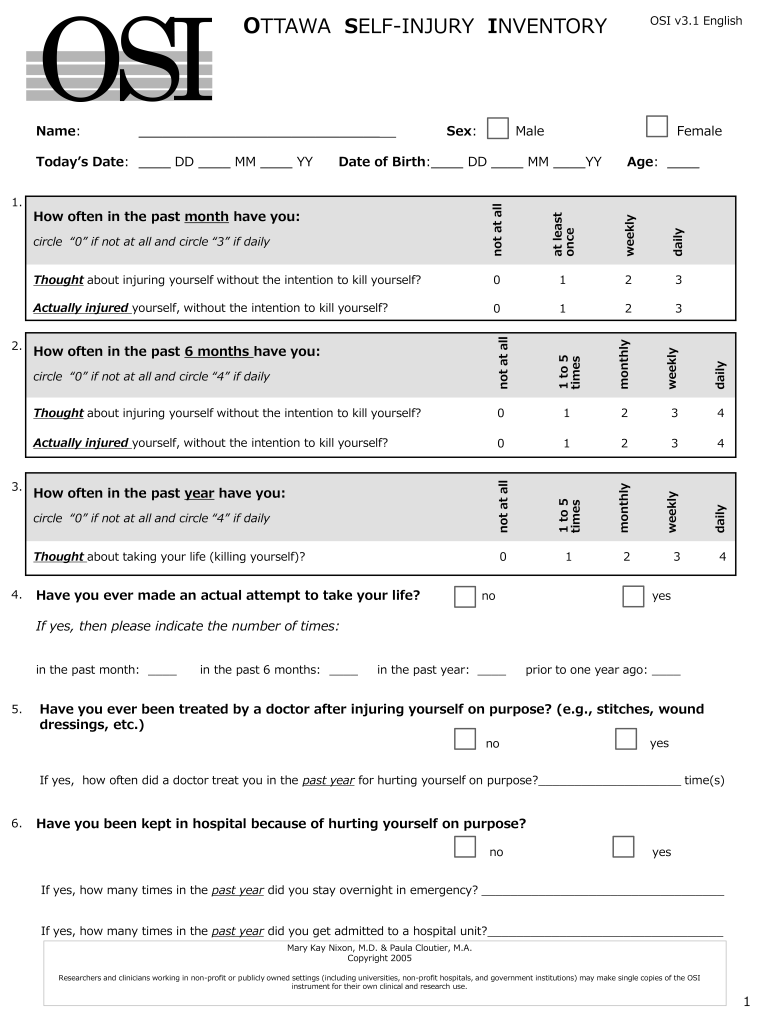
ottawa self injury inventory Preview on Page 1

Here's how it works

01. Edit your ottawa self injury inventory online
Type text, add images, blackout confidential details, add comments, highlights and more.
02. Sign it in a few clicks
Draw your signature, type it, upload its image, or use your mobile device as a signature pad.
03. Share your form with others
Send it via email, link, or fax. You can also download it, export it or print it out.

How to use or fill out Ottawa self-injury inventory - Non-suicidal Self Injury in Youth - insync-group with our platform

Form edit decoration
9.5
Ease of Setup
DocHub User Ratings on G2
9.0
Ease of Use
DocHub User Ratings on G2
  1. Click ‘Get Form’ to open the Ottawa self-injury inventory in the editor.
  2. Begin by entering your personal information, including your name, age, and date of birth. This information is crucial for accurate assessment.
  3. Proceed to the first section where you will indicate how often you have thought about or engaged in self-injury over various time frames. Use the scale provided (0-4) to reflect your experiences honestly.
  4. In subsequent sections, answer questions regarding past attempts at self-harm and any medical treatment received. Be sure to circle the appropriate responses as indicated.
  5. Continue through the form, providing details on triggers for self-injury and coping mechanisms. This information can be vital for understanding patterns and seeking help.
  6. Once completed, review your answers for accuracy before saving or sharing your responses directly from the editor.

Engage with our platform today to complete your Ottawa self-injury inventory easily and securely!

be ready to get more

Complete this form in 5 minutes or less

Get form

Got questions?

We have answers to the most popular questions from our customers. If you can't find an answer to your question, please contact us.
Contact us
Several interventions appear to hold promise for reducing NSSI, including dialectical behaviour therapy, emotion regulation group therapy, manual-assisted cognitive therapy, dynamic deconstructive psychotherapy, atypical antipsychotics (aripiprazole), naltrexone, and selective serotonin reuptake inhibitors (with or
How DBT Therapy Can Help Reduce Self Harm Developing Distress Tolerance Skills. Enhancing Emotion Regulation. Increasing Mindfulness Practice. Improving Interpersonal Effectiveness. Cultivating Self-Compassion. Addressing Underlying Trauma. Creating Safety Plans. Promoting Commitment to Treatment.
These factors encompass sex, physical symptoms (eg, disabilities and sleep problems), mental disorders, low health literacy, adverse childhood experiences, bullying, and problem behaviors. Regarding personal factors, a mental disorder diagnosis may heighten the risk of NSSI18.
Therapeutic approaches such as dialectical behaviour therapy (DBT) and cognitivebehavioural therapy (CBT), and emotion-regulation training may all be used to treat adolescents who self-harm. Both DBT and CBT have been adapted to in-patient settings and have been shown to reduce self-harming behaviours in adolescents.
The good news is that there is a highly effective treatment approach for those that engage in NSSI behaviors. The first-line of treatment is Dialectical Behavioral Therapy (DBT), medications, or both.

Security and compliance

At DocHub, your data security is our priority. We follow HIPAA, SOC2, GDPR, and other standards, so you can work on your documents with confidence.

Learn more
ccpa2
pci-dss
gdpr-compliance
hipaa
soc-compliance
be ready to get more

Complete this form in 5 minutes or less

Get form

People also ask

The diagnostic criteria for NSSID in the DSM-5 (American Psychiatric Association, 2013) include the following: (1) engagement in NSSI on 5 or more days in the past year (Criterion A); (2) the expectation that NSSI will solve an interpersonal problem, provide relief from unpleasant thoughts and/or emotions, or induce a
Coping Strategies When You Feel Like Self-Harming Check in with yourself. Get outside. Time with others. Talk to someone. Turn up the volume. Try guided imagery. Be creative. Harm minimization.

Related links