






Definition and Meaning of Questions for Free Falling Bodies
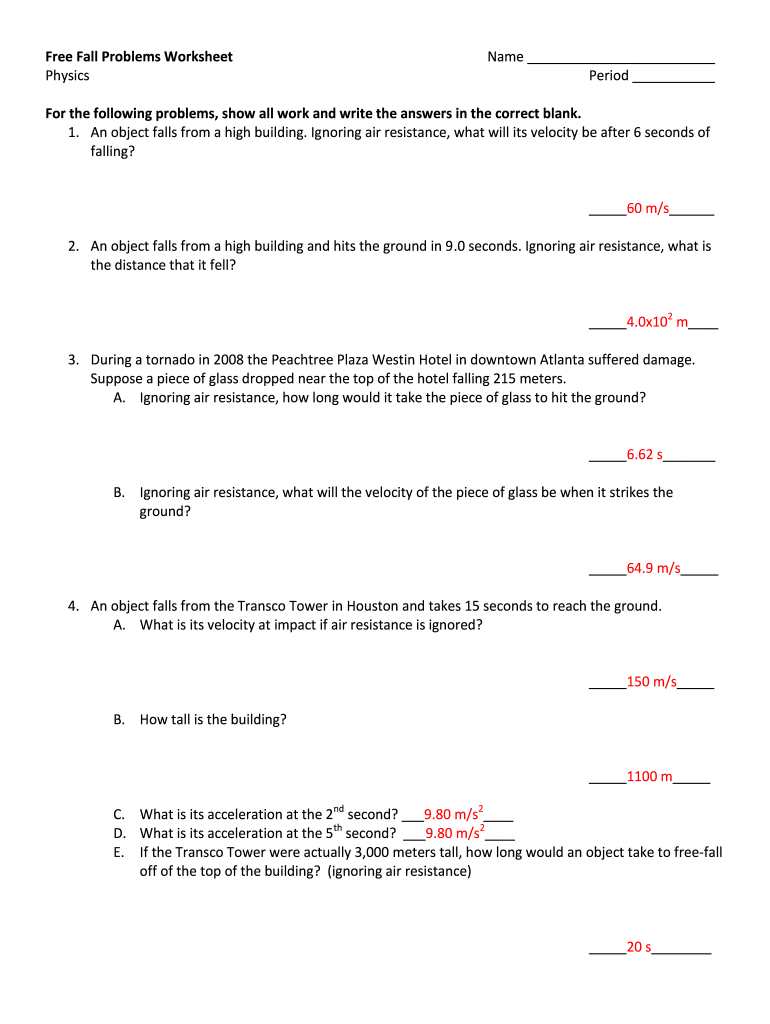
The term "questions for falling bodies" refers to a set of physics problems focused on the motion of objects in free fall under the influence of gravity, neglecting air resistance. These questions often require calculations related to velocity, distance, and time to understand the fundamental principles guiding gravitational acceleration. It is an essential topic in physics education, often included in curriculums to illustrate the laws of motion as described by Isaac Newton.
How to Use the Questions for Free Falling Bodies
Using questions related to free falling bodies typically involves several steps that guide students through the problem-solving process effectively. Here’s how to utilize these questions:
- Identify the Problem: Read the question carefully to determine what is being asked. Common problems might involve calculating the time taken for an object to hit the ground or the final velocity of an object just before impact.
- Gather Known Values: Note down all given values such as initial velocity (often zero when dropped), distance, and acceleration due to gravity (approximately 9.81 m/s² on Earth).
- Select the Appropriate Equations: Use relevant physics equations like ( d = vt ) or ( v^2 = u^2 + 2as ), where:
- ( d ) = distance,
- ( v ) = final velocity,
- ( u ) = initial velocity,
- ( a ) = acceleration,
- ( t ) = time.
- Calculate: Substitute the known values into the equation and solve step by step.
- Interpret the Results: Finally, analyze the calculated results in the context of the question to ensure they make sense.
By following these steps, students gain a deeper understanding of free fall dynamics.
Examples of Using the Questions for Free Falling Bodies
Sample scenarios illustrating the use of questions related to free falling bodies can clarify their application:
-
Example 1: Dropping an Object from a Height
A stone is dropped from a height of 20 meters. To find the time taken to reach the ground:- Known values: ( d = 20 ) m, ( u = 0 ) m/s, ( a = 9.81 ) m/s².
- Using the equation ( d = ut + \frac{1}{2}at^2 ):
- Rearranging yields ( 20 = 0 + \frac{1}{2} * 9.81 * t^2 ),
- Solving this gives ( t \approx 2.02 ) seconds.
-
Example 2: Object Thrown Downwards
A ball is thrown downward with an initial speed of 5 m/s from a height of 30 meters.
To find how long it takes to hit the ground:- Known values: ( u = 5 ) m/s, ( d = 30 ) m, ( a = 9.81 ) m/s².
- Using ( d = ut + \frac{1}{2}at^2 ), an appropriate calculation method will yield the time taken.
These examples demonstrate practical applications of the physics concepts underlying free fall.
Key Elements of Free Falling Body Questions
Understanding the key elements involved in questions related to free falling bodies enhances comprehension and problem-solving:
- Acceleration Due to Gravity (g): This constant is approximately 9.81 m/s² on Earth and is critical for calculations.
- Initial Velocity (u): Determines the starting speed of the object; in free fall, this is often zero unless specified.
- Distance (d): The vertical distance an object falls, which directly affects time and final velocity.
- Final Velocity (v): This is calculated at the moment just before impact, using the equations of motion.
By focusing on these elements, students can systematically tackle free falling problems.
Important Terms Related to Free Falling Bodies
Familiarizing oneself with important terms related to free falling bodies is essential for grasping the underlying principles:
- Free Fall: The motion of a body where gravity is the only force acting upon it.
- Air Resistance: Often neglected in calculations for simplicity, though it can affect an object's acceleration in real scenarios.
- Kinematics: The area of physics that describes the motion of objects, including displacement, velocity, and acceleration.
- Projectile Motion: A type of motion experienced by an object thrown or projected into the air, influenced by gravity.
Understanding these terms helps create a solid foundation for understanding and solving questions about falling bodies.
Why Should You Study Free Falling Bodies?
Studying free falling bodies is pivotal for several reasons:
- Fundamental Physics Concepts: It forms the basis for understanding fundamental concepts in physics such as gravity, motion, and forces.
- Real-World Applications: Knowledge of free fall principles applies to various real-life scenarios, such as safety regulations in construction or understanding atmospheric entry for spacecraft.
- Preparation for Advanced Topics: Mastery of this topic lays the groundwork for more complex studies in mechanics, aerodynamics, and engineering fields.
By engaging with questions and problems related to free falling bodies, students build critical analytical skills that are applicable in scientific and engineering domains.