




How to fill out a minnesota standard residential purchase agreement 2026

Get Form
real estate contract for sale by owner Preview on Page 1

Here's how it works

01. Edit your real estate contract for sale by owner online
Type text, add images, blackout confidential details, add comments, highlights and more.
02. Sign it in a few clicks
Draw your signature, type it, upload its image, or use your mobile device as a signature pad.
03. Share your form with others
Send for sale by owner contract via email, link, or fax. You can also download it, export it or print it out.

Understanding the Minnesota Standard Residential Purchase Agreement

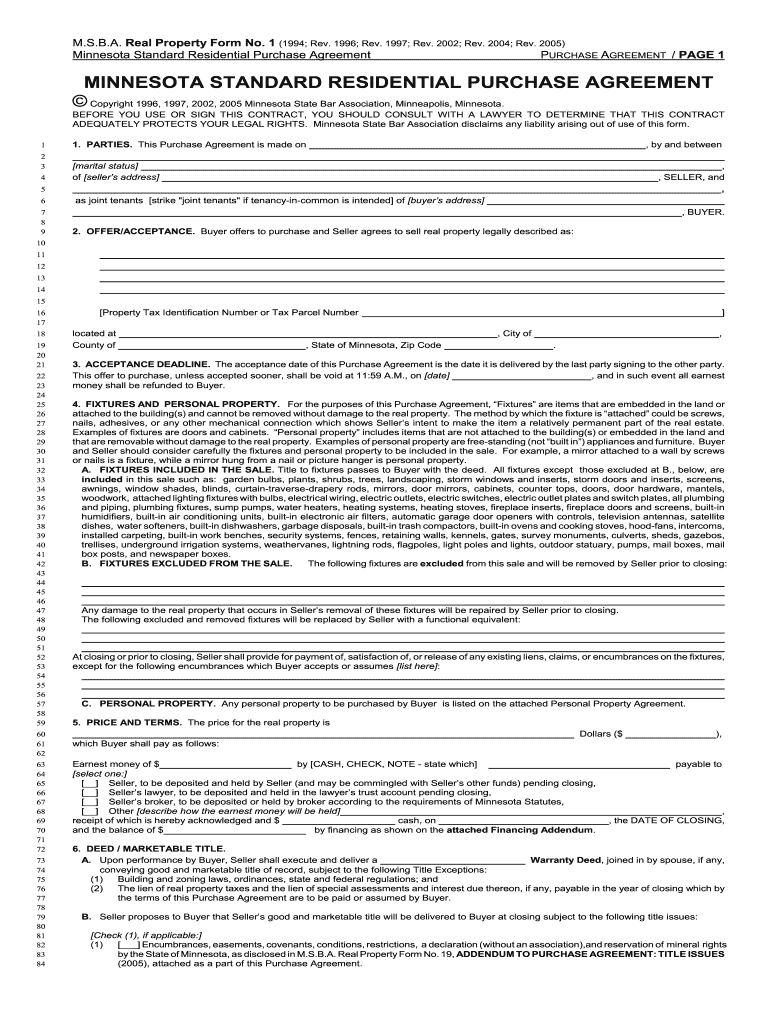
The Minnesota Standard Residential Purchase Agreement is a legal document critical for real estate transactions in Minnesota. This form delineates the terms and conditions between buyers and sellers, ensuring all parties understand their rights and obligations before proceeding with a property transfer. The agreement includes vital details such as property information, sale price, and key dates—elements essential for a legally binding transaction.

Key Components of the Agreement

Parties Involved

  • Buyer and Seller Details: The agreement starts by identifying the buyer and seller, including their legal names and contact information. This ensures clarity about who is legally bound by the contract terms.
  • Third Parties: There might be references to agents or attorneys representing either party, depending on the complexity of the sale.

Property Description

A precise description of the residential property is included, covering the legal address, size, and unique identifiers like lot numbers. This section is crucial for ensuring the exact property details are reflected in the agreement to avoid future disputes.

Financial Terms

  • Purchase Price: This section outlines the total agreed-upon price for the property.
  • Payment Terms: Details about the deposit amount, balance payment, and financing conditions are outlined, ensuring both parties are aware of how and when payments occur.

Fixtures and Personal Property

The agreement specifies which fixtures and personal property are included in the sale. Items such as appliances or installed systems need to be explicitly mentioned to prevent misunderstandings post-sale.

Legal Requirements and Compliance

Disclosures and Contingencies

The seller is required to disclose any known issues with the property, such as structural problems or legal issues. This is not only a legal requirement but also an ethical part of the transaction to ensure transparency.

  • Contingencies: The agreement may include conditions that must be met before the sale can proceed, such as passing a property inspection or securing financing.

Seller’s Warranties

These are assurances from the seller regarding the property's condition and the absence of legal encumbrances. Understanding these guarantees helps the buyer make informed decisions.

Steps to Complete the Purchase Agreement

  1. Read the Document Thoroughly: Before filling out any sections, both parties should read and understand the entire agreement.
  2. Fill in Basic Information: Begin by entering the names of the buyer and seller, followed by property details and financial terms.
  3. Include Earnest Money Details: Specify the amount of earnest money, who will hold it, and conditions for its return.
  4. Define Closing Procedures: Agree on a closing date and procedures, including any specific actions both parties need to complete beforehand.
  5. Review Legal Disclosures: Ensure all necessary disclosures have been included and both parties agree to the terms.

State-Specific Considerations

Minnesota-Specific Rules

Minnesota state laws might necessitate specific disclosures or conditions, such as those concerning local environmental laws or regional taxes. Buyers and sellers should be aware of these rules to ensure compliance and avoid legal repercussions.

Common Use Cases and Scenarios

Typical Users

This form is predominantly used by home buyers and sellers, real estate agents, and legal professionals involved in residential property transactions. Understanding who commonly uses the agreement can provide insights into how it simplifies real estate processes.

Practical Examples

  • First-Time Home Buyers: They often rely on this standardized form to streamline their home purchasing experience, ensuring all legal necessities are covered.
  • Real Estate Investors: For investors, the form provides clarity and consistency across multiple transactions, aiding in managing numerous property deals efficiently.

Important Considerations

Legal Consultation

While the purchase agreement provides a comprehensive framework, consulting a legal expert is advisable to address any specific concerns or state-specific requirements, especially in complex property deals.

Digital vs. Paper Versions

Using platforms like DocHub can simplify the completion and signing of the purchase agreement digitally, enhancing ease of use and secure document handling. Digital forms offer real-time collaboration and editing features, which can be advantageous for busy professionals.

Conclusion

The Minnesota Standard Residential Purchase Agreement is a foundational document that facilitates transparent and smooth real estate transactions. It ensures all terms and conditions are agreed upon by both parties, safeguarding their rights and outlining duties throughout the buying or selling process. Comprehensively understanding and accurately completing this form is vital for a successful residential property transaction in Minnesota.

be ready to get more

Complete this form in 5 minutes or less

Get form

Got questions?

We have answers to the most popular questions from our customers. If you can't find an answer to your question, please contact us.
Contact us
For example, in terms of real estate, a handwritten contract (e.g. buying a house) is perfectly legally binding as long as both parties provide a signature.Apr 10, 2025
Yes, you can write your own purchase agreement, as its a legal document that doesnt strictly require a lawyer, but its generally not recommended for complex transactions like real estate without professional review due to DocHub legal risks, as its easy to miss crucial clauses, state-specific requirements, or unintentionally create unfavorable terms, which can lead to costly disputes. Using standardized templates or seeking help from a real estate agent or lawyer is usually best to ensure its clear, enforceable, and protects both parties. When You Might Write Your Own (Simple Transactions) Private Sales: For simple, low-value transactions where both parties are knowledgeable and agreeable. Basic Terms: If the deal involves straightforward terms, minimal contingencies, and no complex assets. Key Elements to Include Regardless of who writes it, a valid agreement needs: Parties Details: Full names and addresses of buyer and seller. Property Description: Legal description and address. Financial Terms: Purchase price, deposit amount, payment method. Conditions/Contingencies: Financing approval, inspections, sale of another property, etc. Dates: Closing date, possession date, acceptance deadline. Signatures: Legally binding when signed by all parties. Why Professional Help is Recommended (Especially for Real Estate) Legal Complexity: Real estate laws vary by state, and agreements have specific legal jargon. Risk Management: Agents and lawyers have insurance (Errors Omissions) for mistakes, which you wont have if you draft it yourself. Avoiding Pitfalls: Prevents missing essential clauses or unenforceable terms that could cost you dearly later. Best Practices Use Templates Wisely: Start with reputable templates (from legal sites, agents) but customize carefully. Get a Lawyers Review: Have an attorney review any agreement before signing, especially for DocHub purchases, to ensure it meets all legal needs and protects you. AI can make mistakes, so double-check responsesHow to draft a purchase agreement - DocHubApr 28, 2025 Can I write my own purchase agreement? Yes, you can absolutely write your own purchase agreement! But starting from scDocHubWhat is a real estate purchase agreement? - Rocket MortgageJun 20, 2025 Can I write my own purchase agreement? In theory, yes: Youre free to do so, given that a buyer or seller is allowed tRocket Mortgage
How to write a real estate purchase agreement. Identify the address of the property being purchased, including all required legal descriptions. Identify the names and addresses of both the buyer and the seller. Detail the price of the property and the terms of the purchase. Set the closing date and closing costs.
Every purchase agreement form should include these core elements: Parties. Full legal names and mailing addresses of both buyer and seller. Item or Property Description. Be specific. Purchase Price and Payment Method. Closing Date. Contingencies. Disclosures. 6 days ago
If youre asking whether you need a lawyer to draft a contract, legally, the answer is no. Anyone can draft a contract on their own and as long as the elements above are included and both parties are legally competent and consent to the agreement, it is generally lawful.

Security and compliance

At DocHub, your data security is our priority. We follow HIPAA, SOC2, GDPR, and other standards, so you can work on your documents with confidence.

Learn more
ccpa2
pci-dss
gdpr-compliance
hipaa
soc-compliance
be ready to get more

Complete this form in 5 minutes or less

Get form

People also ask

A valid real estate contract needs competent parties, a legal purpose, a clear offer and acceptance (meeting of the minds), consideration (value exchanged like money), and must be in writing and signed, ensuring all parties understand and agree to the terms, with specifics like property description and closing details included for enforceability. Here are the 5 core elements: Competent Parties: Both buyer and seller must be of legal age, sound mind, and not under duress, ensuring they have the legal capacity to enter the agreement. Legal Purpose: The contracts goal must be lawful, meaning it cant involve illegal activities or property use. Offer and Acceptance (Mutual Assent): One party makes a clear offer, and the other accepts it unequivocally, creating a meeting of the minds on the property and terms. Consideration: Something of value exchanged, typically the agreed-upon purchase price, but also includes other promises or items of value. Written Signed (Statute of Frauds): While verbal agreements can exist, real estate contracts must be in writing and signed by all parties to be enforceable, as required by the Statute of Frauds. Other Key Components for a Strong Contract: Property Description: A precise legal description, not just a street address. Contingencies: Conditions like financing, inspections, or appraisal that must be met. Disclosures: Required seller disclosures about property conditions. Timelines: Deadlines for inspections, financing, and closing. AI can make mistakes, so double-check responses5 Essential Elements of a Real Estate ContractLegally Competent Parties: The parties involved in the contract must be legally competent, meaning they are of legal age and have Eagle Property ManagementEssential Elements of a Real Estate Contract - RedfinAug 21, 2025 Essential elements of a real estate contract * Offer and acceptance. The buyer proposes an offer, and the seller mustRedfin
The short answer is yes, you can. In a lot of cases, you can create your own contract without a lawyer and have it hold up in court. The key is making sure it meets the legal requirements for validity. Many individuals and businesses create their own agreements all the time.Aug 20, 2025

mn purchase agreement for sale by owner