




01. Edit your osha respirator fit test form pdf online
Type text, add images, blackout confidential details, add comments, highlights and more.

Type text, add images, blackout confidential details, add comments, highlights and more.

Draw your signature, type it, upload its image, or use your mobile device as a signature pad.

Send fit test form via email, link, or fax. You can also download it, export it or print it out.
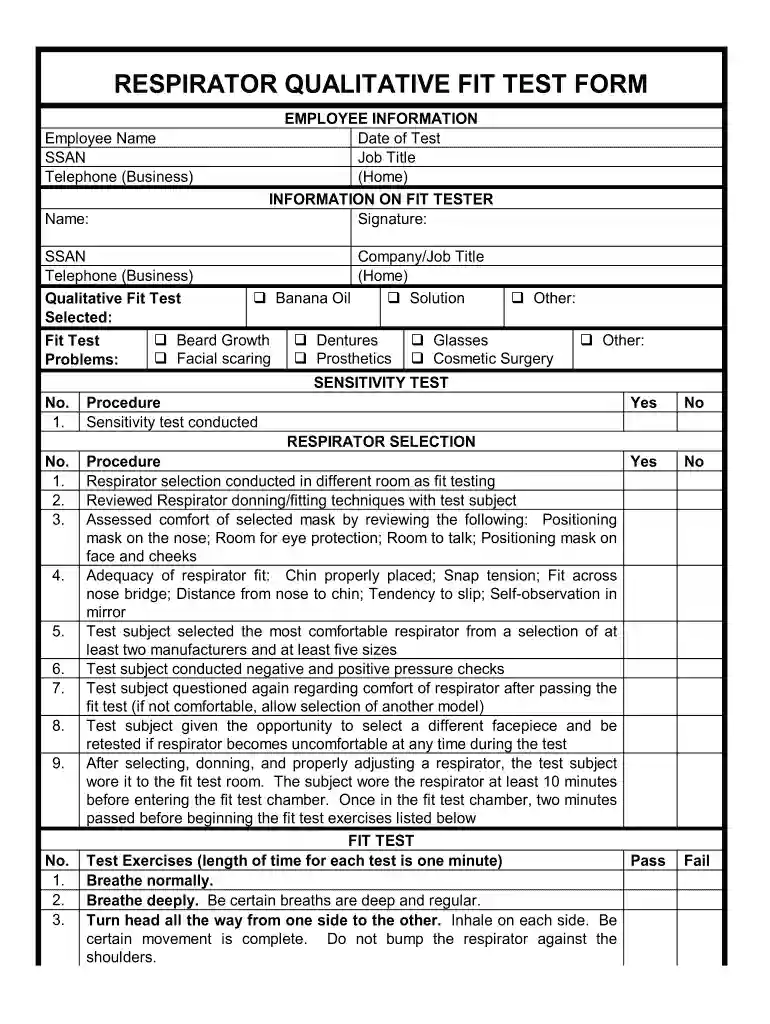
The respirator qualitative fit test form is a critical document used in occupational health and safety to assess the fit and effectiveness of respiratory protective equipment for employees. This form outlines various procedures that confirm the correct fit of respirators, ensuring that workers are adequately protected from airborne contaminants. It typically includes sections for recording employee information, test procedures, and verification of successful fit tests. The form serves as an official record that indicates compliance with safety regulations set forth by the Occupational Safety and Health Administration (OSHA).
Key components of the respirator qualitative fit test form include:
Understanding the definition and components of this form is essential for maintaining workplace safety and adhering to regulatory standards.
Using the respirator qualitative fit test form involves several structured steps to ensure accuracy and compliance. This process not only guarantees that employees are provided with appropriate protective gear but also fulfills regulatory obligations.
Utilizing this form effectively ensures that all legal requirements are met and helps maintain a safe work environment.
Understanding essential terms associated with the respirator qualitative fit test form enhances clarity regarding its use and significance in workplace safety.
Familiarity with these terms is fundamental for effective communication among safety professionals and workers.
Completing the respirator qualitative fit test form involves distinct steps that ensure all required information is accurately documented. Each step is crucial for validating the fit and effectiveness of respiratory protection.
These steps promote thorough documentation, helping companies remain compliant with OSHA regulations and enhancing employee safety.
The respirator qualitative fit test form is commonly used by various professionals and organizations, primarily in sectors where respiratory protection is crucial. Typical users include:
Identifying these users promotes better understanding and adherence to safety protocols associated with respirator use.


The legal use of the respirator qualitative fit test form is governed by regulations established by OSHA and other regulatory bodies. Compliance with these regulations is vital for maintaining workplace safety and avoiding legal repercussions.
Key legal aspects include:
Understanding these legal parameters aids organizations in designing effective safety management practices.
Sure, it is possible with DocHub. This secure and compliant online service features a phone-based signing option. Once you log in to your DocHub account and add your osha respirator fit test form to our editor, complete all empty fields and use the Sign tool on the upper barf. Click on Create your signature and select Phone from the available options. Here, you scan a QR code with your smartphone and draw your signature on your phone display, as you normally do when signing hard copies. If you access DocHub right from your mobile device, you can eSign your document by drawing your electronic signature, uploading its photo, or simply with a typed name.
Having a swift editing platform like DocHub, you do not need anything but a web browser and connection to the internet to edit your osha fit test form on the internet easily. Add your file or find the appropriate form in DocHub’s catalog, open our editor with one click, and complete it digitally. To revise your forms anytime, sign up a free account with DocHub.
At DocHub, your data security is our priority. We follow HIPAA, SOC2, GDPR, and other standards, so you can work on your documents with confidence.


I DocHub that the above named individual has been trained and qualitatively fit-tested in accordance with the guidelines established in the EPA RespiratoryRead more
Nov 7, 2022 Please Follow the 3m Qualitative Fit Test Instructions in the Fit Testing Kit. Qualitative Fit Testing Solution Used: Number of Bulb Squeezes toRead more
This qualitative fit test uses a persons response to the irritating chemicals released in the smoke produced by a stannic chloride ventilation smoke tube toRead more


