




01. Edit your release of claims template online
Type text, add images, blackout confidential details, add comments, highlights and more.

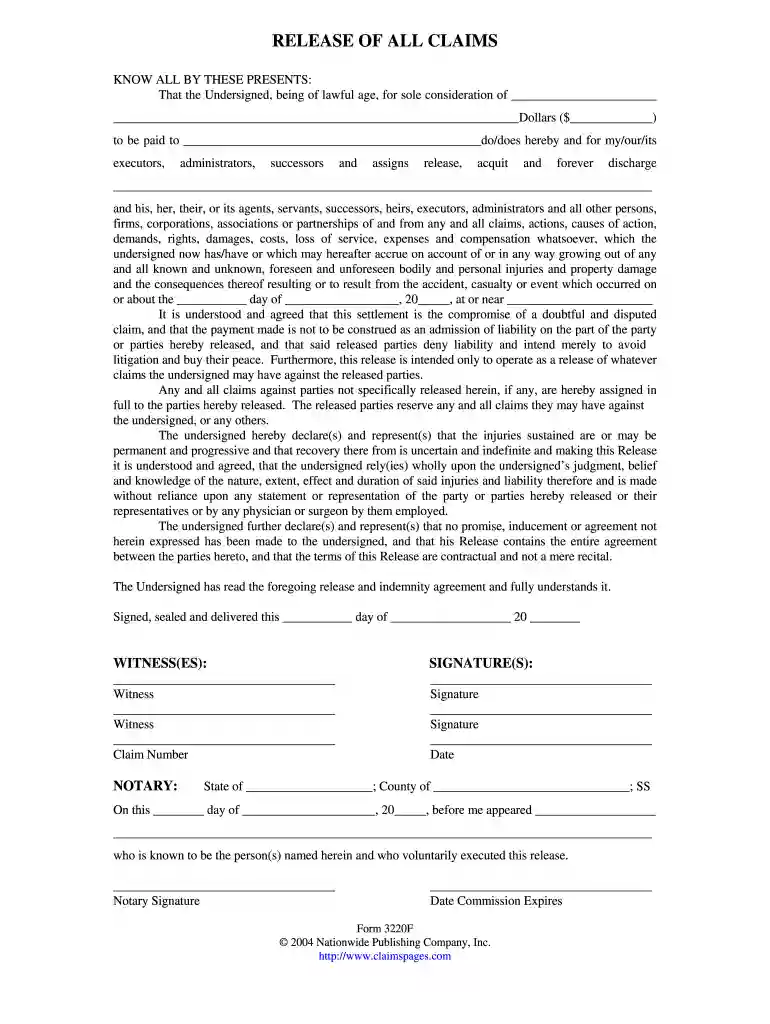
Type text, add images, blackout confidential details, add comments, highlights and more.

Draw your signature, type it, upload its image, or use your mobile device as a signature pad.

Send release of all claims form pdf via email, link, or fax. You can also download it, export it or print it out.
A simple release of claims all is a legal document that ensures one party discharges all claims against another party. This form is commonly utilized when there is a settlement agreement where one party agrees to relinquish their right to pursue any legal actions. The undersigned confirms that they understand the implications of signing the document, which might include waiving future claims related to past incidents. Importantly, the release typically emphasizes that it does not constitute an admission of liability by the party being released; rather, it serves as a mutual agreement to resolve disputes amicably.
In practical terms, this document is crucial in various situations, such as personal injury settlements or employment disputes, where one party agrees to tolerate certain conditions in exchange for compensation. By acknowledging the potential permanence of any injuries sustained and confirming understanding of the terms, the parties involved can move forward without the weight of unresolved claims.
Using a simple release of claims all involves several deliberate steps to ensure that both parties are fully aware of their rights and obligations. Starting with the identification of the parties involved, it is important to clearly state the names and relevant details of each party. The document should outline the specific claims being released and provide context around the reasons for the release.
After clearly articulating the terms, both parties must review the document to ensure understanding and agreement. Once satisfied, signatures from all involved parties are required in the presence of a notary public to add legal validity. An important aspect of this process is the acknowledgment and date of signing, which signifies that both parties are entering into this agreement voluntarily and without coercion.
A simple release of claims all is composed of essential components that must be present for the document to be legally binding. These elements include the identification of the parties, a clear statement of the claims being discharged, and an affirmation that the release is given voluntarily.
Each important term should be meticulously defined, ensuring there is no ambiguity regarding what is being released. Notably, the document should also state any compensation provided in exchange for the release to clarify the agreement’s terms. Moreover, including a clause that specifies the governing law can assist in outlining the jurisdiction under which any potential disputes will be resolved.
Completing a simple release of claims all requires careful attention to detail in the preparation and execution of the document. The following steps provide a structured approach:
Gather Necessary Information:
Draft the Release Document:
Review and Edit:
Signing Process:
Distribute Copies:
By following these steps, parties can ensure that the simple release of claims all is executed properly, thereby minimizing potential disputes in the future.
The simple release of claims all holds legal significance, especially in contexts where parties negotiate settlements to avoid litigation. It is essential for protecting the interests of both parties involved by providing a clear framework for the resolution of disputes without further legal engagement. By signing this document, the releasing party essentially agrees to relinquish their right to seek any future remedies related to the claims specified in the document.
Various legal scenarios necessitate the use of this form, such as settlement agreements in employment cases, personal injury claims, or any dispute resolution involving potential liability. It is important to remember that while the release absolves one party of further claims, it still must adhere to state-specific legal requirements to be enforceable.
At DocHub, your data security is our priority. We follow HIPAA, SOC2, GDPR, and other standards, so you can work on your documents with confidence.
The FDIC-R releases the Released Parties, their respective agents, employees, attorneys, successors and assigns from all possible claims, rights, interests,Read more
This release covers all Claims arising from the beginning of time up to and including the date of this Agreement. Exclusions: Notwithstanding any otherRead more


