
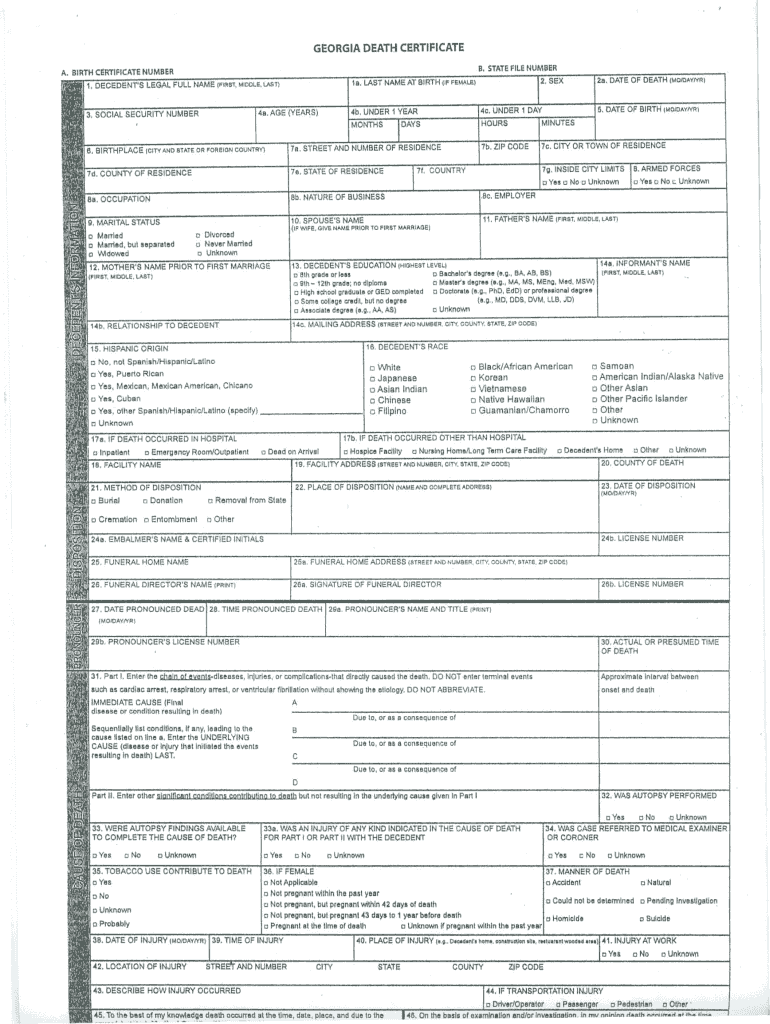







Understanding the Georgia Death Certificate
The Georgia death certificate is an official document that indicates the passing of an individual. It contains essential information required for legal, personal, and financial purposes. Understanding the components and uses of this important document is pivotal for both the bereaved and those involved in legal or medical matters.
Key Elements of the Georgia Death Certificate
A Georgia death certificate includes several critical fields that must be accurately completed. These fields generally encompass:
- Decedent’s Information: Full name, date of birth, and age at death.
- Parental Details: Names of the deceased's parents, providing vital genealogical information.
- Place of Death: The specific location where the individual passed, which can include hospitals or other facilities.
- Cause of Death: Documentation outlining the medical reasons leading to the death, which may require a certified medical professional's input.
- Pronouncement of Death: Details regarding who declared the individual deceased, often including the attending physician's name and signature.
- Autopsy Information: If an autopsy was performed, this section captures pertinent details regarding the procedure.
Obtaining a Copy of the Georgia Death Certificate
To secure a copy of a Georgia death certificate, the following steps are usually required:
- Eligibility: Individuals eligible to request a death certificate typically include immediate family members, legal representatives, or those with a legitimate interest.
- Application Submission: An application form must be completed. This form can often be found on the Georgia Department of Public Health website or through local health departments.
- Identification: Valid identification is necessary to confirm the requester’s identity. Accepted forms may include a driver's license or passport.
- Payment of Fees: A fee is usually associated with obtaining the certificate, which can vary by location. Payment methods typically include checks or money orders.
Importance of the Georgia Death Certificate
The Georgia death certificate serves multiple critical functions, including:
- Legal Requirements: It is often required for settling estates, insurance claims, and burial permits.
- Genealogical Records: Researchers and families may rely on death certificates to trace family history and understand ancestral origins.
- Public Health Records: Data collected are invaluable for public health statistics, allowing authorities to analyze mortality trends within populations.
Variants of the Georgia Death Certificate
There might be different types of death certificates, including:
- Long Form: This comprehensive version includes detailed medical and demographic data.
- Short Form: A condensed document that provides limited information for less formal needs.
- Amendments: In instances where information was initially entered incorrectly, amendment processes are in place to correct vital details on death certificates.
Legal Aspects Surrounding the Georgia Death Certificate
Legally, the Georgia death certificate holds significant weight. It is recognized as a formal record that verifies a person's death and affirms the event's legal standing. Additionally:
- Confidentiality: Certain details contained within the death certificate may be confidential and restricted from public view for specified periods.
- Compliance: Failing to obtain or provide a death certificate when necessary can lead to legal complications, especially in matters pertaining to estates or benefits.
Filling Out the Georgia Death Certificate Form
When completing the Georgia death certificate form, attention must be paid to the following:
- Accuracy: All entries must reflect true and correct information to avoid legal issues or delays.
- Signature: The form must be signed by authorized personnel, typically a medical examiner or attending physician.
- Filing: The completed form must be filed with the local vital records office within a stipulated period after death, ensuring timely processing and documentation.
Common Uses for the Georgia Death Certificate
Various entities and individuals utilize the Georgia death certificate for multiple purposes, including:
- Insurance Claims: Beneficiaries may need a death certificate to initiate claims with life insurance companies.
- Estate Settlements: Executors of estates require the certificate to manage the decedent's affairs legally.
- Banking Transactions: Financial institutions often request a death certificate for operations involving joint accounts or estate accounts.
Potential Challenges in Managing a Georgia Death Certificate
Engaging with a Georgia death certificate can pose several challenges, such as:
- Administrative Delays: Sometimes, processing requests for death certificates can take longer than anticipated due to high volumes or errors in submitted forms.
- Disputes: Legal disputes may arise regarding eligibility for obtaining death certificates, especially in complex familial situations.
These complexities underscore the necessity for individuals to approach the process with care and informed awareness, ensuring that they meet all criteria and understand the implications of the Georgia death certificate.




