




01. Edit your quadas 2 template online
Type text, add images, blackout confidential details, add comments, highlights and more.

Type text, add images, blackout confidential details, add comments, highlights and more.

Draw your signature, type it, upload its image, or use your mobile device as a signature pad.

Send quadas 2 checklist via email, link, or fax. You can also download it, export it or print it out.
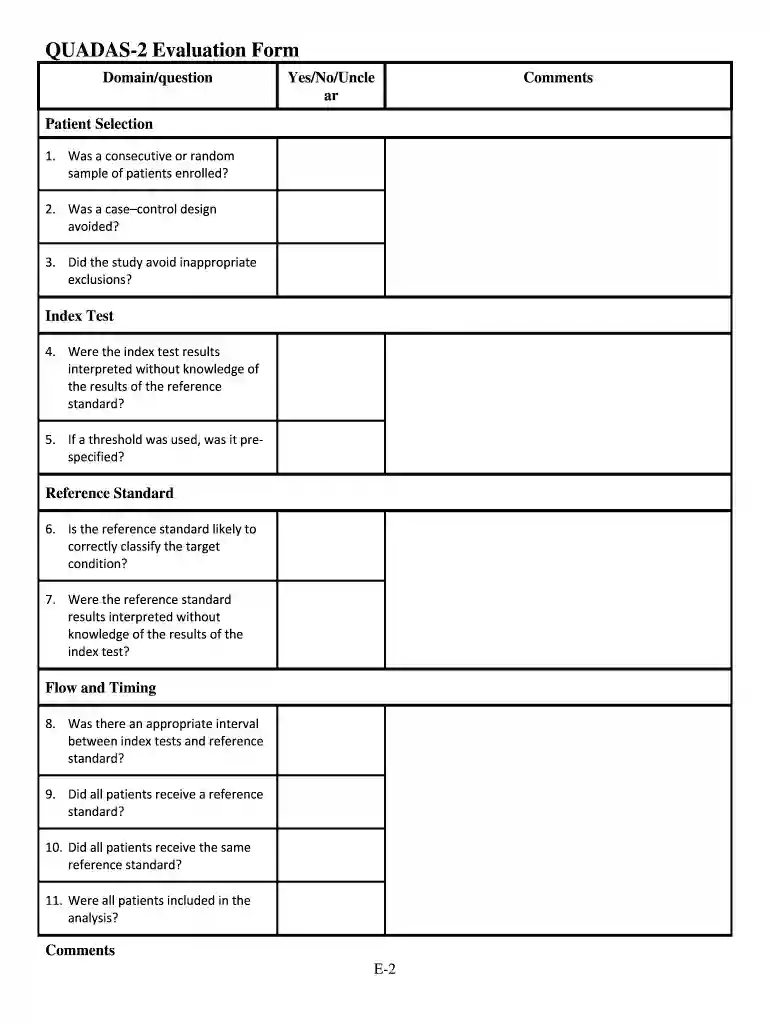
The QUADAS 2 tool is a structured assessment framework specifically designed to evaluate the quality of diagnostic accuracy studies. This tool aims to assess various areas critical to ensuring the validity and reliability of such studies. Each component of the QUADAS 2 tool is aimed at identifying methodological weaknesses that could potentially bias results, making it a cornerstone for researchers and healthcare professionals who rely on diagnostic test accuracy.
The framework is divided into several key domains that cover different aspects of the study design and execution:
By employing the QUADAS 2 tool, researchers can systematically evaluate these facets to bolster the evidence supporting the diagnostic test's use in clinical practice.
Using the QUADAS 2 tool requires a structured approach to ensure each aspect of the study is thoroughly evaluated. Here’s a step-by-step guide on how to apply this tool effectively:
Gather Study Information: Before applying the QUADAS 2 tool, collect all relevant documentation related to the diagnostic study, including protocols, patient demographics, and results from both the index and reference tests.
Complete Each Domain: Assess each of the four key domains:
Use the Checklist: Utilize the QUADAS 2 checklist, which includes specific questions tailored to each domain. Answer each question based on the evidence you’ve gathered from the study. This promotes a thorough investigation of potential biases.
Summarize Findings: After evaluating each domain, compile a summary that highlights strengths and weaknesses, focusing on how these may impact the overall findings and recommendations drawn from the study.
Review for Completeness and Accuracy: Finally, ensure that all sections of the assessment have been completed accurately and that all necessary documentation has been referenced.
Essential components form the backbone of the QUADAS 2 tool, enhancing its functionality as a quality assessment framework. Understanding these elements can significantly improve the tool's application and outcomes:
Domains and Questions: Each domain consists of specific evaluative questions that need to be answered based on study documentation. This structured approach ensures that all critical aspects are scrutinized.
Risk of Bias Ratings: The QUADAS 2 tool incorporates the concept of risk of bias, allowing users to rate each component as low, high, or unclear risk. This categorization helps in clearly communicating the quality of the study to stakeholders.
User-Friendly Format: The design of the QUADAS 2 tool is intended to be straightforward, promoting ease of use for varied audiences, from researchers to healthcare practitioners. The checklist format supports systematic evaluation.
Flexible Application: While primarily employed in diagnostic accuracy studies, the tool can adapt to different types of studies beyond pharmaceuticals, including devices, procedures, and diagnostic algorithms.
Reproducibility of Results: By following a standardized assessment process, the QUADAS 2 tool enhances the reproducibility of results, which is vital for maintaining scientific credibility and facilitating peer review.
Familiarity with specific terminology associated with the QUADAS 2 tool enriches understanding and utilization of this framework. Key terms include:
By comprehensively understanding these terms, stakeholders can better evaluate the study's rigor and relevance.
Practical application of the QUADAS 2 tool can significantly enhance the credibility of diagnostic studies. Below are scenarios illustrating its use:
Cardiology Study: A research team evaluates a new echocardiography technique to diagnose heart disease. They employ the QUADAS 2 tool to assess patient selection criteria, ensuring diversity and relevant clinical conditions are represented. The tool helps them identify that a significant portion of patients with complex comorbidities was excluded, raising concerns around the test's applicability in broader settings.
Oncology Research: In a diagnostic accuracy study for breast cancer detection, researchers utilize the QUADAS 2 tool to critique their adherence to the reference standard (biopsy). The tool reveals discrepancies in how many patients were offered the biopsy, leading to improved protocols that address these biases in future studies.
Pulmonology Assessment: An investigation into a new lung function test employs the QUADAS 2 checklist to assess whether the methodology of administering standard pulmonary tests was consistent across all patients. The assessment identifies logistical delays that affected results, prompting changes in testing timelines for better accuracy.
These cases exemplify how employing the QUADAS 2 tool can lead to more robust, reliable, and implementable results in diagnostic accuracy studies.
Understanding the legal implications associated with the QUADAS 2 tool is crucial for researchers and healthcare professionals. Below are critical aspects concerning its legal use:
Compliance with Regulations: When employing the QUADAS 2 tool, researchers must ensure that their studies comply with relevant regulatory standards such as the Health Insurance Portability and Accountability Act (HIPAA) for confidentiality and data protection.
Liability Considerations: Accurate reporting using the QUADAS 2 tool can help limit legal liability in case of adverse outcomes from misdiagnoses. Thorough documentation can provide evidence that due diligence was exercised during study evaluations.
Publication Ethics: Researchers must follow ethical guidelines regarding the use of the tool in published studies. Misrepresentation of findings or data can lead to severe consequences in terms of academic integrity and legal ramifications.
Institutional Review Board (IRB) Approval: Studies employing the QUADAS 2 tool typically require IRB approval to ensure ethical treatment of participants. This approval process involves submitting study designs that address potential biases as identified through the QUADAS evaluation.
Adhering to these legal considerations promotes ethical and responsible use of the QUADAS 2 tool, ensuring its application benefits both research integrity and patient safety.
At DocHub, your data security is our priority. We follow HIPAA, SOC2, GDPR, and other standards, so you can work on your documents with confidence.
by PF Whiting 2011 Cited by 14755 This tool will allow for more transparent rating of bias and applicability of primary diagnostic accuracy studies.Read more
Oct 9, 2025 Background: A quality assessment tool for diagnostic accuracy studies, named QUADAS, has recently been developed. Although QUADAS has beenRead more


