




01. Edit your 32 draw sheet online
Type text, add images, blackout confidential details, add comments, highlights and more.

Type text, add images, blackout confidential details, add comments, highlights and more.

Draw your signature, type it, upload its image, or use your mobile device as a signature pad.

Send it via email, link, or fax. You can also download it, export it or print it out.
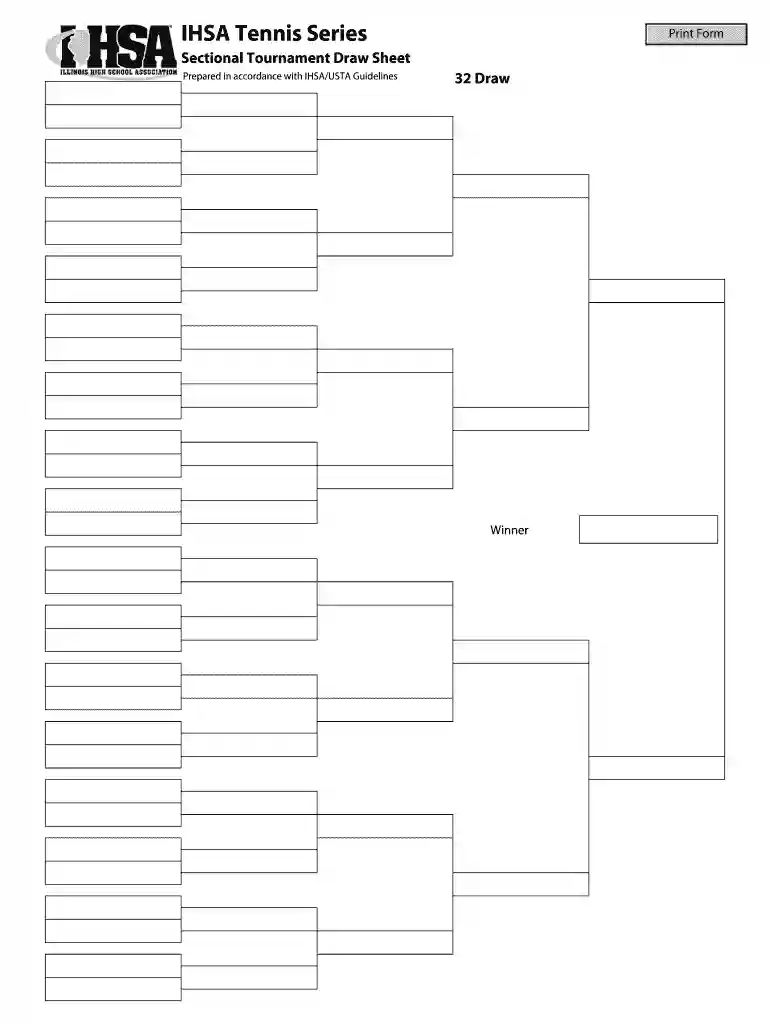
A Draw Sheet for 32 Entries serves as an official document used in tournament formats, particularly in sports such as tennis, to denote the match layout and progression. This sheet provides a systematic way to track participants and matches throughout the competition. Each entry corresponds to a competitor or team, and the format allows for a single-elimination process where competitors can be systematically eliminated until a winner is declared.
Understanding the structure of the draw sheet is crucial for officials and participants. It typically includes match time slots, player names, and the anticipated match results. A draw sheet for 32 entries generally signifies that there will be 32 competitors, leading to a total of 31 matches required to declare a champion. As the tournament progresses, the draw sheet is updated to reflect match outcomes and remaining competitors.
Completing a Draw Sheet for 32 Entries involves several structured steps to ensure clarity and organization.
By following these steps, officials can maintain a clear and accessible record of tournament progress.
The Draw Sheet for 32 Entries is primarily utilized by tournament organizers, officials, competitors, and coaching staff. Each group interacts with the sheet for varying reasons:
By understanding the roles these stakeholders play, it becomes clear how critical the draw sheet is to the overall tournament experience.


Familiarity with key terminology associated with the Draw Sheet for 32 Entries is vital for effective use. Below are some important terms:
Understanding these terms enhances clarity when discussing tournament structures and processes.
Practical examples highlight how the Draw Sheet for 32 Entries is applied in real-world scenarios:
These examples illustrate how the draw sheet is a pivotal component for organizing and facilitating competitive events across various leagues and formats.
The choice between a digital and paper version of the Draw Sheet for 32 Entries imposes various advantages and disadvantages influenced by accessibility and functionality.
Both formats have unique strengths and can often complement each other during tournaments, depending on the specific needs of the event.
Key elements found in a Draw Sheet for 32 Entries provide essential structure and organization to the document:
These elements are critical for maintaining a functioning tournament that operates smoothly and provides users with necessary information.
State-specific regulations may influence how the Draw Sheet for 32 Entries is executed, particularly in sports governed by local athletic associations. Common considerations include:
Awareness of these differences ensures that organizers adhere to legal and logistical requirements when setting up their tournaments.
At DocHub, your data security is our priority. We follow HIPAA, SOC2, GDPR, and other standards, so you can work on your documents with confidence.
DWG 32 OF 42 AS453 MODULAR ASEWORK ELEVATIONS LAB. DWG 33 OF 42 AS454 MODULAR CASEWORK ELEVATIONS PHARMACY. DWG 34 OF 42 AS455 MODULAR CASEWORK ELEVATIONS
Jun 15, 2004 Table 1 (for 8 to 16 entries) On a draw sheet numbered 1 to 16. Table 2 (for 17 to 32 entries) On a draw sheet numbered 1 to 32.Read more
SHEET 1 OF 6. DRAWN. CHECKED dfoster. 12/30/2012. DWG NO. FE-00036. SIZE. D. SCALE. FIRST. 200 Bedford Street, Manchester, NH 03101. (603) 666-Read more


