




01. Edit your band competition scoring sheet online
Type text, add images, blackout confidential details, add comments, highlights and more.

Type text, add images, blackout confidential details, add comments, highlights and more.

Draw your signature, type it, upload its image, or use your mobile device as a signature pad.

Send how are marching band competitions scored via email, link, or fax. You can also download it, export it or print it out.
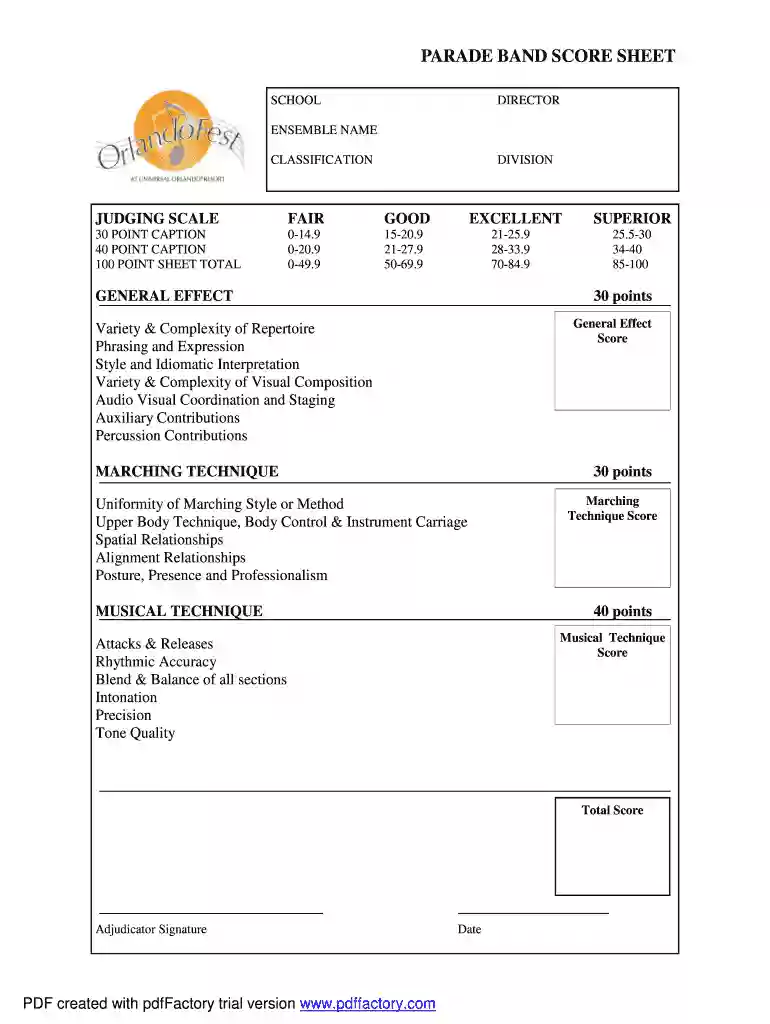
The marching band competition score sheet is a vital tool in evaluating performances during competitions. It serves as a structured format for judges to assess various elements of a band’s performance and assign scores that reflect their overall quality. Understanding this score sheet is essential for participants and educators alike, enabling them to prepare effectively for competitions.
The scoring sheet typically includes several critical sections that help judges evaluate bands on different criteria. These sections generally include:
The total score on a marching band competition score sheet often sums to one hundred points, divided among various performance elements. Performance quality may be rated based on a categorical scale, typically ranging from Fair to Superior. Judges use this scale to provide feedback and better understand performance levels.
The feedback received from the score sheet is crucial for bands seeking to improve their performance. Judges often provide written comments alongside numerical scores, allowing participants to understand their strengths and areas for growth.
In practice, high schools frequently use marching band competition score sheets during local and regional competitions, such as the UIL state marching contest or MPA music competitions. For instance:
While the structure typically remains consistent, different regions may tailor their score sheets to reflect local evaluation standards. For example:
Understanding the nuances and detailed criteria of a marching band competition score sheet is vital for success in the competitive landscape of marching band events. Utilizing this structured approach enhances not only individual performances but also the collective growth of participating bands.
We've got more versions of the band competition scoring sheet form. Select the right band competition scoring sheet version from the list and start editing it straight away!
| Versions | Form popularity | Fillable & printable |
|---|---|---|
| 2010 | 4 Satisfied (60 Votes) |
At DocHub, your data security is our priority. We follow HIPAA, SOC2, GDPR, and other standards, so you can work on your documents with confidence.
Sep 3, 2024 Paiste is a unique cymbal company in that their alloys are substantially different in quality and sound characteristics compared to the Turkish way of B20Read more
Order Band Name. Class. Total. Score. 1. Mus. Ind. 2. Mus. Ens. Total. Music. 3a. Music Eff. 1. 3b. Music Eff. 2. 6. Visual. Eff. Total. Effect. 4. Visual. Ind.Read more
Apr 1, 2026 Marching bands cannot stop while marching through the competition area Score sheets will be provided after the contest. 20. The winnerRead more


