
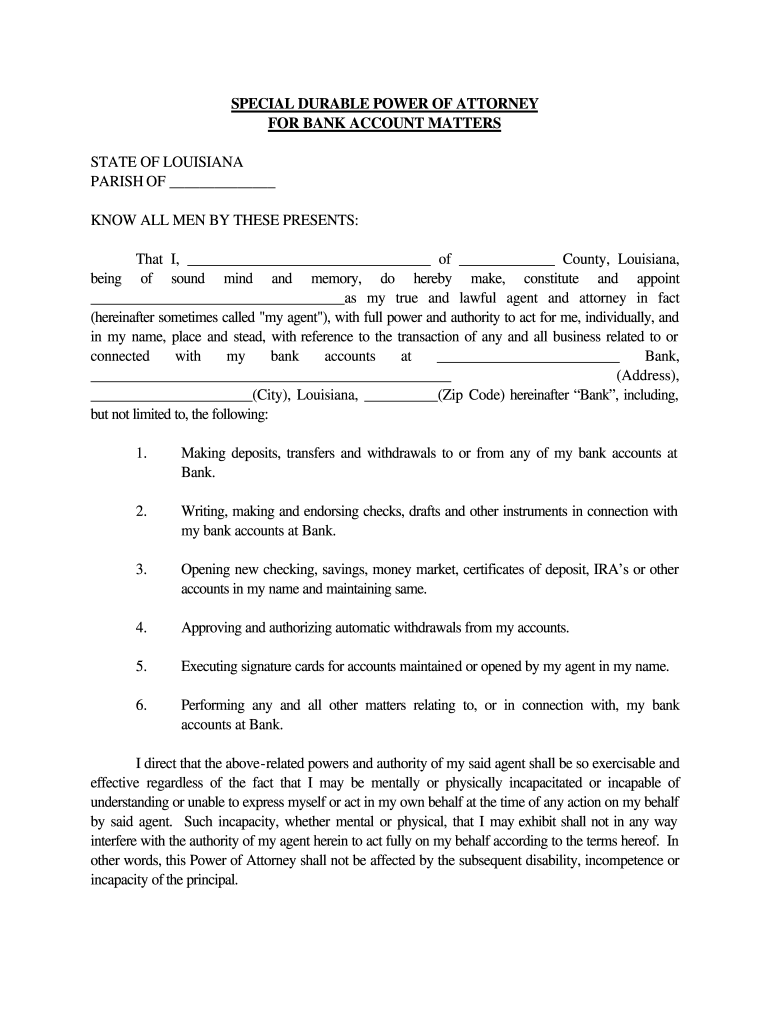







Definition and Importance of Power of Attorney for Bank Account
A power of attorney for a bank account is a legal document that grants an individual (the agent) the authority to manage the financial matters of another person (the principal). This includes the ability to conduct transactions, such as deposits, withdrawals, and account management, on behalf of the principal. This document is crucial in situations where the principal is unable to manage their finances due to incapacitation or other reasons.
- Functions of the Power of Attorney:
- Facilitates smooth financial management when the principal is incapacitated.
- Enables the agent to make decisions that align with the principal's best interests.
- Can be tailored to specify the extent of the agent's authority, which may include handling obligations related to loans or investments.
Types of Power of Attorney for Bank Accounts
There are different types of power of attorney relevant to bank accounts, each serving unique purposes:
- General Power of Attorney: Grants broad powers to the agent, covering various financial transactions.
- Special Power of Attorney: Limited to specific transactions or decisions, such as managing a single bank account.
- Durable Power of Attorney: Remains effective if the principal becomes incapacitated, ensuring uninterrupted financial management.
Understanding the differences among these types is essential for selecting the appropriate format based on individual needs.
Creating a Power of Attorney for Bank Account PDF
When preparing a power of attorney for a bank account in PDF format, it's important to ensure the document is complete and legally binding. Here are the steps to create a compliant power of attorney for bank account operations:
-
Gather Necessary Information:
- Full name and address of both the principal and the agent.
- Details of the specific bank accounts affected.
- Desired powers granted to the agent, detailing any limitations.
-
Draft the Document:
- Use a bank power of attorney template to standardize the format.
- Clearly indicate the authority given to the agent regarding account operations.
-
Include Required Legal Language:
- Add provisions detailing the indemnification of any financial institution relying on the document.
- Specify that the document is executed when the principal is in sound mind and voluntarily signing.
-
Sign and Witness the Document:
- The principal must sign the document in the presence of witnesses or a notary public, depending on state requirements.
-
Distribute Copies Appropriately:
- Provide copies of the signed document to the bank, the agent, and retain a copy for personal records.
Format and Structure of the PDF
Creating the document in PDF format allows for easy sharing and secure signature collection. Essential elements to include in the PDF are:
- Title: Clearly labeled as a "Power of Attorney for Bank Account."
- Sections outlining the powers granted, limitations, and any specific instructions or conditions.
- Signature space for the principal, witnesses, and notary.
Advantages of Using a Power of Attorney for Banking Transactions
Utilizing a power of attorney for banking transactions offers several benefits, especially in critical situations where timely financial management is essential:
- Accessibility: The appointed agent can access account information anytime, which is particularly useful in emergencies.
- Continuity: Financial arrangements can continue without interruption if the principal becomes unavailable or incapacitated.
- Efficiency: The agent can swiftly handle banking matters, decreasing stress and delays for families during challenging times.
Real-World Scenarios
Consider a situation where an elderly parent becomes ill. Their child, designated as the agent under a power of attorney, can execute necessary transactions—like paying bills or managing investments—without delay, ensuring the parent’s financial obligations are met.
Common Misconceptions About Power of Attorney for Bank Accounts
There are several misconceptions surrounding the power of attorney for bank accounts that can lead to misunderstandings:
-
Misconception 1: A power of attorney automatically includes real estate transactions.
Fact: It must be explicitly stated if real estate powers are granted since they are not included by default in financial powers. -
Misconception 2: A power of attorney loses effectiveness upon the principal’s incapacitation.
Fact: Durable powers of attorney remain valid even if the principal becomes incapacitated, ensuring continued management of financial affairs.
Legal Considerations and State-Specific Regulations
Each state has specific requirements and regulations governing the creation and execution of power of attorney documents. It is essential to ensure compliance with local laws, including:
- Witnessing Requirements: Some states require witnesses for the signing, while others may not.
- Notarization: States may vary on whether notarization is required for enforcement.
- Termination Clauses: Knowledge of how and when the power of attorney automatically terminates is crucial for both parties.
Examples of State Variations
For example, while most states acknowledge durable powers of attorney, the precise format, filing protocols, or required language can differ significantly. Hence, consulting with a legal professional familiar with state laws is advisable.
Conclusion
The power of attorney for bank accounts is a vital tool for financial management, especially in periods of incapacity. Understanding its uses, processes, and legal requirements ensures that individuals can effectively manage their banking relationships with trust and clarity. Consider utilizing templates and resources that comply with state regulations to create a power of attorney that suits your needs and protects your interests.




