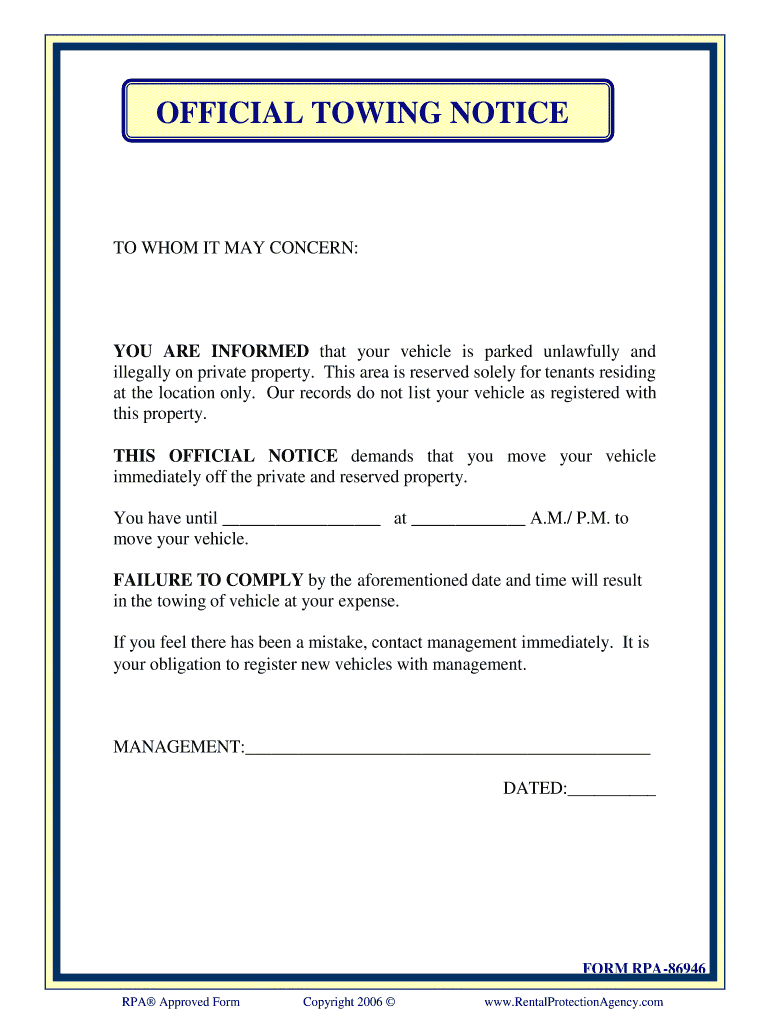







Definition and Purpose of a Towing Warning Notice
A towing warning notice serves as a formal notification indicating that a vehicle is parked illegally on private property or in a prohibited area. This notice is often utilized by property management, homeowners' associations, or businesses to inform vehicle owners of the violation and demand the immediate removal of the vehicle. The document typically specifies a time frame within which the vehicle must be removed, highlighting that failure to comply will result in towing at the owner's expense.
Effective use of this notice ensures that property rights are upheld while providing vehicle owners a chance to rectify the situation. By providing clear instructions and consequences, the towing warning notice aids in managing parking rules, thereby maintaining order in designated areas.
How to Complete a Towing Warning Notice
Completing a towing warning notice requires precision to ensure clarity and legal compliance. Here are the key steps involved:
-
Select a Template: Begin by choosing a towing warning notice template that fits the situation. Templates often include essential fields already formatted.
-
Fill Out Vehicle Information: Include detailed information about the vehicle, such as the make, model, color, and license plate number. This helps clearly identify the offending vehicle.
-
Provide Contact Information: Include the name of the issuing authority, such as property management or security personnel. This contact information is crucial for any disputes that may arise.
-
Specify the Violation: Clearly outline the violation, including the specific parking rules broken (e.g., unauthorized parking in disabled spots).
-
Set a Deadline for Removal: Indicate the time frame for removing the vehicle, typically twenty-four to seventy-two hours from issuance.
-
Outline Consequences: Clearly state that failure to remove the vehicle by the specified time will result in towing at the owner's expense.
Taking care to ensure all information is accurate and clearly presented reduces the potential for misunderstandings and legal disputes.
Legal Implications of a Towing Warning Notice
The towing warning notice is not just a formality; it carries significant legal implications. Legally, a properly issued notice can protect the property owner's rights and provide them with recourse should the matter escalate.
- Compliance with Local Laws: Different states or municipalities have specific laws regarding the issuance of towing notices. It's essential to ensure that the warning adheres to local ordinances concerning parking enforcement.
- Notification Requirements: Some jurisdictions stipulate specific requirements for how a warning must be issued (e.g., physical placement on the vehicle or delivery to the registered owner).
- Potential Liability: If a vehicle is towed without a valid warning notice, property owners can face legal repercussions. This highlights the importance of understanding local regulations when utilizing a towing notice.
Failing to comply with these legal guidelines can result in financial penalties for property owners and disputes over towing charges.
Key Elements of an Effective Towing Warning Notice
A well-crafted towing warning notice should contain several essential elements to be effective:
- Header Information: Include a title that clearly labels the document as a towing warning notice.
- Date of Issuance: Indicate when the notice is being issued; this is critical for determining compliance deadlines.
- Vehicle Details: Specifics about the vehicle in violation must be included, such as the make, model, color, and license plate number.
- Description of the Violation: Clearly articulate how the vehicle is in violation of parking rules, referencing any relevant policies or regulations.
- Removal Deadline: A clear timeframe within which the vehicle must be removed, typically indicated in hours or days.
- Consequences of Non-Compliance: Specify the repercussions of failing to remove the vehicle, including towing and associated costs.
Incorporating all these elements ensures that the notice is clear, actionable, and legally sound.
Who Uses Towing Warning Notices
Towing warning notices are utilized by various entities to manage parking on private property or restricted areas. Typical users include:
- Property Management Companies: These organizations issue towing warnings as part of maintaining order in residential or commercial complexes.
- Homeowners' Associations: HOAs use these notices to enforce community guidelines regarding parking to ensure fair use of shared spaces.
- Business Owners: Retailers and service providers may deploy towing notices to prevent unauthorized parking in their lots, protecting their customers and business operations.
- Law Enforcement: In some instances, law enforcement may issue towing notices for vehicles that are abandoned or pose a safety hazard.
Each of these groups aims to maintain order and ensure compliance with established parking regulations.
Examples of Towing Warning Notices
Real-world examples provide essential context for understanding towing warning notices:
- Example 1: A towing warning notice might be issued at an apartment complex where a vehicle is parked in a fire lane. The notice would specify the violation (parking in a fire lane), describe the vehicle, and demand its removal within twenty-four hours to avoid towing.
- Example 2: A notice could also be issued in a commercial parking lot where unauthorized vehicles are taking up customer parking spaces. The warning would inform vehicle owners of the need to vacate the lot by a specified time or face towing charges.
These examples illustrate the practical application of towing warnings in various settings, highlighting the importance of compliance with parking regulations.
State-Specific Rules for Towing Warning Notices
Towing regulations can vary significantly by state, impacting how towing warning notices are issued and enforced.
- California: Requires that property owners post signs indicating towing regulations and specify that a warning notice must be placed on the vehicle before towing, with exact language required in the notice.
- Texas: Allows vehicle owners to dispute a tow within a set timeframe and mandates that towing companies offer clear information regarding the towing charge and process.
- Florida: Requires compliance with the Florida Towing and Immobilization Act, which sets forth notice requirements and towing processes.
Understanding these state-specific rules is essential for effective enforcement and to ensure compliance with legal obligations regarding towing.