
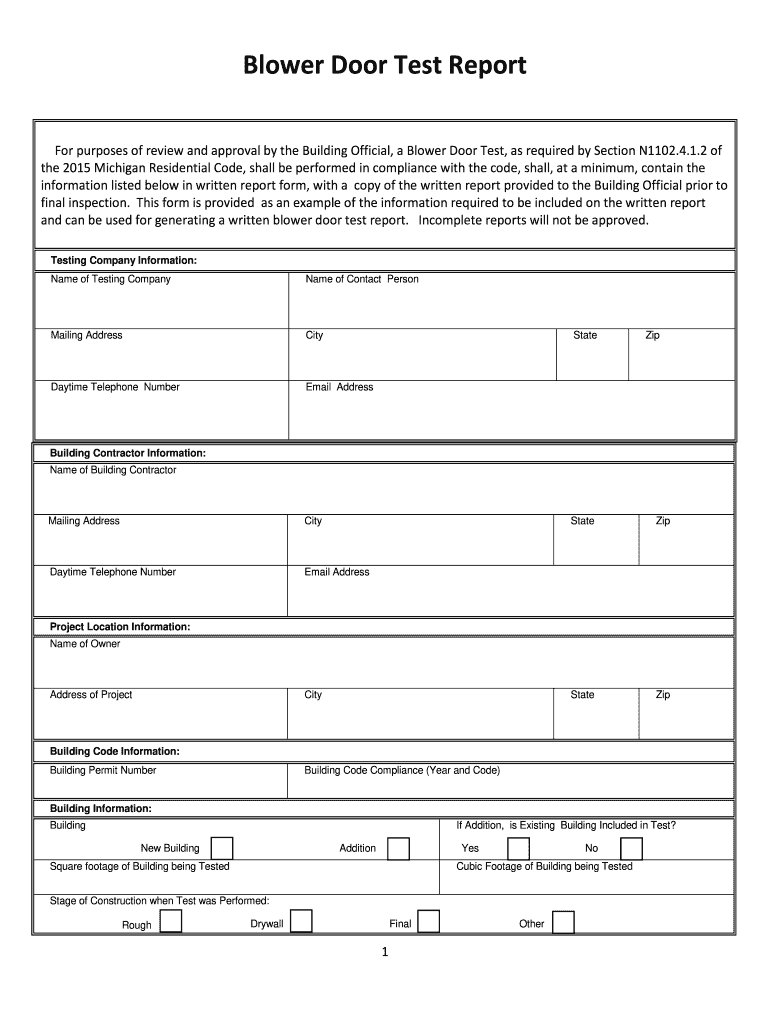







Definition and Importance of the Blower Door Test Report Form
The blower door test report form is a critical document used in the evaluation of a building's air leakage and overall energy efficiency. This form outlines the results of a blower door test, which measures the airtightness of a building by using a fan to depressurize the interior. The primary purpose of this test and the accompanying report is to identify sources of air leaks, assisting builders and contractors in enhancing energy performance and ensuring compliance with relevant building codes, such as those outlined in the 2015 Michigan Residential Code.
The blower door test results form captures vital information including:
- Testing Company Details: Identification of the inspecting agency or contractor responsible for the test.
- Project Information: Key data regarding the building's address, type, and owner.
- Test Results: Measurement outcomes reflecting the rate of air leakage, often expressed in air changes per hour (ACH) or cubic feet per minute (CFM) at a specified pressure.
- Compliance Status: Confirmation that the results meet established air leakage standards.
This documentation is essential not only for regulatory compliance but also for improving energy efficiency in residential and commercial structures.
Steps to Complete the Blower Door Test Report Form
Completing the blower door test report form requires methodical execution to ensure all relevant data is captured accurately. Here are the detailed steps:
-
Preparation of the Site: Before testing, ensure the building is prepared by closing all doors and windows and disabling any HVAC systems or combustibles that may affect results.
-
Conducting the Test: Utilize the blower door setup, including the fan and pressure gauges, to measure the air leakage. Document all findings as they occur to maintain accuracy.
-
Filling Out the Form:
- Start with the testing company information including the name, licensing details, and contact information.
- Input project details like the address, type of building, and owner’s name.
- Record the test results, noting the specific leakage rates and compliance benchmarks as per applicable regulations.
-
Verification and Signatures: Ensure that a qualified individual reviews the results and signs off on the report to validate its accuracy and reliability.
-
Final Submission: Determine the submission method, whether electronic or paper-based, and forward the completed form to the appropriate building authority or client.
Including detailed observations and results throughout these steps ensures the form is comprehensive and fulfills its intended purpose.
Who Typically Uses the Blower Door Test Report Form
The blower door test report form is commonly utilized by various professionals and entities involved in construction, energy efficiency, and regulatory compliance, including:
-
Contractors and Builders: Individuals involved in constructing or renovating buildings to ensure they meet energy efficiency standards.
-
Home Inspectors: Professionals who assess the condition of residential properties and provide insights into energy performance.
-
Energy Auditors: Experts who specialize in identifying energy-saving opportunities within buildings, using blower door test results as a key reference.
-
Building Officials: Regulatory authorities responsible for approving new constructions and renovations, often requiring this documentation to verify compliance.
-
Homeowners and Property Managers: Stakeholders interested in understanding and improving their property’s energy efficiency and comfort levels.
The utilization of this form directly impacts the building’s sustainability and adherence to energy regulations.


Important Terms Related to Blower Door Test Report Form
Understanding the terminology associated with the blower door test report form is essential for accurate completion and interpretation. Key terms include:
-
Air Changes per Hour (ACH): A measurement of how many times the air within a building is replaced in one hour, indicating the level of air leakage.
-
Cubic Feet per Minute (CFM): A unit measuring the volume of air entering or leaving a building, used in assessing leakage.
-
Depressurization: The process of lowering the air pressure inside a building to facilitate the blower door test.
-
Energy Efficiency Standards: Guidelines or codes established by local or national authorities, dictating acceptable levels of air leakage.
-
Thermal Envelope: The physical barrier enclosing the conditioned space of a building, critical in determining air leakage points.
These terms facilitate clear communication and understanding among all stakeholders involved in the reporting and regulatory process.
Legal Use of the Blower Door Test Report Form
The blower door test report form is essential for legal compliance concerning building codes and energy efficiency regulations. Its use is mandated by various authorities to ensure structures meet specific air leakage standards before occupancy. Legal requirements include:
-
Submission to Building Officials: The completed form must be submitted to the appropriate regulatory body, often prior to final inspections, confirming compliance with local energy codes.
-
Retention of Records: Contractors and builders are typically required to maintain copies of the report for a specified period for auditing and compliance purposes.
-
Accountability Measures: Falsifying test results or failing to submit the report can lead to penalties, delayed project approvals, or additional inspections mandated by local governance.
Understanding these legal stipulations is imperative for professionals in construction and building management, ensuring they operate within the law and maintain the integrity of the buildings they manage or construct.




