




01. Edit your invoice cum packing list online
Type text, add images, blackout confidential details, add comments, highlights and more.

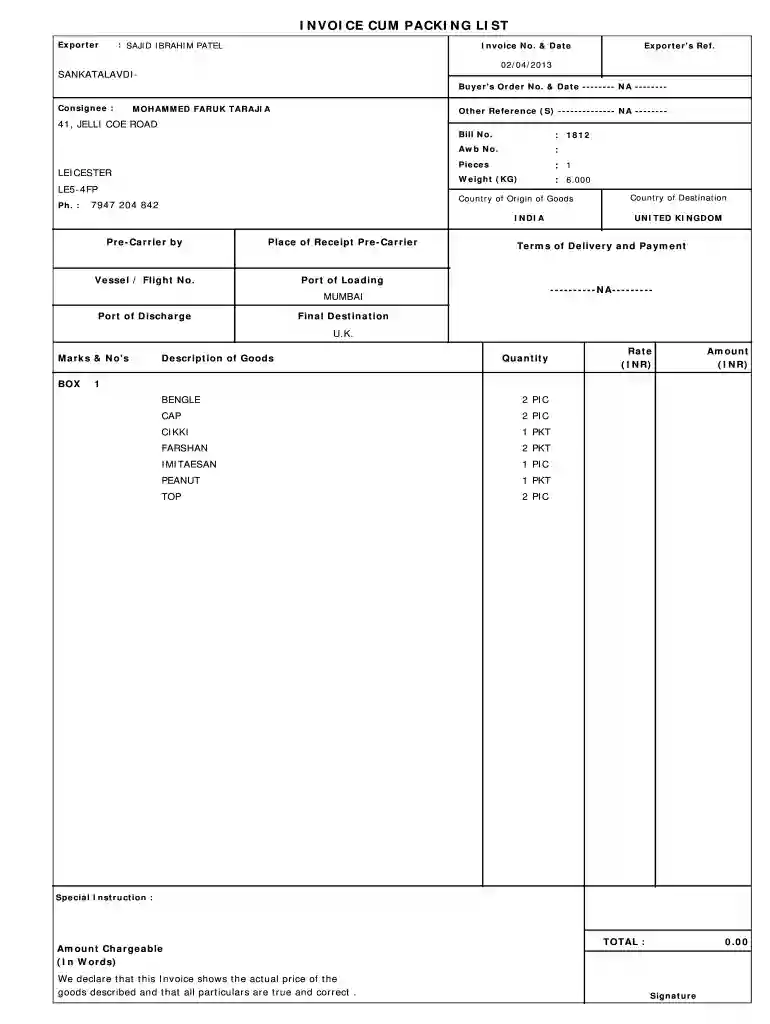
Type text, add images, blackout confidential details, add comments, highlights and more.

Draw your signature, type it, upload its image, or use your mobile device as a signature pad.

Send invoice packing list via email, link, or fax. You can also download it, export it or print it out.
The invoice cum packing list serves as a critical document in international trade and logistics, consolidating the functions of both an invoice and a packing list within a single form. It is essential for both exporters and importers, ensuring that all relevant details pertaining to the shipment are captured accurately.
The invoice cum packing list includes all necessary information that summarizes the shipment contents and serves as the basis for billing. Its primary purposes are:
In many cases, it is issued by the exporter and sent to the consignee, providing confirmation of the shipment arrangement, payment details, and accurate descriptions of the goods.
An effective invoice cum packing list must contain several key components to facilitate its use and ensure compliance:
Including these elements helps ensure clarity and accountability in transactions.
The invoice cum packing list can come in different formats depending on the specific requirements of the trade parties involved and the nature of the goods. Common formats include:
Each format should adhere to industry standards and incorporate all necessary details for a smooth transaction.
The invoice cum packing list must comply with various legal requirements, particularly in international shipping. This generally includes adherence to customs regulations, which often dictate the information that must be included. Important compliance aspects involve:
Failure to comply with these regulations may lead to delays, additional fees, or the seizure of goods.
Invoice cum packing lists are commonly used across various industries. Typical scenarios include:
These examples illustrate the versatility and necessity of the invoice cum packing list in modern commerce.
In practice, there are scenarios where the invoice cum packing list must adapt or be tailored to specific needs:
These considerations ensure that every applicable detail is managed efficiently throughout the shipment and transaction processes.
At DocHub, your data security is our priority. We follow HIPAA, SOC2, GDPR, and other standards, so you can work on your documents with confidence.
Commercial invoice 2. Packing list 3. Bill of lading 4. Combined transport Packing Note and List : Difference between a packing note and a packing listRead more
6. 46. 1112920200. CYLINDER BLOCK COVER PACKING. 3. 47. 1096800240. WATER DRAIN COCK ASSY. 1. 48. 1096660360. DRAIN COCK JOINT. 1. 49. 1096301150. WATER DRAINRead more
Jan 1, 2026 L3908 Wrist cock-up non-molded. 2 per yr. 1/1/26. 64.29. Y. L3912 Flex glove w/elastic finger. 2 per yr. 1/1/26. 111.38. Y. L3913. Hand fingerRead more


