
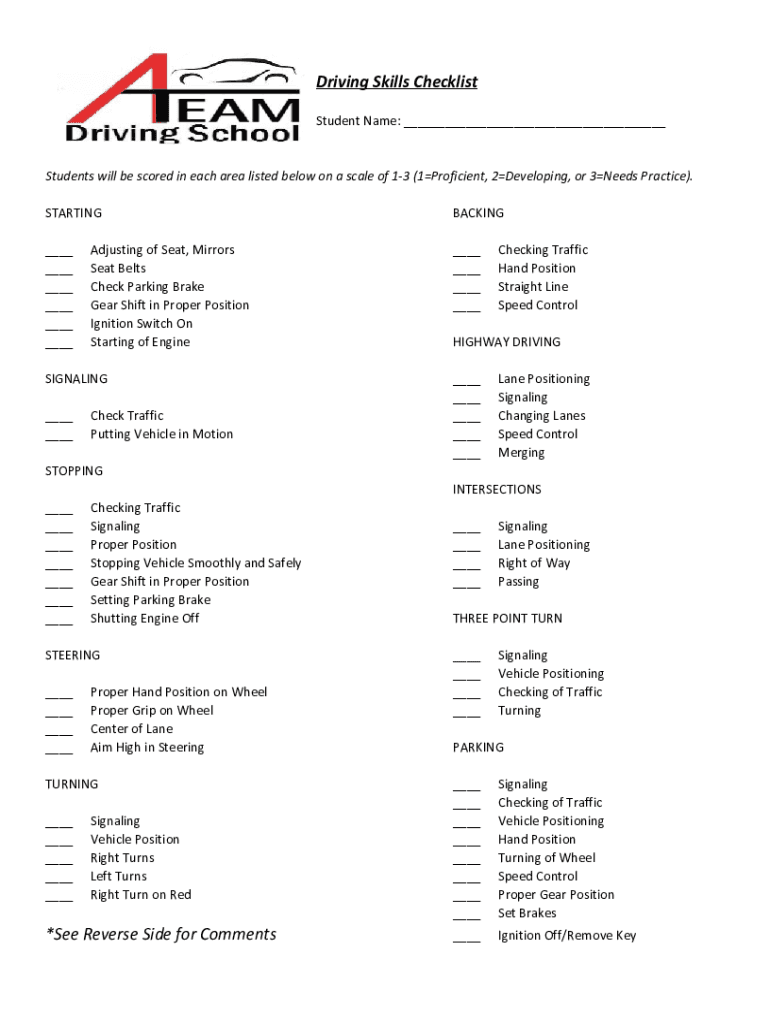







Definition and Meaning of the Driving Skills Checklist Form
The Driving Skills Checklist Form is a structured tool used to assess and evaluate the driving abilities of individuals. It serves as an educational and evaluative instrument, offering a comprehensive overview of a driver's proficiency in various aspects of driving. Typically employed by driving instructors, driving schools, or licensing authorities, this form helps identify which driving skills are proficient and which areas require further development or practice.
Purpose and Importance
- Performance Assessment: The form provides a clear measure of a driver's performance across multiple driving tasks.
- Skill Identification: It helps in pinpointing specific skills where an individual excels or needs improvement.
- Structured Evaluation: Offers a standardized method for instructors to evaluate drivers consistently.
Use in Educational Contexts
The form is an essential part of driver training programs. It ensures that students meet the necessary competencies before taking formal driving tests. By leveraging this checklist, instructors can create targeted lesson plans to address weaknesses and build on strengths.
Steps to Use the Driving Skills Checklist Form
Using the Driving Skills Checklist Form requires a systematic approach. Here is a detailed step-by-step guide on effectively utilizing this tool:
- Preparation: Gather all necessary materials, including the checklist form and writing instruments, before the assessment begins.
- Introduction: Explain the purpose and components of the form to the student or individual being assessed.
- Assessment:
- Conduct driving exercises, closely observing the driver’s skills.
- Evaluate each skill area as listed in the checklist, scoring them according to proficiency levels: proficient, developing, or needs practice.
- Review and Feedback:
- Discuss the results with the driver.
- Highlight areas of strength and provide constructive feedback on areas needing improvement.
Skills Assessed
- Starting and Stopping: Evaluates smoothness and control.
- Backing: Assesses the ability to reverse safely and accurately.
- Traffic Signals Compliance: Monitors adherence to traffic lights and signals.
How to Obtain the Driving Skills Checklist Form
Securing a Driving Skills Checklist Form can be straightforward if you follow the right channels. These forms are usually available from:
- Driving Schools and Educational Institutions: Many driving programs provide forms as part of their training materials.
- Licensing Authorities: Some state departments of motor vehicles (DMV) offer these forms either online or at local offices.
Digital Access
Consider checking online resources for downloadable versions. Many educators and organizations share template forms that can be customized to fit specific needs.
Key Elements of the Driving Skills Checklist Form
A well-structured Driving Skills Checklist Form includes several crucial elements designed to create a comprehensive profile of a driver's abilities:
- Driver Information: Basic details like name and contact information.
- Skill Categories: Breaking down driving skills into key areas such as maneuverability, awareness, and vehicle control.
- Rating System: Typically ranges from proficient to needs practice, providing clear indicators of skill level.
- Comments Section: Space for evaluators to write specific notes and recommendations.
Example Elements
- Intersection Navigation: How well does the driver handle turning and negotiating intersections?
- Emergency Maneuvers: Ability to execute quick stops or changes in direction safely.
Who Typically Uses the Driving Skills Checklist Form
The Driving Skills Checklist Form serves various users, each with specific objectives:
- Driving Instructors: Use it to assess student progress and tailor lessons accordingly.
- Learners: Benefit from feedback to focus on developing weaker skills.
- Evaluators and Examiners: Employ it during driving tests to ensure standards are met.


Use Cases
Real-world scenarios might include a driving school scheduling periodic evaluations for students or licensing authorities conducting road tests as part of the licensing process.
Legal Use of the Driving Skills Checklist Form
The checklist form, while primarily educational, also holds legal significance in certain contexts:
- Driver Licensing: Used as a tool in driver licensing tests to document skill proficiency.
- Accreditation for Schools: Can be part of the documentation required for driving schools to maintain accreditation status.
Compliance and Standards
Using the form in standardized ways contributes to fair and consistent driver evaluations that align with legal and safety requirements across regions.
Examples of Using the Driving Skills Checklist Form
Practical examples enhance understanding of its application:
- New Driver Programs: A school integrates the checklist to track progress.
- Corporate Training: Companies may use the form for evaluating employees required to drive for work, ensuring compliance with safety standards.
Case Studies
Consider a driving school that sees a 20% increase in pass rates for licensing exams after implementing a checklist-based assessment system.
State-Specific Rules for Driving Skills Checklist Form
Although the form is standardized, individual states might have unique requirements or additional components. Understanding these differences is vital:
- California: May have stricter criteria for urban driving skills.
- Texas: Could emphasize rural driving and long-distance navigation.
Local Compliance
Communicate with local authorities to ensure all relevant state-specific elements are included in assessments for accurate and accepted evaluation.
Integration with Digital Platforms
The digital transformation in documentation has influenced the use of forms like the Driving Skills Checklist Form. Platforms such as DocHub enable:
- Digital Completion and Submission: Enhance efficiency by reducing paper use and allowing real-time tracking.
- Collaboration: Multiple users can input data, proof of comprehension, or sign digitally.
Advantages
- Efficiency: Streamlines the entire process from assessment to final documentation.
- Accessibility: Forms can be accessed and completed from any location, expanding reach and usability.
By maximizing the advantages of tools like DocHub, users can ensure that their workflow remains modern, efficient, and secure, enhancing both the accuracy and accessibility of driving skills assessments.




