




01. Edit your form online
Type text, add images, blackout confidential details, add comments, highlights and more.

Type text, add images, blackout confidential details, add comments, highlights and more.

Draw your signature, type it, upload its image, or use your mobile device as a signature pad.

Send it via email, link, or fax. You can also download it, export it or print it out.
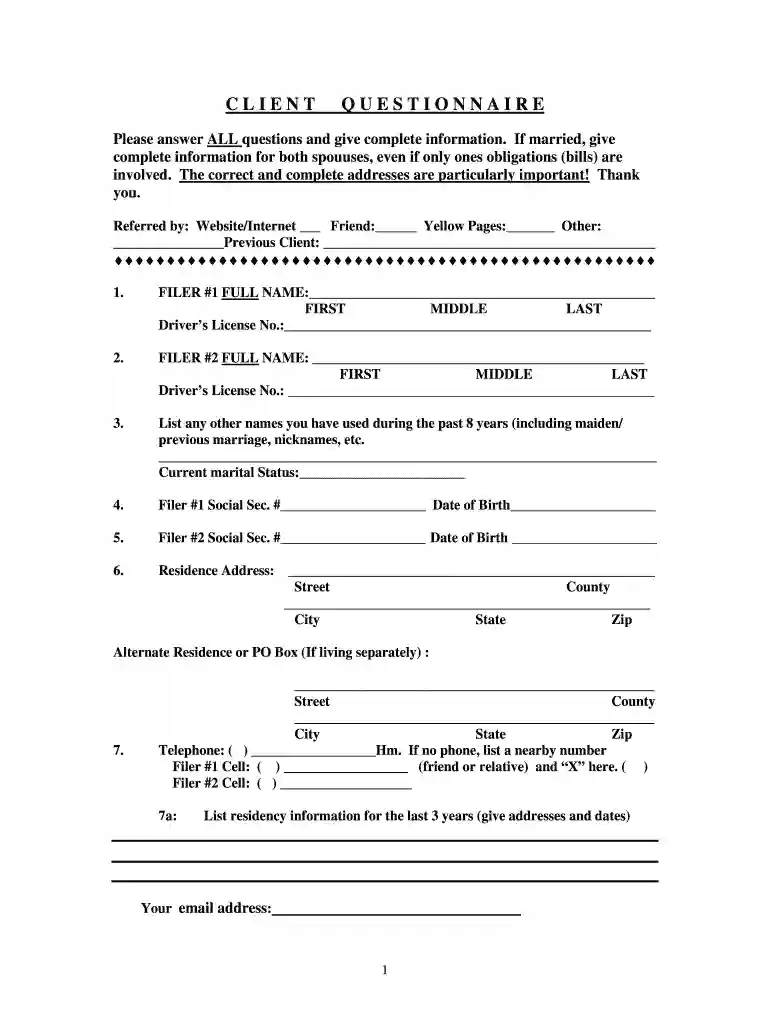
The Client Questionnaire for Bankruptcy serves as a comprehensive form designed to collect critical information from individuals or entities considering filing for bankruptcy. This document offers a structured approach to gathering data regarding debts, assets, income, expenses, and other financial obligations. By completing the questionnaire, clients provide essential information that helps attorneys or financial advisors assess their eligibility for bankruptcy and develop a tailored strategy.
The questionnaire typically includes sections to record personal information, a detailed history of financial transactions, and an overview of current financial positions. Each entry aims to capture the client's economic landscape, ensuring that legal representatives have a thorough understanding of the case. This step-by-step form ensures a methodical and detailed analysis of financial conditions, helping clients make informed decisions about bankruptcy options.
To effectively utilize the Client Questionnaire for Bankruptcy, individuals should follow a structured process. Start by gathering all relevant financial documents, such as pay stubs, tax returns, and bank statements, to ensure accuracy when filling out the form.
Personal Information: Begin with basic personal details, including name, address, and contact information. For married individuals, it is important to include information for both spouses.
Income Documentation: Record all sources of income, including wages, freelance work, and any other earnings. Disclose additional income sources, such as side businesses or rental properties.
Asset Listing: Detail all significant assets, ranging from real estate properties to personal belongings like vehicles or valuable collectibles. Include any joint ownerships or shared property interests.
Debt Inventory: Provide a comprehensive list of debts, including credit card balances, loans, and outstanding medical bills. Include all creditors’ names, contact information, and current balances.
Monthly Expenses: Outline monthly expenditures, covering categories like housing, utilities, groceries, and transportation. Include recurrent and occasional expenses to give an accurate financial picture.
Financial History: Elaborate on any past bankruptcies, judgments, or liens that might impact the current filing, providing context for past financial decisions.
By accurately completing each section, the individual ensures their attorney has a complete financial picture to build a solid bankruptcy case.
Preparing for a successful bankruptcy filing requires a detailed and organized approach to completing the Client Questionnaire. Here are key steps:
Preparation: Gather and organize all financial documents needed to answer questions accurately. This initial step greatly aids in reducing errors and omissions.
Review Each Section: Carefully read each section of the questionnaire to understand what information is required. Take time to familiarize yourself with financial terminology to ensure clarity.
Detailed Responses: Provide detailed answers for each query. Avoid vague responses; specify numbers, dates, and descriptions where applicable.
Use Additional Sheets: If the provided space is insufficient, use additional sheets to include all relevant information. Attach these sheets securely and index them properly for clarity.
Double-Check Entries: Conduct a thorough review of the completed form to ensure all necessary fields are filled correctly and no information is missing.
Seek Clarification: If any part of the questionnaire is unclear, don't hesitate to seek clarification from your attorney or financial advisor. Accurate completion is crucial for a successful filing.
Following these steps ensures that all necessary details are captured accurately, which facilitates a smooth bankruptcy process.
The Client Questionnaire for Bankruptcy includes several critical components that contribute to a clear understanding of the client's financial situation.
Personal and Household Information: This section captures details such as household size and dependents, crucial for calculating allowable expenses and understanding obligations.
Income Sources and Employment Details: Outline current employment status, job title, and employer information, along with any changes in employment over the past two years.
Expenses Breakdown: Detailed records of living expenses provide insight into the cost of living and potential areas for budget adjustments.
Debts and Creditors: Including a clear list of creditors and debt amounts helps in managing negotiations and understanding total financial liabilities.
Property and Asset Documentation: Details of all owned property, along with its current value, help ascertain non-exempt assets that might be liquidated during bankruptcy.
Each element plays a key role in forming an accurate and complete representation of the client's financial situation, essential for determining the appropriate bankruptcy path.
The Client Questionnaire for Bankruptcy provides crucial insights that guide legal proceedings within bankruptcy cases. Legal professionals use the responses to craft a filing strategy that maximizes legal protections while adhering to bankruptcy laws. This document must be completed accurately as it serves as evidence in court, reflecting the client's financial reality.
Confidentiality: Ensures client data is handled with strict confidentiality, as required by legal standards, to protect client privacy and trust.
Strategic Planning: Attorneys use questionnaire data to plan chapters under which to file bankruptcy, such as Chapter 7 or Chapter 13, depending on asset and income eligibility.
Compliance: It ensures compliance with court requirements, including the necessary documentation for timely and accurate submissions to bankruptcy courts.
By outlining the client's complete financial picture, this questionnaire upholds legal principles and ensures a fair trial.
This questionnaire is primarily used by individuals or businesses contemplating bankruptcy but involves several other stakeholders:
Attorneys: Utilize the information to draft legal documents and devise strategic plans to navigate bankruptcy proceedings.
Financial Advisors: Assess the financial health and offer advice on alternatives to bankruptcy or steps post-filing.
Court Officials: Review submitted data to confirm accuracy and ensure compliance with legal conditions.
Bankruptcy Trustees: Analyze the data to manage asset liquidation or payment plans under the selected bankruptcy chapter.
Understanding who utilizes the form typically informs seekers about professional collaborations and document sharing throughout the bankruptcy process.


Navigating bankruptcy requires familiarity with specific financial and legal terminology:
Assets: All properties, cash, investments owned by an individual that could be used to pay creditors.
Liabilities: Debts and obligations that one owes to creditors.
Dischargeable Debt: Debt that can be eliminated through bankruptcy, freeing the individual from necessary repayment.
Exemptions: Properties or values protected by law from being seized or liquidated in bankruptcy.
Trustee: Court-appointed individual overseeing asset management and restructuring in bankruptcy.
Understanding these terms supports efficient completion of the form and helps individuals identify critical areas in their financial profile that influence the bankruptcy process.
At DocHub, your data security is our priority. We follow HIPAA, SOC2, GDPR, and other standards, so you can work on your documents with confidence.


