




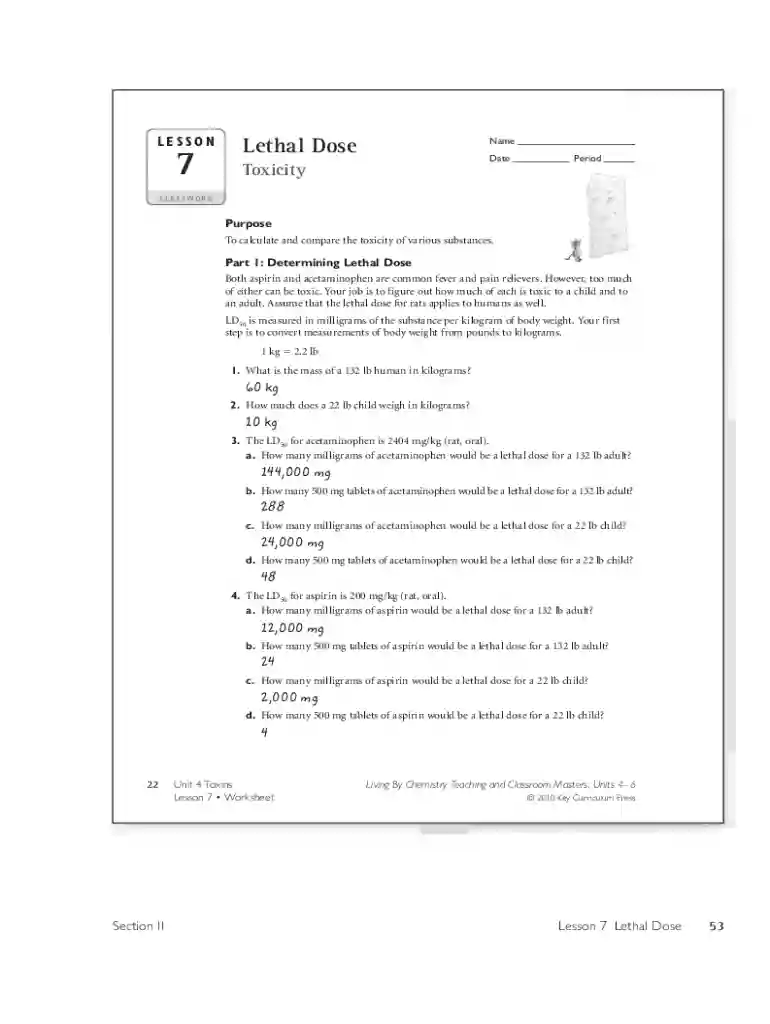
01. Edit your ld50 worksheet online
Type text, add images, blackout confidential details, add comments, highlights and more.

Type text, add images, blackout confidential details, add comments, highlights and more.

Draw your signature, type it, upload its image, or use your mobile device as a signature pad.

Send ld50 worksheet answers via email, link, or fax. You can also download it, export it or print it out.
The "Lethal Dose Worksheet" is a specialized tool designed to evaluate the toxicity levels of various substances by calculating their lethal doses. This worksheet is utilized in educational settings, particularly in chemistry and biology fields, to help students understand how different substances interact with biological systems. The worksheet enables users to compare the toxicity of common drugs, chemicals, and other compounds, thus providing a practical approach to studying dose-response relationships in toxicology.
The Lethal Dose Worksheet typically includes several key components:
Utilizing the worksheet involves several steps:
Completing the worksheet effectively requires careful attention to detail:
Understanding key terms is essential to navigate the worksheet proficiently:
In the United States, the legal application of the Lethal Dose Worksheet primarily involves educational and research settings. The worksheet can be part of a curriculum designed to teach students about toxicology principles. It is important to adhere to ethical guidelines and federal regulations while conducting experiments or teaching exercises involving potentially hazardous substances.
Practical examples can enhance the learning experience:
While there is a general framework for using the Lethal Dose Worksheet, educational institutions may have additional state-specific requirements. This could involve regulations on conducting experiments with certain toxic substances or requiring specific teacher certifications to supervise such activities. It's crucial to consult local educational authorities to ensure compliance with all applicable guidelines.
The Lethal Dose Worksheet can be adapted for use in both digital and paper formats. Digital versions are often compatible with tools like DocHub, which allows for real-time collaboration and flexible document management. This can streamline the process of editing, saving, and sharing the worksheet, especially in a research environment, where multiple individuals might be adding data or analyzing results concurrently.
At DocHub, your data security is our priority. We follow HIPAA, SOC2, GDPR, and other standards, so you can work on your documents with confidence.
A highly toxic material produces a lethal dose or lethal concentration which falls within any of the following categories: 1. A chemical that has a medianRead more
IMPORTANT: This guidance document was developed for use on the web. Please review the following disclaimers before using the PDF version of the web-basedRead more
Purpose: In this activity you will compare the toxicity of various substances. Lethal Dose (LD50) is the amount of an ingested substance that kills 50 percentRead more


