




01. Edit your form online
Type text, add images, blackout confidential details, add comments, highlights and more.

Type text, add images, blackout confidential details, add comments, highlights and more.

Draw your signature, type it, upload its image, or use your mobile device as a signature pad.

Send it via email, link, or fax. You can also download it, export it or print it out.
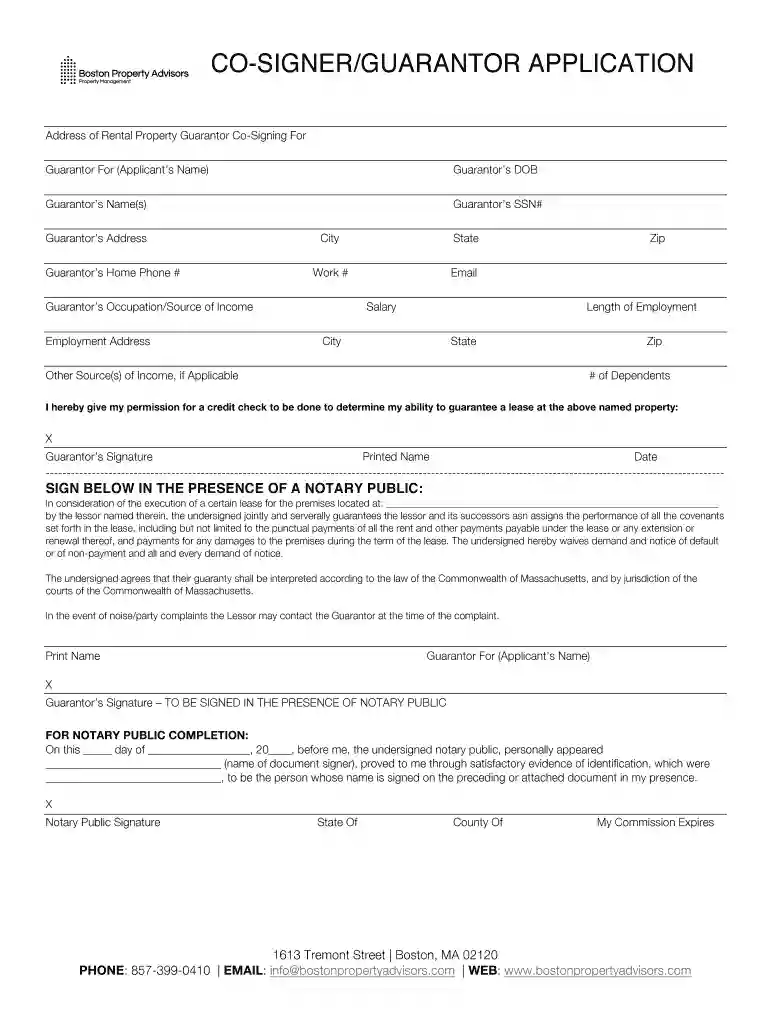
The Co-Signer Guarantor Application serves as a formal document that commits an individual, known as the guarantor, to cover financial obligations if the primary applicant fails to meet them. This application is particularly vital in scenarios such as rental agreements or loan applications, where an entity requires assurance of payments. The form is legally binding and outlines responsibilities and rights associated with being a co-signer or guarantor.
Consider a college student renting their first apartment. Without a substantial credit history, landlords may require a Co-Signer Guarantor Application from a financially secure relative who agrees to cover rent if the student defaults.
Gather Personal Information: The form will require data such as full name, address, contact details, and Social Security Number.
Provide Financial Details: Include income sources, bank details, and other financial commitments to demonstrate the ability to fulfill potential obligations.
Detail Specific Obligations: Specify what commitments you are co-signing for, such as rental payments or a loan, and confirm the terms.
Sign the Agreement: Review the entire document carefully, ensure all information is correct, and sign in the designated area to formalize the guarantee.
Students and Young Adults: These groups often lack sufficient credit history and require a guarantor to secure housing or loans.
Entrepreneurs and Small Business Owners: A well-established individual may co-sign to secure a business loan, particularly when the business has limited creditworthiness.


A newly formed LLC seeking to lease office space may require a seasoned entrepreneur as a co-signer to reassure landlords of reliable payment.
Guarantor: The individual who agrees to be responsible for someone else's debt or obligations in case of default.
Primary Applicant: The main person who initially applies and is responsible for the agreement unless they default.
Obligation Type: The specific responsibility being guaranteed, like rent payments or a loan.
Understanding these terms is crucial, as they define the roles and responsibilities that each party assumes within the agreement.
The Co-Signer Guarantor Application is legally recognized across the United States and provides a safety net for creditors by ensuring debt recovery through a guarantor. The legal framework supporting this application ensures that obligations are met, promoting trust between the lender and borrower.
If a tenant defaults on the rent, the landlord can legally pursue payment from the guarantor as stipulated in the agreement, making it enforceable in a court of law if necessary.
Identity Verification: Requires valid identification to ensure the correct parties are involved.
Financial Snapshot: An overview of the guarantor's financial position to evaluate their ability to cover potential defaults.
Terms and Conditions: Detailed conditions under which the guarantor will assume responsibility.
These elements reinforce the application's intent to protect creditors, verifying both the identity and the financial competence of the guarantor to prevent fraud or misunderstanding.
While the application is standard, some states have unique laws or regulations, such as additional disclosure requirements or limits on the amount a guarantor can assume responsibility for.
California mandates certain disclosures to guarantors about the potential outcomes and liabilities they face, offering an added layer of consumer protection not required in all states.
To accompany the Co-Signer Guarantor Application, you will typically need:
Identification Documents: Passport or driver's license for identity verification.
Proof of Income: Recent pay stubs or tax returns to show financial stability.
Credit Report: Often required to evaluate the guarantor's creditworthiness.
Bank Statements: Recent statements to confirm available funds and sound financial status.
Having these documents readily available can expedite the application process and provide the necessary assurance to the primary party requiring the guarantee.
At DocHub, your data security is our priority. We follow HIPAA, SOC2, GDPR, and other standards, so you can work on your documents with confidence.


I understand that my signature hereto is only an acknowledgement of the receipt of this notice and is not intended to obligate me on the debt described above.Read more
A guarantor is a person who will co-sign an apartment lease alongside a tenant, guaranteeing to pay the rent if the tenant fails to do so.Read more


