







Definition & Meaning
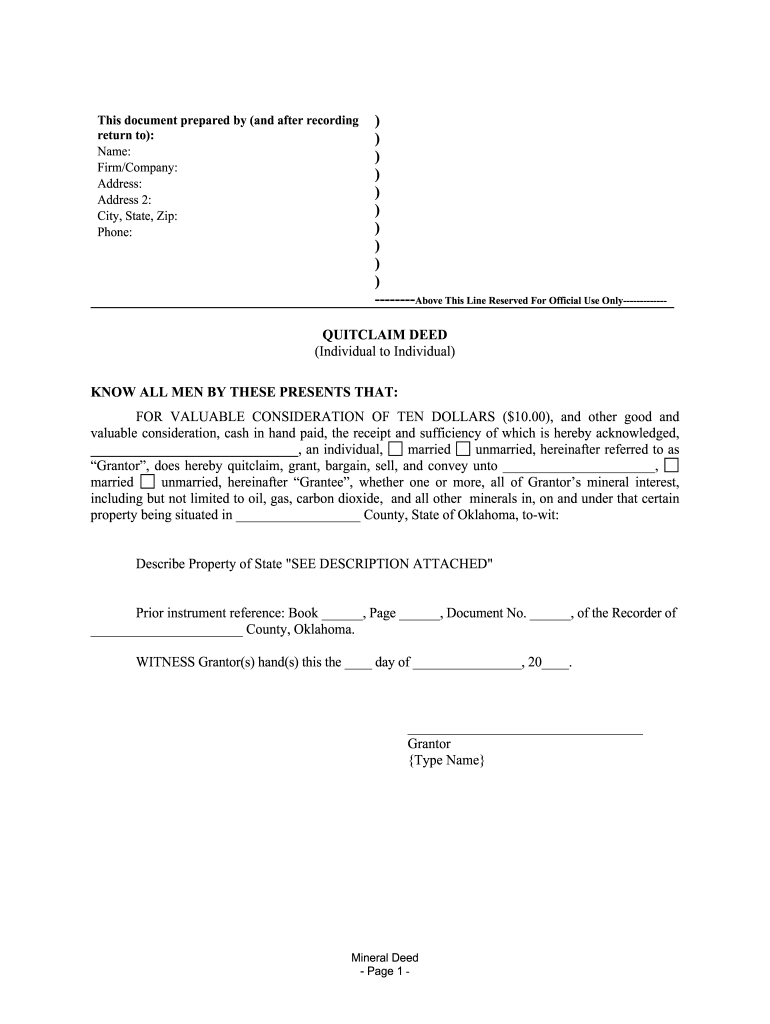
The Oklahoma Quitclaim Mineral Deed is a legal instrument used to transfer ownership or interest in mineral rights in Oklahoma from one party to another without making any warranties about the title. This type of deed is often utilized when the grantor, who is transferring the rights, does not guarantee the quality of the title or when the relationship between the grantor and grantee is based on trust. By using a quitclaim deed, the grantee takes on the risk of any defects in the title, which might include existing liens or other encumbrances.
Key Characteristics
- No Warranties: Unlike warranty deeds, quitclaim deeds offer no guarantees about the title's status, leaving the grantee to assume any risks.
- Simplicity: Often used for straightforward transfers, such as between family members or to resolve title discrepancies.
- Efficiency: Easier and quicker to draft compared to other types of deeds.
Key Elements of the Oklahoma Quitclaim Mineral Deed
The Oklahoma Quitclaim Mineral Deed contains several critical elements that must be accurately completed to ensure its validity:
- Grantor and Grantee Identification: Names and, often, addresses of both parties are required to establish who is transferring the rights and who is receiving them.
- Legal Description of Mineral Rights: A detailed legal description of the property or mineral rights being conveyed must be included to avoid ambiguity.
- Consideration: The deed should mention the amount of consideration (usually a nominal amount) or value exchanged for the transfer, signaling an intention to convey the rights.
- Date of Execution: It should include the date on which the deed is executed, as this can affect rights and obligations.
- Signatures: The document must be signed by the grantor and ideally notarized to enhance its enforceability.
Steps to Complete the Oklahoma Quitclaim Mineral Deed
Completing an Oklahoma Quitclaim Mineral Deed requires several precise steps to ensure that all legal requirements are met:
- Gather Information: Collect full names, addresses, and the legal description of the property or mineral rights.
- Draft the Deed: Use a template or legal form specific to Oklahoma quitclaim deeds and input the gathered information.
- Determine Consideration: Decide on a nominal consideration, such as $10, which is common in quitclaim transfers.
- Sign and Notarize: Both parties should sign the deed in the presence of a notary public who will affix their seal.
- Record the Deed: File or record the executed deed with the county clerk’s office where the property is located to provide public notice and complete the transfer.
Legal Use of the Oklahoma Quitclaim Mineral Deed
The Oklahoma Quitclaim Mineral Deed is used primarily for transfers involving mineral rights and typically under certain conditions:
- Private Transactions: Often employed in private transactions, such as transfers within families, clarifying ownership among heirs, or between business partners.
- Dispute Resolution: Utilized to resolve or settle disputes regarding ownership when the title's status is uncertain.
- Trust-Based Transfers: Suitable for situations where the grantee trusts the grantor to not make any title guarantees.
State-Specific Rules for the Oklahoma Quitclaim Mineral Deed
Oklahoma imposes specific rules and standards to which all quitclaim mineral deeds in the state must adhere:
- Recording: It's essential to record the deed in the county where the mineral rights are located, as failure to do so might not provide public notice.
- Taxes and Fees: The transfer might be subject to state and local taxes or fees, depending on the consideration stated and other factors.
- Legal Requirements: Oklahoma law requires that deeds convey at least a minimal amount of consideration, even if symbolic, to establish an enforceable transfer.
Examples of Using the Oklahoma Quitclaim Mineral Deed
The Oklahoma Quitclaim Mineral Deed often comes into play in scenarios such as:
- Family Transfers: Transferring mineral rights from parents to children as part of estate planning.
- Partnerships and Corporations: Among business entities to redistribute ownership shares without involving warranty commitments.
- Dispute Settlements: Settling claims or disputes over uncertain or overlapping mineral rights.
Who Typically Uses the Oklahoma Quitclaim Mineral Deed
The use of quitclaim mineral deeds is prevalent among various groups who require flexible and quick transfer processes:
- Private Landowners: Individuals looking to clarify or recognize ownership among family members or co-owners.
- Estate Attorneys: Lawyers facilitating the transfer of mineral rights during probate or estate settlement.
- Real Estate Developers: Professionals handling mineral rights as a part of larger projects or land acquisitions.


Important Terms Related to Oklahoma Quitclaim Mineral Deed
Understanding critical terminology associated with the Oklahoma Quitclaim Mineral Deed is vital for its effective use:
- Grantor: The person or entity transferring the interest in mineral rights.
- Grantee: The recipient of the transferred rights.
- Consideration: The value exchanged for the transfer, not necessarily monetary.
- Recording: The process of filing the deed with the appropriate county to provide legal notice of the transfer.




