




01. Edit your form online
Type text, add images, blackout confidential details, add comments, highlights and more.

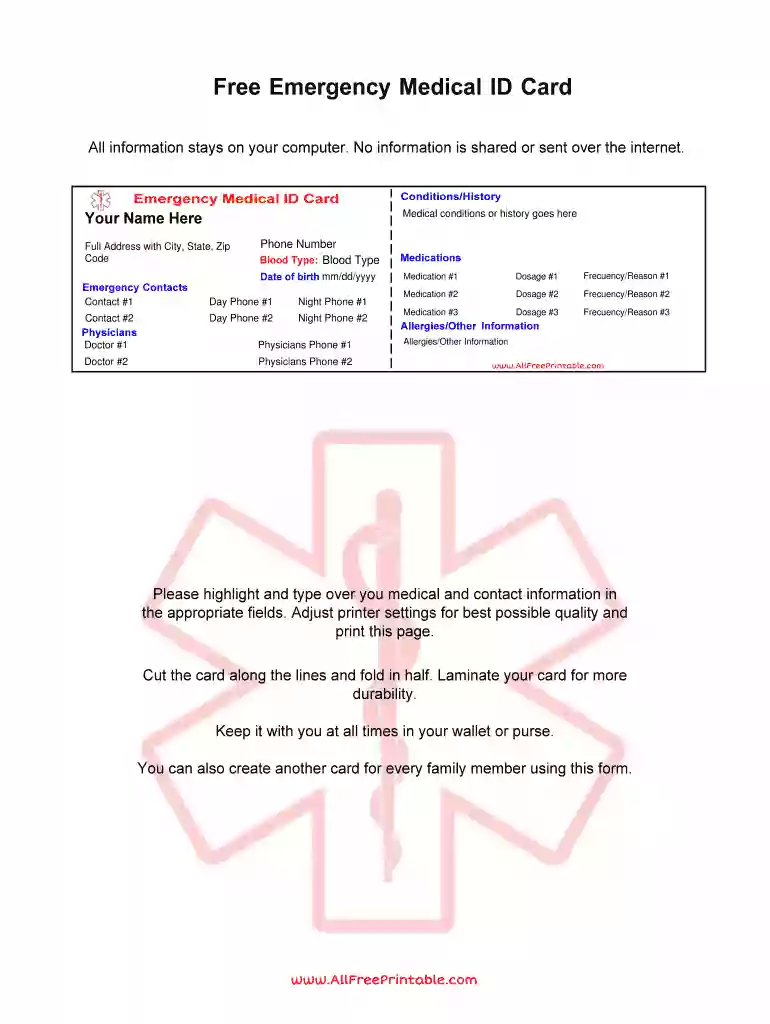
Type text, add images, blackout confidential details, add comments, highlights and more.

Draw your signature, type it, upload its image, or use your mobile device as a signature pad.

Send it via email, link, or fax. You can also download it, export it or print it out.
An Emergency Medical ID Card is a critical document designed to provide immediate and essential medical information to first responders during an emergency situation. This card typically includes personal medical details such as allergies, medical conditions, medications currently being taken, and contact information for family members or healthcare providers. Its primary purpose is to ensure that medical personnel are informed about a person's health needs when time is of the essence. By offering a concise, accessible snapshot of an individual’s medical profile, these cards can play a crucial role in preventing treatment errors and enhancing patient safety.
Moreover, an Emergency Medical ID Card is often considered a vital part of emergency preparedness, especially for individuals with complex medical histories or chronic conditions. Anyone prone to severe allergic reactions, taking multiple medications, or requiring specific treatments should carry an Emergency Medical ID Card to facilitate rapid and accurate medical intervention.
To maximize the utility of an Emergency Medical ID Card, individuals should carry it in a place where it can be readily located by first responders. Common storage places include a wallet, purse, or the glove compartment of a car. It is equally important to regularly update the card to ensure the information accurately reflects their current medical status and contact information. This could include recent diagnoses, new allergies, or changes in medication regimes.
Additionally, consider using digital solutions or apps linked to wearable devices for more tech-savvy users. These digital IDs can be updated more conveniently and can store more detailed medical histories that might not fit on a physical card. However, having a physical copy remains vital, as technology might not always be accessible in every emergency scenario.
Gather Personal Information: Start with basic details like your full name, date of birth, and emergency contact numbers.
Medical Information: Include all known allergies, current medications, chronic conditions, and recent surgeries. Details about blood type and any life-saving measures that should or should not be taken can also be highly valuable.
Emergency Contacts: Provide names and phone numbers of family members or friends who should be notified in case of an emergency, ensuring they are aware of your medical background.
Storage and Accessibility: Decide on the most practical method for carrying the card and consider notifying loved ones about where it is kept.
Reviewing these steps periodically is essential, especially after any significant health changes to ensure the information remains relevant and accurate, thus optimizing its effectiveness in emergencies.
An Emergency Medical ID Card should be comprehensive yet concise. The key elements typically include:
These elements ensure that comprehensive and pertinent information is readily available to enhance medical decision-making during critical moments.
Emergency Medical ID Cards are often utilized by individuals with unique medical needs or complex medical histories. This includes:
The Emergency Medical ID Card can be a legally valuable resource, although it is primarily informational. It does not generally alter consent requirements under medical law but can facilitate decision-making in urgent situations. In the United States, it may serve as a directive or supplement consent, especially in cases where an individual might be unable to communicate effectively.
While not a substitute for legal documents like living wills or advance directives, emergency personnel may use the information from a Medical ID Card to make initial treatment decisions. Therefore, it's crucial for users to ensure their Medical ID Card is updated regularly to reflect the most current and accurate medical information possible.
To acquire an Emergency Medical ID Card, several options are available:
Ensuring your Emergency Medical ID Card is easily obtainable and updated can greatly improve your preparedness during unforeseen medical crises.
Consider the following scenarios to understand the practical applications of an Emergency Medical ID Card:
These examples illustrate how having an Emergency Medical ID Card can make a meaningful difference during emergencies by guiding medical personnel toward safe, appropriate treatment based on accurate medical histories.
At DocHub, your data security is our priority. We follow HIPAA, SOC2, GDPR, and other standards, so you can work on your documents with confidence.
Lifesign Scan is a weapon from the Emergency Meeting DLC of Vampire Survivors. It is the starting weapon of Ghost Lino. It is unlocked by getting itself toRead more
Provide emergency medical information with this emergency medical id card template. Choose from 200+ professionally designed and completely customizable free idRead more
An emergency health information card should contain information about medications, equipment you use, allergies and sensitivities, communication difficultiesRead more


