







Definition & Meaning
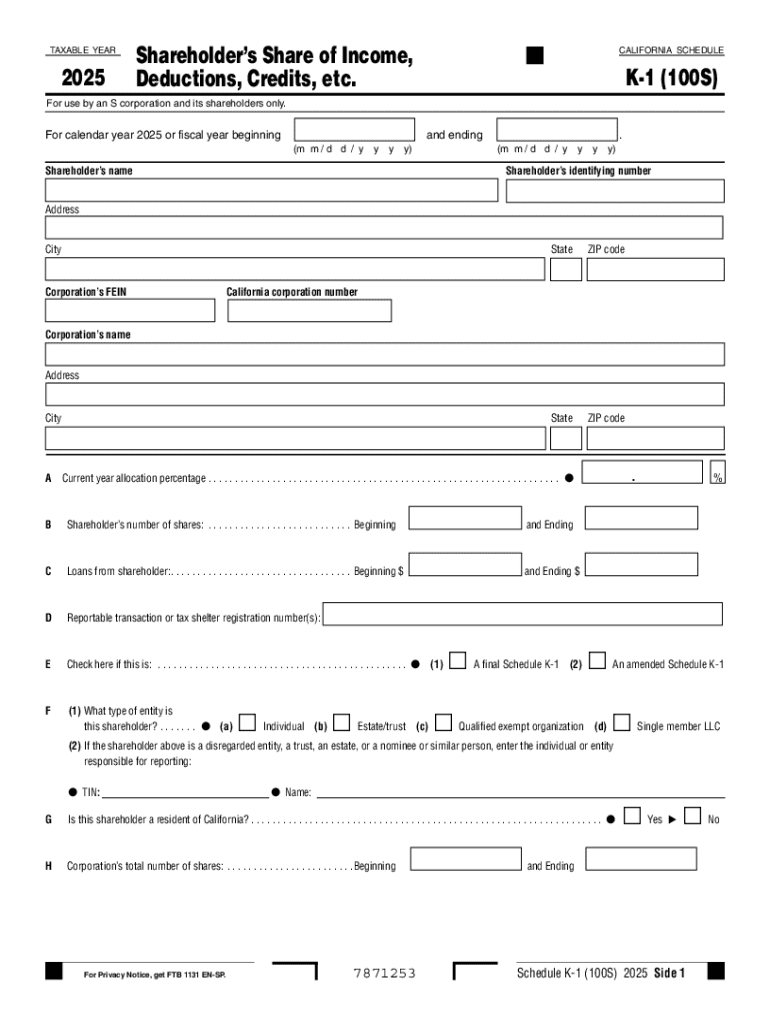
The California Schedule K-1 (100S) 2025 is a tax form specifically designed for S corporations and their shareholders. It details each shareholder's share of the corporation's income, deductions, credits, and other financial information required for their personal tax returns. As a critical component of tax compliance for S corporations, the form ensures shareholders accurately report financial distributions and are taxed appropriately on their personal state tax filings.
How to Use the California Schedule K-1 (100S) 2025
Shareholders use the California Schedule K-1 (100S) 2025 to report their respective shares of an S corporation's income, credits, deductions, and other pertinent financial details on their personal tax returns. Each shareholder receives a copy of the form from the S corporation, which they use to transfer the reported data onto their individual tax forms, ensuring compliance with California state tax laws.
- Calculate total income: Include all income segments such as dividends, rental income, and capital gains.
- Record deductions and credits: Accurately input all applicable deductions and credits as specified.
- Verify accuracy: Cross-check all figures against individual financial records and the corporation’s tax filings.
Steps to Complete the California Schedule K-1 (100S) 2025
Completing the California Schedule K-1 (100S) 2025 involves meticulous attention to detail. Follow these steps for accurate completion:
- Obtain the form: Ensure the corporation provides the latest version of Schedule K-1.
- Review instructions: Carefully read IRS instructions and guidelines specific to the California Schedule K-1 (100S) for 2025.
- Input income data: Record total income as allocated to each shareholder.
- Account for deductions and credits: Enter all applicable deductions and tax credits.
- Verify personal information: Ensure that personal details are correct and match those on corresponding tax filings.
- Sign and share: Finalize the form with appropriate signatures and share copies with all shareholders.
Key Elements of the California Schedule K-1 (100S) 2025
Understanding the key components of the California Schedule K-1 (100S) 2025 is essential for compliance and reporting. The form includes:
- Shareholder information: Personal and contact details of each shareholder.
- Income categories: Detailed breakdowns of income types, including ordinary business income, interest, and dividends.
- Deductions and credits: Allocated deductions, such as business deductions, and available tax credits.
- Other financial data: Additional sections for miscellaneous income and specific allocations pertinent to shareholders.
State-Specific Rules for the California Schedule K-1 (100S) 2025
California imposes unique state-specific rules for interpreting and using Schedule K-1 (100S). Key considerations include:
- Timing and filing procedures: Timelines and stipulations issued by the California Franchise Tax Board.
- State deductions: Unique California deductions affecting shareholder tax allocations.
- Compliance standards: Rigorous adherence to state guidelines for reporting and documentation.
Examples of Using the California Schedule K-1 (100S) 2025
Real-world scenarios demonstrate the practical usage of the California Schedule K-1 (100S) 2025:
- Start-up S corporation: A new S corporation distributing initial income and corresponding taxes via Schedule K-1.
- Established corporation with multiple shareholders: An S corporation distributing diverse income and deduction allocations among numerous stakeholders.
- S corporation with significant deductions: Effectively applying and reporting allowable deductions to reduce shareholder taxable income accurately.
Important Terms Related to California Schedule K-1 (100S) 2025
Several crucial terms pertain to using the California Schedule K-1 (100S) 2025:
- Pass-through entity: Refers to the tax nature of an S corporation where income or losses pass through to the shareholders.
- Allocation: The distribution of income, deductions, and credits among shareholders based on ownership percentage.
- Distribution: The actual payment or credit of profits to shareholders, recorded on Schedule K-1.
Filing Deadlines / Important Dates
Adhering to deadlines is a vital aspect of tax compliance. Key dates include:
- March 15: General deadline for S corporations to send Schedule K-1 forms to shareholders.
- April 15: Individual tax filing deadline where taxpayers incorporate Schedule K-1 data into their returns.
- Extended deadlines: For corporations and individuals who apply for extensions, essential to monitor any amended deadlines for submissions.
Required Documents
Proper completion of the California Schedule K-1 (100S) 2025 requires specific documentation:
- Shareholder agreements: Original documents reflective of shareholder stakes.
- Financial statements: Verified income statements, balance sheets, and other necessary financial documents.
- Previous tax filings: Past Schedule K-1 forms for cross-reference while preparing current year filings.




