






Definition & Meaning
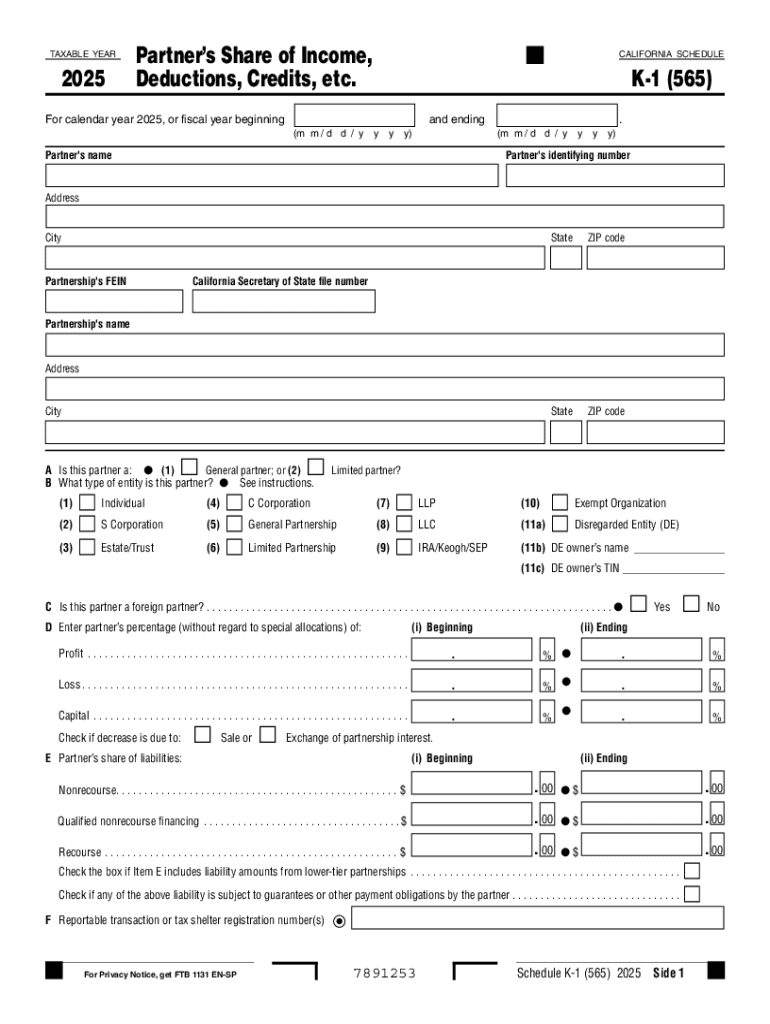
California Schedule K-1 (565) 2025 is a crucial tax form used by partnerships in California to report each partner's share of the partnership's income, deductions, credits, and other tax-related information. This form is specifically designed to provide transparency and ensure that individual partners accurately reflect their portion of the partnership's fiscal activities on their personal tax returns. The form is part of the larger California Form 565, which is the state equivalent of the federal Schedule K-1.
Key Components
- Income and Losses: Details each partner's share of the partnership's income or losses, which can be from regular business operations or investment activities.
- Deductions: Lists any deductible expenses that are allocated to each partner.
- Credits: Includes information on tax credits that the partnership can pass through to its partners.
How to Use the California Schedule K-1 (565) 2025
This form is used by partners to report their portion of a partnership's earnings and financial activities on their personal tax returns.
- Review: Ensure all personal information and allocation percentages are correct.
- Interpret Income: Understand taxable income, which could influence personal tax liability.
- Apply Deductions and Credits: Recognize eligible deductions and credits that can be used to lower overall tax obligations.
Best Practices
- Consult a Tax Professional: Consider hiring an accountant for complex tax situations.
- Verify Allocations: Check that income and deductions align with partnership agreements.
- Keep Records: Maintain documentation to support any figures reported.
Steps to Complete the California Schedule K-1 (565) 2025
Filing the California Schedule K-1 (565) requires systematic attention to detail.
- Gather Necessary Documents: Collect the partnership agreement, prior K-1s, and financial statements.
- Fill In Personal Details: Start with basic information including the partner’s name, address, and tax identification number.
- Report Income: Enter the total distributed share of income as calculated by the partnership.
- Detail Deductions and Credits: Accurately reflect both standard and special deductions.
- Review and Adjust: Confirm all entries before submission to ensure accuracy and compliance with both state and federal tax laws.
Considerations
- New Tax Laws: Stay updated on changes in tax legislation affecting partnership taxation.
- Amended Returns: Be prepared to amend returns if information on Schedule K-1 changes.
Key Elements of the California Schedule K-1 (565) 2025
Several components are critical for the proper completion and submission of this form.
Allocation Percentages
The schedule outlines each partner’s ownership percentage, which determines how income, deductions, and credits are allocated.
- Fixed vs. Variable Shares: Some partnerships may have dynamic shares based on performance or business agreements.
- Impact on Taxes: These percentages directly affect individual tax responsibility.
Income Categories
Identifying and categorizing income correctly is paramount for taxation:
- Ordinary Business Income: Standard earnings from partnership activities.
- Interest and Dividends: Additional income sources that can affect overall tax liability.
Legal Use of the California Schedule K-1 (565) 2025
This form must be used in compliance with California’s state tax laws and regulations.
Compliance Requirements
- Timely Filing: File by the partnership return deadline to avoid penalties.
- Accurate Reporting: Ensure all figures accurately represent the partnership's financial activities.
Consequences of Misreporting
- Financial Penalties: Inaccurate submissions can lead to fines.
- Legal Repercussions: May trigger audits or further legal investigations.
Important Terms Related to California Schedule K-1 (565) 2025
Common Language and Terminology
- Distributive Share: The allocation of partnership income among partners based on agreements.
- Pass-Through Entity: Partnerships generally don't pay taxes; instead, they pass income to partners.
- Partnership Agreement: Legal document dictating the terms and conditions of the partnership.
Filing Deadlines / Important Dates
Timeliness is critical when dealing with tax forms.
- Regular Submission: Generally due by the 15th day of the third month following the end of the partnership's tax year.
- Extensions: Partnerships may apply for an extension, usually resulting in a six-month grace period.
Taxpayer Scenarios
Different scenarios affect how the form is completed.
- Self-Employed: Partners who operate as self-employed need to consider self-employment taxes.
- Students or Retired Individuals: May have unique considerations for tax credits and exclusions.


Real-World Implications
- Business Growth: New partners or changes in shares can significantly alter tax outcomes.
- Economic Hardships: Losses can affect the amount of taxable income reported by the partner.
Each section provides insights into how the California Schedule K-1 (565) 2025 is utilized by various entities and individuals involved in partnerships. This thorough examination ensures readers are well-prepared for accurate reporting and compliance with California's tax obligations.