




01. Edit your form online
Type text, add images, blackout confidential details, add comments, highlights and more.

Type text, add images, blackout confidential details, add comments, highlights and more.

Draw your signature, type it, upload its image, or use your mobile device as a signature pad.

Send it via email, link, or fax. You can also download it, export it or print it out.
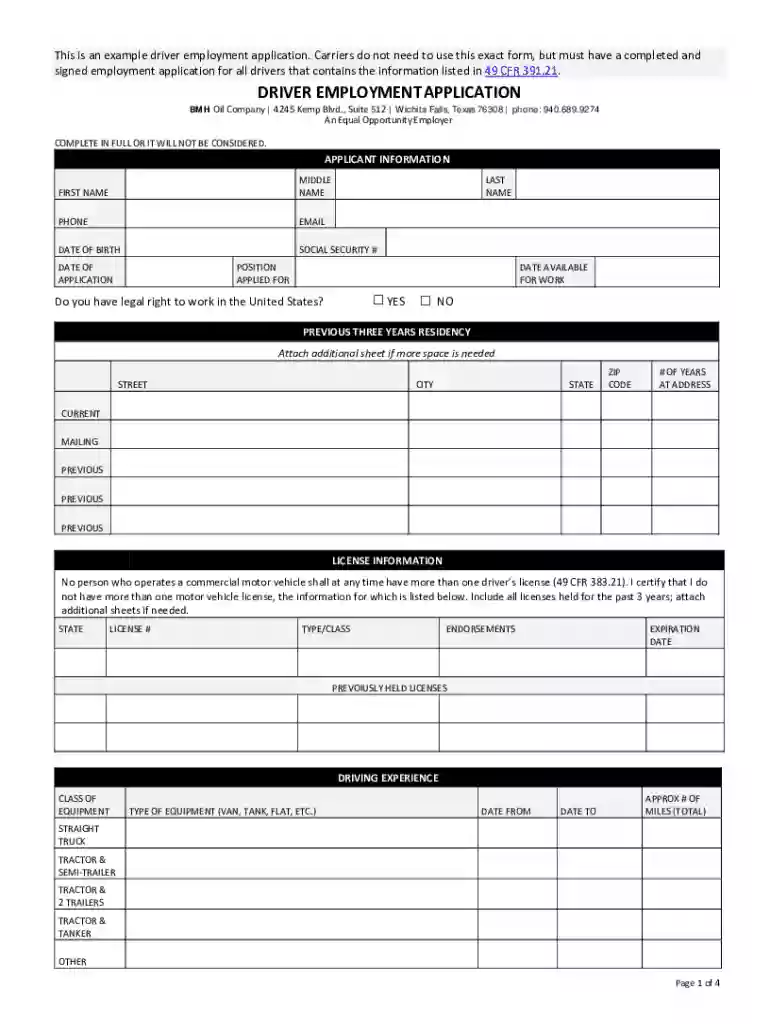
The Driver Employment Application is a comprehensive form used in the transportation industry to evaluate and onboard prospective drivers. This document collects vital information about an applicant's driving history, qualifications, and personal details to assess their suitability for employment. By ensuring that all pertinent data is gathered, the application aids employers in maintaining compliance with federal and state regulations, such as those enforced by the Federal Motor Carrier Safety Administration (FMCSA). Additionally, it safeguards businesses by documenting a candidate's employment history and eligibility to operate commercial vehicles legally.
Personal Information:
Employment History:
Driving Experience:
Certification and Endorsements:
Completing the Driver Employment Application involves a systematic approach to ensure all necessary information is provided accurately.
Gather Required Documents:
Fill Out Personal and Contact Information:
Detail Employment History:
Outline Driving Experience and Records:
Verify Certification and Endorsements:
The application is utilized extensively by logistics companies, transportation agencies, and courier services. It serves as a critical tool not only for hiring managers and HR professionals within these organizations but also for independent contractors seeking to establish partnerships with freight companies. Moreover, it assists the FMCSA and state licensing bodies during audits to verify the compliance and record-keeping practices of transportation firms.


Freight and Logistics:
Passenger Transport:
Commercial Delivery Services:
The integrity of the Driver Employment Application is crucial for legal compliance. It aligns with federal guidelines set by the FMCSA, ensuring drivers employed under DOT (Department of Transportation) regulations meet all qualifications for operating commercial vehicles. Employers must maintain these applications on file for a minimum of three years as required by law, providing evidence of due diligence in hiring and adherence to legal standards.
Record Retention:
Accurate Documentation:
In the modern work environment, digitizing the Driver Employment Application has brought multiple conveniences and efficiencies, supporting electronic completion and submission methods. This transition also offers the advantage of integrated data analysis and centralized document archiving.
Efficiency and Accessibility:
Environmentally Friendly:
Software Integration:
Security Measures:
By comprehending these detailed elements of the Driver Employment Application, companies can efficiently assess potential hires while maintaining compliance with legal mandates. This efficiency ensures that businesses are both legally protected and operationally optimized in their hiring processes.
At DocHub, your data security is our priority. We follow HIPAA, SOC2, GDPR, and other standards, so you can work on your documents with confidence.
Carriers do not need to use this exact form, but must have a completed and signed employment application for all drivers that contains the information listed inRead more
DRIVER APPLICATION FOR EMPLOYMENT. COMPANY: STREET ADDRESS: CITY, STATE AND ZIP CODE : NAME: ADDRESS: HOW LONG: DATE OF BIRTH: SOCIAL SECURITY NO: TELEPHONERead more


