
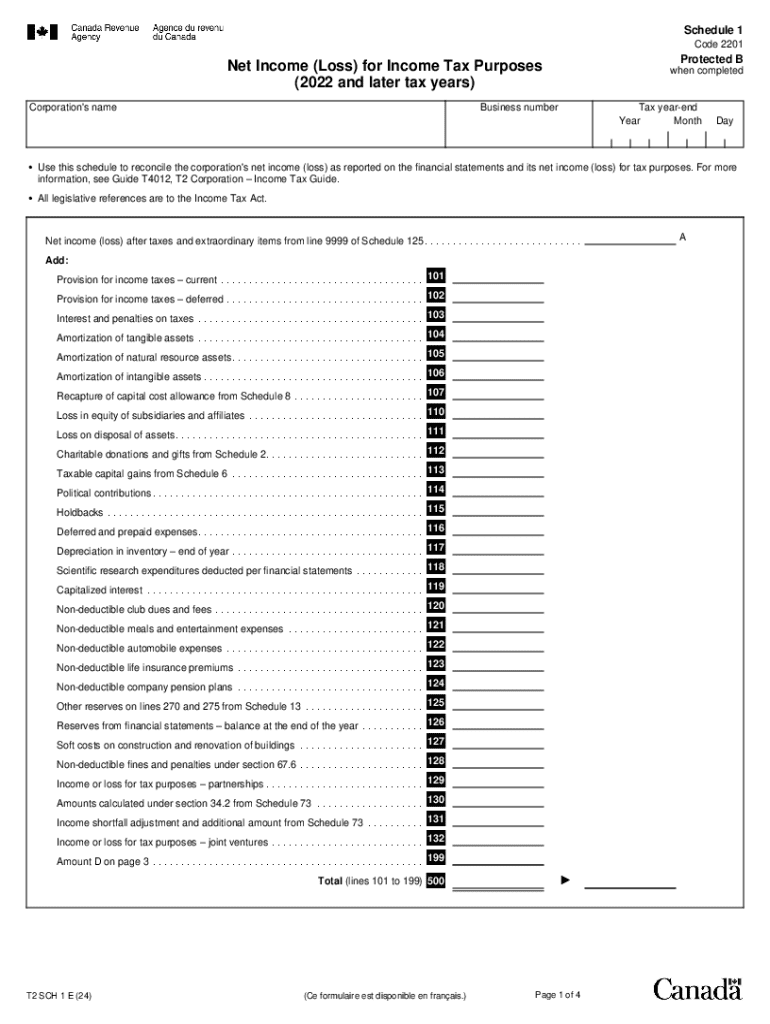







Definition and Purpose of Schedule 1 Net Income for Tax Purposes
The "Schedule 1 Net Income for Tax Purposes" is an essential tax form used in the U.S. to reconcile the net income reported on a financial statement with the taxable income for corporations. It ensures that the income reported aligns with tax regulations and captures necessary adjustments for deductions, exemptions, and credits not reflected in the financial statements. Understanding this form is vital for accurately reporting taxable income, keeping businesses compliant with IRS standards, and identifying potential areas of tax savings.
Detailed Explanation of Components
Schedule 1 captures various adjustments to the net income, such as:
- Non-deductible expenses: Includes items that cannot be deducted from taxable income due to IRS regulations.
- Capital gains and losses: Adjustments made for capital transactions that impact taxable income.
- Depreciation and amortization: Differences in book and tax depreciation methods affecting net income.
- Charitable contributions: Limits and adjustments applicable for contributions to qualified organizations.
- Deferred tax assets and liabilities: Accounting for timing differences that may affect taxable income.
How to Use the Schedule 1 Net Income for Tax Purposes
Using the Schedule 1 form involves aligning your corporation's financial data with IRS tax requirements. This process includes gathering financial records to ensure each adjustment can be substantiated, completing the form with these adjustments, and ensuring accuracy through verification checks.
Step-by-step Instructions
- Gather Financial Statements: Collect the corporation's income statement, balance sheet, and supporting schedules.
- Identify Adjustments: Recognize items that need to be adjusted from the financial net income to match tax regulations.
- Fill the Form: Enter your financial figures into the relevant sections of the Schedule 1 form, ensuring clarity and accuracy.
- Verify Entries: Double-check each entry for accuracy to avoid discrepancies with the IRS.
- Review and Submit: Submit the completed Schedule 1 with the corporation's tax return form.
How to Obtain the Schedule 1 Net Income for Tax Purposes
Obtaining the Schedule 1 form is straightforward and can be done through multiple channels, ensuring flexibility for various preferences and needs.
Access Methods
- IRS Website: Direct download from the IRS site is available, ensuring the most up-to-date form version.
- Tax Software: Integrated access through tax software solutions, which provide automated updates.
- Professional Accountants: Certified public accountants can supply the form and assist in its completion.
Steps to Complete the Schedule 1 Net Income for Tax Purposes
Completing Schedule 1 requires meticulous attention to financial details and regulatory compliance.
Detailed Process Overview
- Initial Preparation: Compile all necessary financial documents for accurate reference.
- Analyze Adjustments: Identify and calculate all necessary tax adjustments to be made from the book income.
- Form Completion:
- Enter adjusted income figures on the form.
- Allocate adjustments appropriately to enhance clarity.
- Review for Errors: Conduct a thorough review to ascertain all entries are correct and backed by documentation.
- Submission: File the completed Schedule 1 as part of the corporation's annual tax return.
Why You Should Use Schedule 1 Net Income for Tax Purposes
Utilizing Schedule 1 is critical for both mandatory compliance and strategic financial management.
Benefits and Importance
- Compliance with IRS Rules: Ensures that all income and deductions are reported in accordance with IRS mandates.
- Tax Liability Accuracy: Helps in precisely calculating the tax liability, potentially reducing over-payments.
- Audit Readiness: Provides a detailed record of any adjustments, providing clarity during audits.
Who Typically Uses the Schedule 1 Net Income for Tax Purposes
The Schedule 1 form is primarily used by corporations aiming to reconcile their financial statement's net income with taxable income.


Target Entities
- Corporations: Especially those with complex financial structures requiring detailed tax adjustments.
- Tax Consultants and CPAs: Professionals assisting corporations in ensuring compliance and optimizing tax liabilities.
- Large Business Entities: Those with significant non-deductible expenses or deferred tax considerations.
Important Terms Related to Schedule 1 Net Income for Tax Purposes
Understanding the terminology used in Schedule 1 aids in the accurate completion and comprehension of the form.
Key Terms
- Non-deductible Expenses: Costs incurred by a business that cannot be subtracted when calculating taxable income.
- Depreciation: The allocation of an asset's cost over its useful life, with tax-specific implications.
- Tax Credit: Reductions in tax liability directly deducted from the owed tax rather than income.
IRS Guidelines for Schedule 1 Net Income for Tax Purposes
The IRS provides specific guidelines regarding the use and completion of Schedule 1.
Compliance and Guidance
- IRS Publications: Refer to IRS resources for detailed explanations and examples of how specific items should be treated.
- Revenue Procedures: Essential for understanding the changes in taxation rules that impact Schedule 1.
- Instruction Manuals: Each form comes with an instruction manual detailing step-by-step guidance for accurate completion.
Properly understanding and using the Schedule 1 form ensures that businesses remain compliant with tax laws while accurately reporting their taxable income, ultimately benefiting from all applicable tax strategies.




