






Definition and Meaning
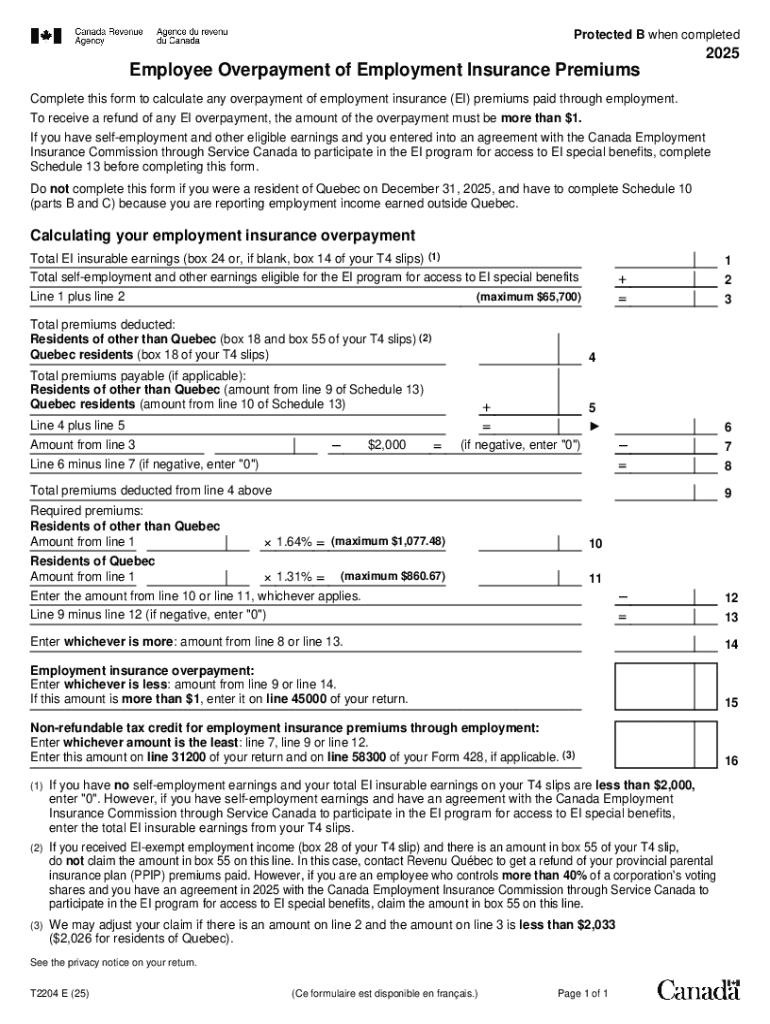
The Employee Overpayment of Employment Insurance Premiums Form is used by individuals who have paid more in employment insurance (EI) premiums than necessary. It allows you to calculate any overpayment and request a refund. Employment insurance is a government program providing temporary financial assistance to unemployed workers in the U.S., thus, accurate contribution calculations are crucial. The overpayment form ensures that employees who have paid excess amounts are refunded appropriately.
How to Use the Employee Overpayment of Employment Insurance Premiums Form
-
Gather Relevant Information: Before completing the form, collect all necessary documentation, such as your employment records, proof of premium payments, and any notices from the employment insurance program.
-
Complete Personal Details: Fill in personal information accurately, including your social security number and contact details.
-
Calculate Overpayment: Carefully input data on your employment history and premium payments to ensure an accurate calculation of overpayments.
-
Request a Refund: Indicate the method by which you would prefer to receive the refund, such as direct deposit or check.
-
Submission: Review the form for completeness and accuracy before submitting it through the appropriate channel as specified, whether online, by mail, or in-person.
Steps to Complete the Employee Overpayment of Employment Insurance Premiums Form
-
Download the Form: Obtain the form from the relevant government website or physical location.
-
Read Instructions: Carefully read any instructions that accompany the form to understand the requirements and processes.
-
Fill Out the Form: Enter all required information as per the instructions, using a digital tool like DocHub for easy editing and accuracy.
-
Attach Required Documents: Include copies of any required documents, such as W-2 forms, proof of employment, or notices of overpayment.
-
Review and Submit: Double-check all entries for accuracy, including calculations, before submitting the form. Ensure it's sent to the correct address or uploaded to the right online portal.
Key Elements of the Employee Overpayment of Employment Insurance Premiums Form
- Identification Section: Includes fields for personal and employment details to verify identity.
- Premium Calculation: Sections to input figures and perform necessary calculations to determine overpayments.
- Refund Request: Area to specify preferred refund methods and contact information for processing.
- Certification and Signature: A declaration certifying the accuracy of provided information, usually requiring a signature.
Required Documents
- Proof of Identity and Employment: May include social security card or employment contract.
- Payment Records: Documents such as pay stubs or tax forms showing premium payments.
- Notices or Correspondence: Any official notices regarding premium adjustments or errors.
Legal Use of the Employee Overpayment of Employment Insurance Premiums Form
The legal use of this form is to ensure compliance with employment insurance rules and to secure refunds for any overpaid premiums. It’s essential to follow regulations and guidelines prescribed by the relevant authorities to maintain legal compliance. Incorrect or fraudulent submissions can lead to penalties or legal action.
Important Terms Related to the Employee Overpayment of Employment Insurance Premiums Form
- Overpayment: Excessive payment beyond what is owed or required under law or agreement.
- Employment Insurance (EI): A U.S. program providing temporary benefits due to unemployment.
- Refund: The process of returning excess funds paid.
Penalties for Non-Compliance
Failure to properly submit this form when overpayments occur may result in:
- Financial Penalties: Charges or interests on undisclosed overpayments.
- Legal Consequences: Legal actions taken by the employment insurance authorities.
- Delayed Refunds: Potential forfeiture of repayment opportunities.
State-by-State Differences
While the Employee Overpayment of Employment Insurance Premiums Form aims for uniformity, variations may occur in:
- Legal Requirements: State-specific statutes or guidelines impacting the submission or processing.
- Eligibility Criteria: Differences in who may qualify for refunds based on state regulations.
Understanding and adhering to both federal and state-specific requirements ensures compliance and facilitates accurate and timely processing of claims. Employing a digital tool such as DocHub may assist in adapting to these variations efficiently by allowing quick updates and corrections.