
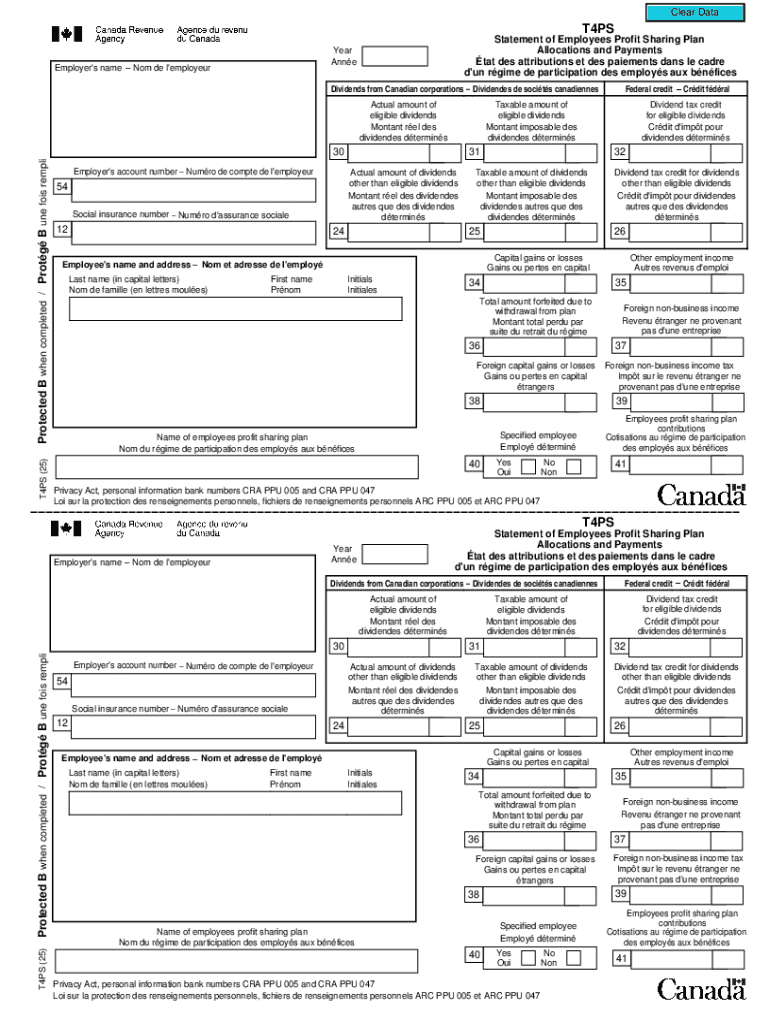







Definition and Meaning
The T4PS Statement of Employees Profit Sharing Plan is a tax form used primarily in Canada to report profit-sharing contributions made by an employer to an employee. It records the employer's contributions to the plan and is essential for tax purposes, as these contributions are often subject to tax considerations. The form is integral in ensuring transparency and accuracy in financial reporting related to profit-sharing.
Key Information Included
- Employer Contributions: Detail the specific amounts contributed by employers to the employee’s profit-sharing plan, providing a clear record of financial allocations.
- Employee Allocation: Information on how the contributions were allocated among employees and any related conditions.
How to Obtain the T4PS Statement
Securing the T4PS Statement involves a few straightforward steps. Typically, the employer will issue this form to employees who participate in the profit-sharing plan, as part of their annual tax documents.
Steps to Receiving the Document
- Request from Employer: Employees should first inquire with their HR department or payroll manager to confirm participation and ensure the statement is generated.
- Verify Information: Ensure all personal and financial details associated with the profit-sharing contributions are correct and reflect accurate allocations.
Steps to Complete the T4PS Statement
Filling out the T4PS Statement requires attention to detail to avoid discrepancies that could affect tax filings. This process is typically handled by employers, but employees should understand the information provided.
Completion Process
- Review Employer Contributions: Verify the contributions reported by the employer match those on company records.
- Check Employee Information: Ensure that all personal identification details are correctly entered to maintain compliance.
- Submit the Statement: Completed forms should be submitted alongside other tax documents when filing taxes.
Key Elements of the T4PS Statement
Understanding the components of the T4PS form can demystify the overall process and enhance accuracy in reporting.
Primary Sections
- Identification Section: Includes employer and employee identification numbers and contact information.
- Financial Details: Specific breakdown of contributions made by the employer to the employee's profit-sharing account.
- Certification: A section requiring the signature of a company authority, certifying the accuracy of the reported data.
IRS Guidelines
While the T4PS Statement is a Canadian tax document, understanding its implications in the context of international tax laws, particularly if residing in the U.S., is crucial.
Considerations
- Cross-Border Taxation: Employees who work across borders may need to consider IRS forms that correspond with foreign income or financial assets.
- Tax Treaties: The U.S.-Canada tax treaty may impact how income and contributions noted on the T4PS are reported and taxed in the United States.
Filing Deadlines and Important Dates
Timely submission of the T4PS Statement is crucial to avoid penalties and ensure compliance.
Key Deadlines
- Annual Filing Deadline: Typically aligns with the Canadian tax deadline, April 30. Extensions might apply in certain districts or under specific conditions.
- Employer Submission: Employers must submit copies to both employees and relevant tax authorities within the specified timelines.
Penalties for Non-Compliance
Failing to file the T4PS Statement or inaccuracies may lead to penalties impacting both employer and employees.
Potential Consequences
- Fines and Audits: Incorrect or late submissions may result in monetary fines or trigger a tax audit.
- Correction of Errors: In some cases, corrections must be submitted, potentially incurring additional charges or penalties.
Business Types That Benefit Most
The T4PS Statement is particularly vital for specific business types that engage in employee profit-sharing programs.
Beneficiary Business Entities
- Corporations: Often have formalized profit-sharing arrangements necessitating accurate financial reporting.
- Partnerships: Smaller partnerships and LLCs frequently utilize profit-sharing plans as part of employee compensation strategies.
By understanding these aspects of the T4PS Statement of Employees Profit Sharing Plan, employees and employers can better manage tax responsibilities and benefit more from profit-sharing initiatives.




