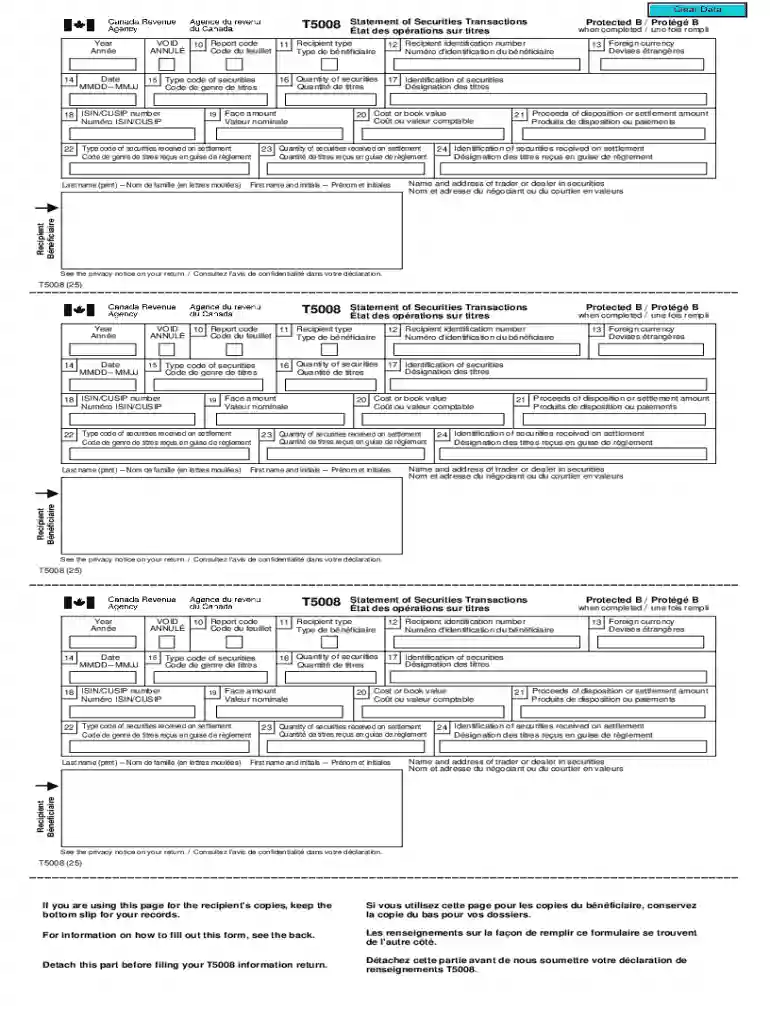
T5008 Statement of Securities Transactions 2026

Get Form
T5008 Statement of Securities Transactions Preview on Page 1

Here's how it works

01. Edit your form online
Type text, add images, blackout confidential details, add comments, highlights and more.

02. Sign it in a few clicks
Draw your signature, type it, upload its image, or use your mobile device as a signature pad.

03. Share your form with others
Send it via email, link, or fax. You can also download it, export it or print it out.

Definition & Meaning

The T5008 Statement of Securities Transactions is a tax form used in the United States to report the proceeds from the sale of securities. This document is essential for taxpayers dealing with investments as it captures the details of their securities transactions, including sales, redemptions, and other dispositions. Taxpayers use this form to calculate capital gains or losses as part of their income tax filings. The form’s specificity ensures that individuals accurately report their securities transaction activities to the Internal Revenue Service (IRS), maintaining compliance with U.S. tax laws.

Key Elements of the T5008 Statement of Securities Transactions

  • Transaction Type: Captures whether the security was sold, redeemed, or otherwise disposed of.
  • Security Identifiers: Includes International Securities Identification Number (ISIN) or Committee on Uniform Securities Identification Procedures (CUSIP) for precise security identification.
  • Proceeds from Disposition: Lists the gross proceeds received from the transaction.
  • Recipient Information: Details about the taxpayer receiving the proceeds, including name and identification number.
  • Date of Transaction: Specifies the execution date of the transaction, which is crucial for determining the applicable tax year.

How to Use the T5008 Statement of Securities Transactions

To use the T5008 Statement effectively, taxpayers must integrate the information into their annual tax filings, specifically when calculating capital gains or losses. Here’s how to do it:

  1. Reviewing Transaction Details: Carefully check each transaction listed for accuracy.
  2. Calculating Gains or Losses: Use the cost basis to determine capital gains or losses. The cost basis may require historical transaction data if not provided on the T5008.
  3. Reporting: Report these figures on Form 8949, which is then summarized on Schedule D with your tax return.

Steps to Complete the T5008 Statement of Securities Transactions

Properly completing the T5008 requires meticulous attention to detail regarding each segment of the form:

  1. Gather All Relevant Documents: Collect any broker statements or previous transaction records.
  2. Verify Transaction Codes: Ensure the correct reporting of transaction types to prevent discrepancies.
  3. Review Proceeds and Costs: Confirm the accuracy of proceeds and cost figures with broker statements.
  4. Complete Tax Forms: Transfer the calculated capital gains or losses to the appropriate sections of your IRS tax return.

Who Typically Uses the T5008 Statement of Securities Transactions

The T5008 is primarily used by individuals and entities involved in securities trading, such as:

  • Retail Investors: Those who actively trade stocks, bonds, derivatives, etc.
  • Financial Advisors: Preparing taxes for clients with securities transactions.
  • Corporate Entities: Reporting on investment activities in their financial portfolios.
decoration image ratings of Dochub

Required Documents

When preparing your T5008 Statement, ensure you have:

  • Brokerage Statements: To verify the accuracy of the T5008 information.
  • Transaction Records: Records providing details of purchase dates, amounts, and any associated fees.
  • Financial Advisor Documentation: If applicable, for confirming complex transactions or investment strategies.

IRS Guidelines

The IRS provides clear guidelines on how taxpayers should incorporate the T5008 form into their tax filings:

  • Form 8949: Complete this IRS form by reporting sales and exchanges of capital assets using details from the T5008.
  • Schedule D: Summarizes overall capital gains and losses to be transferred to Form 1040.

Penalties for Non-Compliance

Failure to accurately report T5008 transactions can result in penalties, including fines or additional tax assessments. Accurate reporting ensures compliance and prevents potential audits from the IRS.

Digital vs. Paper Version

Though traditionally distributed on paper, the T5008 Statement is increasingly available in digital formats. Many brokerage firms provide electronic versions, facilitating easy import into tax software:

  • Benefits: Streamlined data entry through direct import options in software like TurboTax or QuickBooks.
  • Preferability: Digital versions reduce errors and expedite the preparation process.

Filing Deadlines

The critical deadlines related to the T5008 are consistent with overall tax deadlines in the United States:

  • Year-End Transactions: Must be reported in the tax return filed by April 15 of the following year.
  • Extensions and Amendments: Can be requested if discrepancies arise after filing.

Careful management of the T5008 ensures tax compliance and optimizes financial management strategies related to securities investments.

be ready to get more

Complete this form in 5 minutes or less

Get form

Security and compliance

At DocHub, your data security is our priority. We follow HIPAA, SOC2, GDPR, and other standards, so you can work on your documents with confidence.

Learn more
ccpa2
pci-dss
gdpr-compliance
hipaa
soc-compliance