







Definition & Meaning
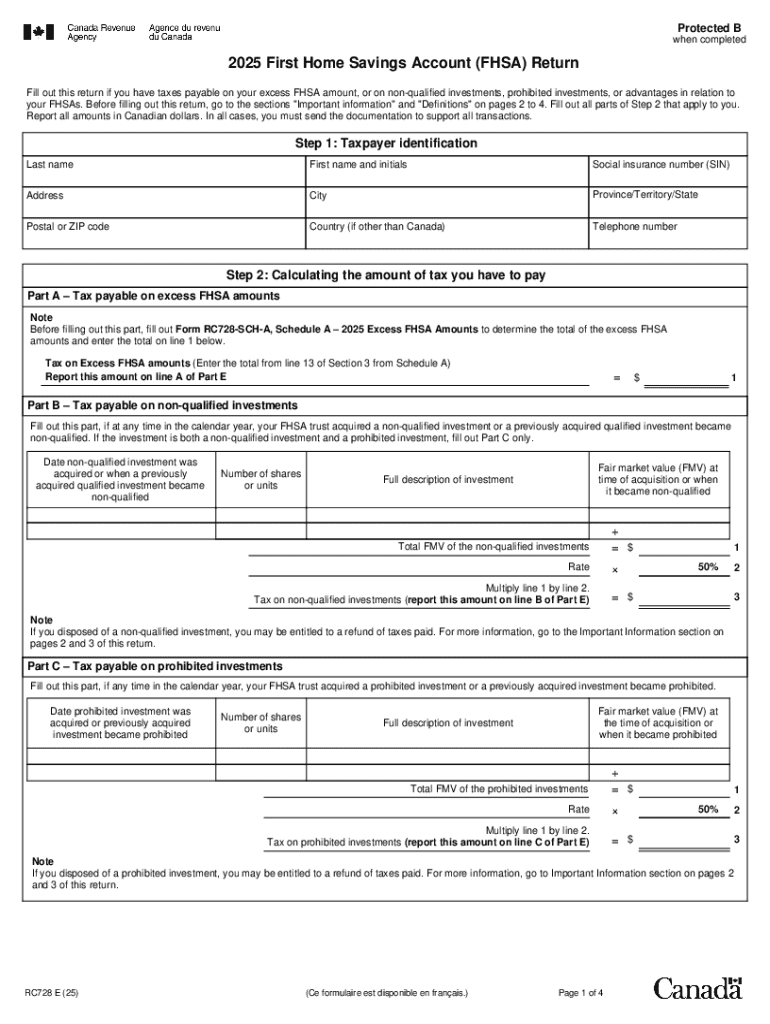
The "2025 First Home Savings Account Return" is a crucial document used for tax purposes concerning the First Home Savings Account (FHSA). This return is specifically for taxpayers who need to address issues such as taxes payable on excess FHSA amounts or adjustments needed for nonqualified investments. In the U.S., it provides a framework to ensure that individuals properly declare their savings contributions and any liabilities associated with it under IRS guidelines.
Steps to Complete the 2025 First Home Savings Account Return
Completing the 2025 FHSA Return involves several steps, each requiring careful attention to detail:
-
Gather Required Documents: Start by collating all necessary financial records, including FHSA statements and any documents related to excess contributions.
-
Calculate Excess Contributions: Determine the total amount contributed over the allowable limit and the taxes due on this excess amount.
-
Account for Nonqualified Investments: Identify any investments within your FHSA that do not meet the qualifications and calculate any associated taxes.
-
Complete the Form: Enter the calculated figures into their respective fields on the form, ensuring accuracy and compliance.
-
Review and Submit: Before submission, review the return for any errors. Forms can be submitted via mail or electronically, depending on preferred methods.
How to Use the 2025 First Home Savings Account Return
Using the 2025 FHSA Return effectively requires understanding its purpose and application:
- Determine Applicability: Identify whether your FHSA contributions and investments necessitate the filing of this return.
- Avoid Penalties: Use the form to declare and correct any excesses or discrepancies and avoid potential penalties.
- Record Keeping: Keep a copy of the completed form and related documents for future reference or audits.
Key Elements of the 2025 First Home Savings Account Return
Important components of the form include:
- Personal Information: Ensure all identifying details, such as name and tax identification number, are accurately recorded.
- Contribution Details: Include specific information about contributions for the fiscal year.
- Excess and Nonqualified Disclosures: Detail any excess contributions or nonqualified investments and their respective tax treatments.
- Authorization and Signatures: Ensure all required signatures are affixed to verify the information provided.
Important Terms Related to 2025 First Home Savings Account Return
Understanding key terminology is essential for accurate completion:
- Excess Contribution: Amount contributed beyond the legal limit for the FHSA.
- Nonqualified Investment: Investments that do not meet IRS criteria to be held within an FHSA.
- Prohibited Investment: Types of investments explicitly not allowed under FHSA rules.
IRS Guidelines
The IRS provides specific guidelines for the First Home Savings Account, which should be consulted to ensure compliance:
- Contribution Limits: Familiarize yourself with the yearly limit on contributions to avoid excess charges.
- Qualified Investment Criteria: Know what constitutes a qualified investment to maximize savings.
- Tax Penalties: Understand consequences of non-compliance such as penalties for excess contributions.
Filing Deadlines / Important Dates
Staying aware of key deadlines is crucial:
- Annual Filing Deadline: The return should be filed by the standard federal tax deadline, typically April 15.
- Extension Information: Be aware of deadlines for filing extensions if the return cannot be completed by the due date.
Required Documents
The preparation of this return necessitates several documents:
- FHSA Statements: Current year statements that detail contributions and balances.
- Tax Documentation: Any documents that relate to income and investments within the FHSA.
- Prior Year Returns: Copies of previous FHSA-related filings may be useful for comparison and verification.
These blocks provide a thorough understanding of the 2025 First Home Savings Account Return, ensuring taxpayers can complete and submit the form accurately within the U.S. legal and tax framework.




