







Definition & Meaning
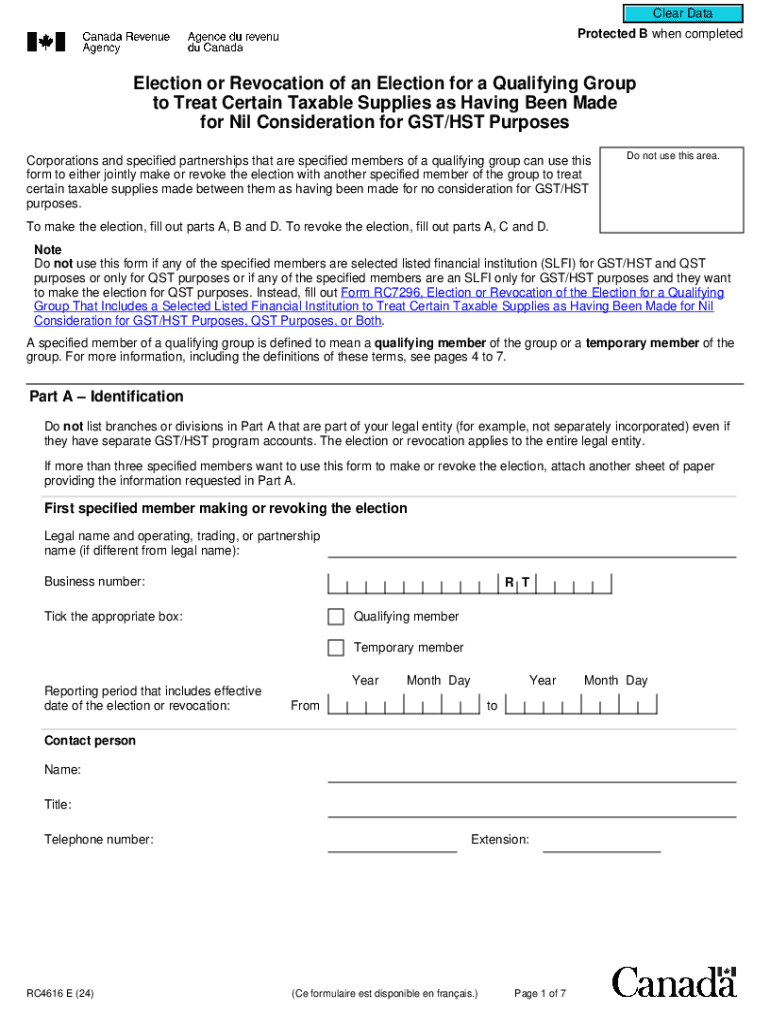
The GST HST Nil Consideration Election Form is a specialized tax form used by corporations in Canada to elect or revoke an election that allows certain taxable supplies to be treated as having been made for nil consideration under the Goods and Services Tax (GST) and Harmonized Sales Tax (HST) system. This feature is particularly relevant to qualifying groups who wish to streamline their tax obligations in specific business contexts. By utilizing this election, businesses can potentially simplify their tax filings and reduce perceived administrative burden.
- GST/HST Overview: GST is a multi-level value-added tax introduced by the Canadian government, while HST includes both federal and provincial sales taxes in certain regions.
- Nil Consideration: Refers to transactions assessed at zero value, impacting how taxes are calculated and filed.
How to Use the GST HST Nil Consideration Election Form
The form facilitates the election to treat certain transactions within a corporate group as exempt from value considerations. It is crucial for accurate compliance and optimizing potential tax efficiencies.
- Assess Eligibility: Verify if your corporate group qualifies for this election under the criteria set by the Canadian Revenue Agency (CRA).
- Complete Required Sections: Each section of the form requires detailed input, including corporate information and specific transactions.
- Submit to CRA: Ensure timely submission to the CRA to activate or revoke the election as intended.
Steps to Complete the GST HST Nil Consideration Election Form
Completing the form requires meticulous attention to detail across various sections:
- Corporate Identification: Include the legal name and address of the business.
- Election Details: Clearly outline the transactions or supplies impacted by this election.
- Signature and Date: The form must be signed by an authorized corporate officer with accurate dating to ensure validity.
- Review for Errors: Double-check all entries for accuracy to avoid processing delays or rejections.
- Attach Supporting Documents: You may need to provide evidence of business structure and transactions.
Legal Use of the GST HST Nil Consideration Election Form
The form is legally binding under Canadian tax law once filed, carrying obligations and responsibilities for adherence:
- Compliance with CRA Guidelines: Ensure that your use of this form meets all current CRA regulations.
- Revocation Process: Understand how to properly revoke the election if business circumstances change.
Key Elements of the GST HST Nil Consideration Election Form
The form comprises several critical sections all requiring accuracy and adherence:
- Qualifying Description: Clearly describe the qualifying group and transactions.
- Effective Date: Specify the precise date from which the election is to begin.
- Details of Nil Consideration: Provide comprehensive details on zero-value transactions being elected.
Examples of Using the GST HST Nil Consideration Election Form
There are several practical scenarios in which this form is used:
- Intercorporate Services: Companies within a corporate group providing services to one another for nil value could file this election.
- Real Estate Transactions: Certain intra-group property exchanges might qualify for nil consideration treatment.
Eligibility Criteria
To be eligible to submit the GST HST Nil Consideration Election Form, businesses must meet specific criteria:
- Membership in a Qualifying Group: Only entities that meet the definition of a qualifying group, as detailed by CRA, can utilize this form.
- Business Structure Compliance: Corporations or other business entities within Canada, adhering to CRA definitions.


Required Documents
Preparing the GST HST Nil Consideration Election Form involves gathering essential documentation:
- Corporate Resolution Documents: Proof of the decision-making process within the corporate group.
- Transaction Records: Clear records of all transactions that will be affected by the election.
- Supporting Financials: Financial statements that justify the nil consideration claim.
These elements must not only fulfill filing requirements but also provide a clear and substantiated record for compliance purposes.




