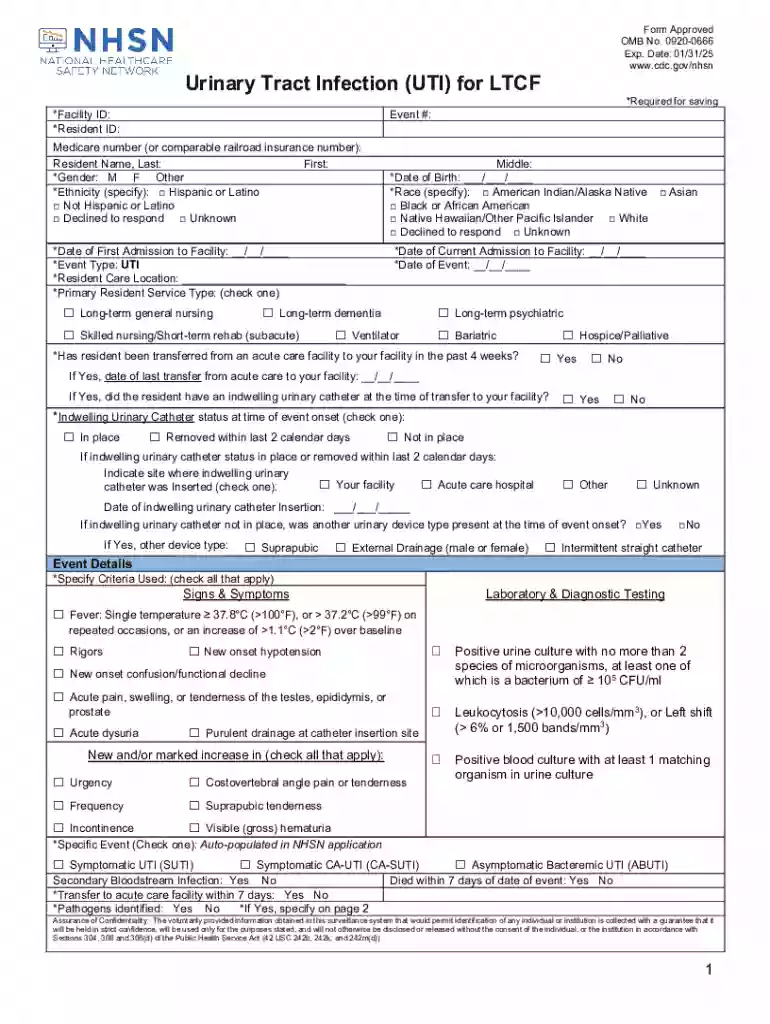
Definition & Meaning
The "Urinary Tract Infection (UTI) for LTCF Form" is a specialized document used in long-term care facilities (LTCFs) to monitor and report instances of urinary tract infections among residents. This form helps in systematically collecting data regarding UTIs, ensuring that healthcare providers can track infection patterns, administer appropriate treatments, and devise effective infection prevention strategies.
Purpose of the Form
- Data Collection: Collects detailed information on the occurrence of UTIs in long-term care settings.
- Medical Documentation: Provides a standardized way to document the nature, severity, and treatment of UTIs.
- Healthcare Planning: Facilitates the development of targeted healthcare interventions and policies to improve resident health outcomes.
How to Use the Urinary Tract Infection (UTI) for LTCF Form
Instructions for Completion
- Identify Resident: Use the 'Facility ID' and 'Resident ID' to uniquely identify the resident experiencing a UTI.
- Document Event: Record details of the infection such as the type, symptoms, and any laboratory test results.
- Treatment Information: Note the prescribed treatment plan, including medications and any follow-up procedures.
Common Mistakes to Avoid
- Incomplete Information: Ensure that all fields marked as required are filled to avoid data inaccuracies.
- Incorrect Resident Information: Double-check the facility and resident IDs to ensure accurate record-keeping.
Key Elements of the Urinary Tract Infection (UTI) for LTCF Form
Essential Fields
- Facility and Resident Identification: Crucial for linking the infection record to the specific resident and care facility.
- Event Number: A unique identifier for each recorded instance of a UTI.
- Clinical Details: Includes sections for symptoms, diagnostic tests, and treatment administered.
Steps to Complete the Urinary Tract Infection (UTI) for LTCF Form
Detailed Process
- Start with Identification: Fill out the facility ID, resident ID, and event number.
- Provide Infection Details:
- Symptoms: Document observable symptoms and onset date.
- Diagnosis: Enter results from laboratory tests if applicable.
- Record Treatment:
- Include medications prescribed and any procedures performed.
User Profile
- Healthcare Providers: Nurses, doctors, and care staff in LTCFs responsible for resident care.
- Administrative Staff: Individuals tasked with maintaining medical records and regulatory compliance within facilities.
Usage Scenarios
- Routine Monitoring: Used as part of regular health assessments in LTCFs.
- Regulatory Compliance: Helps facilities meet health and safety regulations by tracking infection rates.
Legal Use of the Urinary Tract Infection (UTI) for LTCF Form
Compliance and Regulations
- Confidentiality: Ensures personal health information is kept confidential and secure, complying with HIPAA.
- Reporting: Facilitates mandatory reporting of infection data to health regulatory authorities.
Legal Implications
- Misuse or mishandling of the form can lead to regulatory fines and loss of license for care facilities.
State-Specific Rules for the Urinary Tract Infection (UTI) for LTCF Form
Variations by State
- Regulatory Differences: Some states may have specific reporting requirements or additional forms that need to accompany the UTI form.
- Submission Guidelines: State health departments might have distinct guidelines regarding the form's submission timeline and method.
Implications for Facilities
- Facilities must stay informed about state-specific changes to ensure full compliance and avoid regulatory issues.
Examples of Using the Urinary Tract Infection (UTI) for LTCF Form
Real-World Scenarios
- Case Study 1: In a facility experiencing a UTI outbreak, the form helps identify infection patterns and effectiveness of treatment protocols.
- Case Study 2: In a scenario where an LTCF updates its infection prevention policies, historical data from the forms provide insight into what strategies have been effective.
Implementation Benefits
- Improves infection control measures through detailed record-keeping and analysis.
- Supports evidence-based healthcare planning by tracking therapy outcomes against standardized infection data.